
 Amara Maple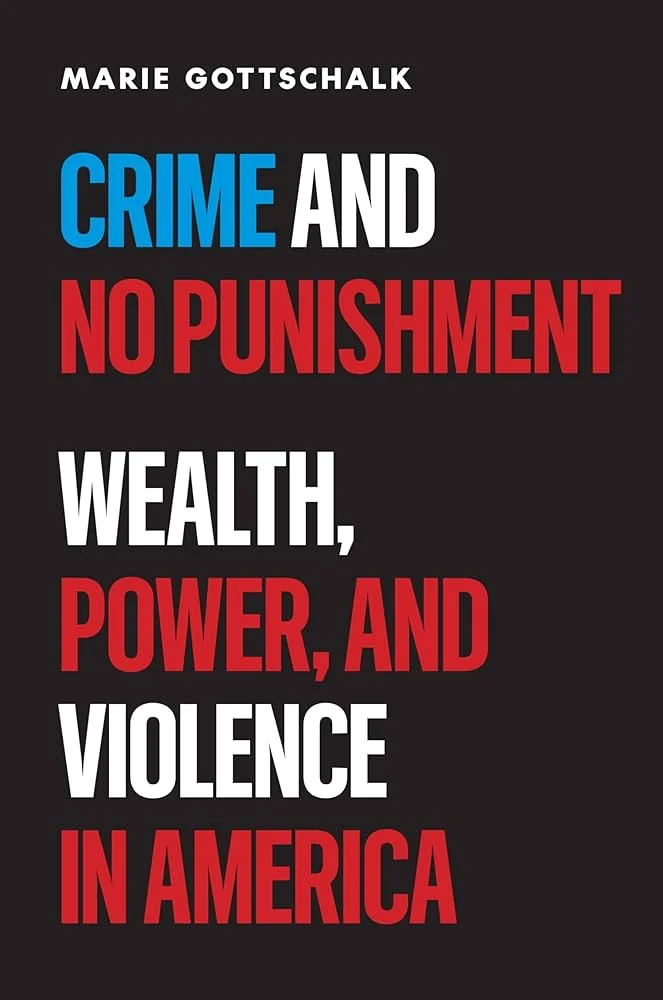
Dr. Marie Gottschalk, a distinguished Professor of Political Science at the University of Pennsylvania, renowned for her profound contributions to the discourse on criminal justice, race, and health policy, has once again challenged conventional wisdom with her latest book, Crime and No Punishment: Wealth, Power, and Violence in America (Princeton University Press, 2025). This seminal work marks a significant pivot in her research, extending her incisive critique of mass incarceration, explored in her award-winning 2006 book, The Prison and the Gallows, to encompass the pervasive yet often overlooked realm of corporate crime and state-sanctioned violence. Gottschalk’s new analysis posits a disturbing interconnectedness between corporate impunity, the financialization of the global economy, militarized policing, the burgeoning carceral state, and persistent military engagements abroad, arguing that these forces collectively foster systemic violence that erodes the legitimacy of America’s foundational political and economic institutions.
A Scholar’s Evolution: From Mass Incarceration to Corporate Impunity
For years, Gottschalk’s academic focus, like that of many scholars in the criminal legal system, primarily centered on issues of street crime and the carceral state. Her 2006 publication, The Prison and the Gallows: The Politics of Mass Incarceration in America, firmly established her as a leading voice on the historical and racial dimensions of America’s unique incarceration rates. However, a recent interview with Corporate Crime Reporter revealed a profound personal and academic reckoning. "It’s crazy," Gottschalk admitted, describing her prior oversight of corporate crime as a "real blind spot." She candidly stated, "This book in a way is my mea culpa. Why wasn’t I doing that? Why wasn’t I not teaching more about corporate crime?"
Her initial immersion into mass incarceration was driven by a desire to understand its roots, finding common explanations insufficient. While she notes her background as a political scientist, not a criminologist, might explain some deviation from typical criminology program curricula, which often neglect white-collar crime, she acknowledges that her intense focus on race and mass incarceration inadvertently overshadowed the equally critical issue of corporate malfeasance. This shift in perspective underscores a growing recognition within progressive academia that a comprehensive understanding of crime and justice in America demands an expansive view that includes the actions of the powerful, not just the marginalized.
The Expanding Carceral State and Shifting Demographics
While Gottschalk’s attention has broadened, her insights into mass incarceration remain sharp. She notes that the national incarceration rate has largely stabilized at approximately 600 per 100,000 population, a figure that still places the United States far ahead of nearly every other developed nation. Yet, the demographic and geographic contours of the carceral state are subtly but significantly changing. Incarceration rates, traditionally concentrated in urban centers and disproportionately affecting African Americans, are now showing marked increases in suburban and rural areas. While racial disparities persist, the gap between incarceration rates for Black and white individuals is gradually narrowing, indicating that "mass incarceration is now affecting a wide swath of Americans." This evolving landscape further complicates the narrative, suggesting that the punitive approach to crime, once viewed as a problem primarily afflicting specific urban communities, is becoming a more generalized societal burden.
Connecting the Threads: Corporate Crime and Street Crime
A core argument of Crime and No Punishment is the intricate and often deliberately obscured connection between corporate crime and street crime. Gottschalk contends that the rise in corporate impunity and rampant economic inequality diverts crucial resources that could otherwise be allocated to address the underlying causes of street crime and invest in alternatives to incarceration. "By creating a hysteria over street crime, you deflect attention from corporate crime. You create a panic over one while ignoring the other," she explains.
The financialization of the economy, characterized by an increasing dominance of financial markets and institutions, is identified as a key driver of concentrated economic and political power. This concentration, in turn, makes it less likely for the crimes of the powerful to be rigorously prosecuted, leading to an unequal distribution of wealth and a regressive tax system. These structural inequities perpetuate societal problems, fostering conditions that can indirectly contribute to street-level offenses and "deaths of despair."
The Devastating Impact of Elite-Level Violence
Despite overwhelming evidence, public and scholarly attention remains disproportionately fixated on violent street crime. Yet, as Gottschalk compellingly argues, corporate and white-collar crime, alongside state and economic violence, directly and indirectly inflict far greater harm on the American populace. The economic costs of corporate fraud, environmental crimes, and unsafe products dwarf those of street crime, and more critically, the human toll is often staggering.
One potent example Gottschalk cites is the opioid crisis. At its peak, the crisis claimed 108,000 lives annually from drug overdoses—a figure twice the number of American fatalities during the entire Vietnam War. She starkly labels this a "social murder," emphasizing that while it lacks the immediate, personal nature of a gun-related homicide, the systemic failures, corporate greed, and regulatory neglect behind it result in an equally devastating loss of life. To put this in perspective, the annual opioid death toll is more than four times the number of people who die from traditional homicides.
Historical precedents illustrate this disparity. The notorious Ford Pinto case from the late 1970s, where a Republican prosecutor in Indiana brought homicide charges against Ford Motor Company for the fiery deaths of three teenage girls due to a known design flaw, serves as a stark reminder. Despite internal memos revealing Ford’s cost-benefit analysis that deemed it cheaper to pay out lawsuits than redesign the fuel tank, the company was acquitted. This case marked the last time a major American corporation faced homicide charges for product-related deaths. More recently, the Boeing 737 MAX crashes, which killed 346 people, are another example that Gottschalk suggests should have triggered manslaughter investigations, rather than primarily civil settlements and deferred prosecution agreements.
Redefining "Violence": Beyond the Conventional
Gottschalk proposes reframing the conversation around "violence" itself. She argues that the term "corporate crime" or "white-collar crime" often elicits a perception of victimless offenses or minor infractions. However, by using the broader term "violence," particularly in her book’s title, she aims to connect these seemingly disparate acts through their shared outcome: premature deaths, preventable injuries, and profound societal suffering.
"If we think the Boeing crashes and the Pinto deaths as acts of violence, the grossly inequitable economic system where people are living paycheck to paycheck and they don’t have health care for their kids and the remarkable unprecedented decline in life expectancy—that’s violence to your society. That’s a society that is dying," Gottschalk asserts. This expansive definition of violence encompasses not just direct physical harm but also the systemic harm wrought by economic policies, regulatory failures, and the concentration of power that preys on vulnerable communities, normalizes death, and siphons off vital resources. The recent decline in American life expectancy, particularly among working-class populations, is a profound indicator of this insidious, pervasive violence.
The Mechanisms of Impunity: Regulatory Capture and the Revolving Door
Gottschalk’s book delves into the systemic factors that enable corporate impunity. A significant issue is the "revolving door" phenomenon, where individuals move fluidly between high-level government positions and lucrative corporate roles. This practice often leads to a weakening of regulatory oversight and a reluctance to aggressively prosecute corporate wrongdoing. She points to the Obama administration’s handling of the 2008 financial crisis, where key administration roles were filled by individuals with deep Wall Street ties, resulting in a notable lack of criminal prosecutions for those responsible for the economic meltdown. Senator Elizabeth Warren famously challenged then-FBI Director James Comey on the absence of such prosecutions, despite criminal referrals.
Similarly, the New York Times’ 2019 report on a "secret opioid memo" revealed that political appointees at the Justice Department intervened to halt criminal prosecutions against those responsible for the opioid crisis, despite initial efforts by line prosecutors in Virginia. This episode highlights how political influence and corporate connections can effectively derail accountability, preventing justice from being served.
Another critical mechanism is the widespread use of deferred prosecution agreements (DPAs) and non-prosecution agreements (NPAs). These agreements, often negotiated behind closed doors, allow corporations to avoid criminal conviction by agreeing to pay fines, implement compliance measures, and cooperate with investigations. While proponents argue they offer flexibility and encourage corporate reform, critics, including Gottschalk, contend they often amount to slaps on the wrist, failing to deter future misconduct and rarely holding individual executives accountable. Mary Jo White, a former U.S. Attorney and SEC Chair, notably pioneered the DPA for corporations in 1994 with Prudential Securities. Gottschalk raises concerns about the lack of transparency surrounding these deals and the difficulty in verifying corporate adherence to their terms. She pushes back against the idea that merely "locking up a few executives" through "show trials" will solve the problem, advocating instead for "much more extensive regulation and accountability" and an examination of "the structural rot in the system."
The "Epstein Class" and Elite Accountability
The recent revelations from the Jeffrey Epstein files provide a stark illustration of the "untouchable class" that Gottschalk critiques. While the sexual abuse itself is horrific, the files also expose a network of powerful individuals cutting across political divides, academia, Hollywood, and Wall Street. Gottschalk notes a particular email exchange where Kathy Ruemmler, a former White House counsel, discussed a "PR strategy for MJ White v. Elizabeth Warren," with Epstein responding approvingly and Ruemmler dismissing Warren as "the worst." This occurred precisely when Warren was releasing a scathing report on the SEC’s inaction under Mary Jo White.
This incident, alongside similar strategies by figures like Timothy Geithner to "contain Elizabeth Warren," reveals a concerted effort by elites, regardless of party affiliation, to neutralize critics who expose corporate wrongdoing. Gottschalk argues that the Epstein files, beyond the sexual crimes, lay bare a broader system of elite protection and mutual reinforcement, making it exceptionally difficult to challenge concentrated power. "It’s being exposed as an untouchable class, even beyond what I thought it would be," she observes.
Charting a Path Forward: Structural Reforms and Redefining Justice
In the concluding chapter of Crime and No Punishment, Gottschalk maps out a transformative path forward, emphasizing the need for "thinking big" and avoiding superficial, "non-reformist reforms." Her vision encompasses several key pillars:
- Reallocating Resources: She calls for a critical examination of the vast expenditures on the "military industrial complex," which consumes approximately $1.5 trillion annually. Diverting a significant portion of this immense budget towards domestic social safety nets, infrastructure, education, and healthcare could ameliorate many of the problems that foster both street crime and "deaths of despair."
- Addressing Economic Inequality: Gottschalk advocates for a robust progressive tax system, including a wealth tax, to counteract rising income inequality. Such measures would provide the necessary resources for a larger, more effective regulatory state capable of holding powerful corporations accountable.
- Strengthening Regulation and Accountability: This involves not just increasing funding for regulatory bodies but also fundamentally rethinking the approach to corporate enforcement, moving beyond DPAs to actual criminal prosecutions for severe offenses and holding individual executives personally liable.
- Investing in Social Safety Nets: A strong social safety net, providing universal healthcare, affordable housing, living wages, and robust social services, would address the root causes of vulnerability and reduce the conditions that lead to both street crime and the societal despair that corporate violence exacerbates.
Academic Isolation and the Call for "Thinking Big"
Gottschalk candidly discusses the challenges of pursuing such broad, interdisciplinary research within contemporary academia, particularly in political science. She notes that the field often prioritizes quantitative, narrowly focused studies that can be "nailed to the wall with a mathematical formula," rather than the "big picture" analysis she undertakes. "Doing what I’m doing now, you might not get tenure," she acknowledges, highlighting the potential career risks for scholars who challenge established paradigms.
The reluctance to use terms like "empire" to describe the United States within mainstream political science, despite its evident global military and economic footprint, is another symptom of this academic conservatism. Gottschalk critiques the prevailing "neoliberal agenda" narrative—small government, low taxes, anti-regulation—as selectively applied, ignoring the massive state apparatus underpinning prison expansion, military spending, and corporate subsidies.
Despite these institutional pressures, Gottschalk finds strength in a network of colleagues across disciplines and senses a profound public hunger for deeper understanding. Her work aims to counter simplistic explanations for complex phenomena like the rise of populism, offering a nuanced, structural analysis that connects seemingly disparate issues into a cohesive framework of power, violence, and impunity.
Crime and No Punishment is more than an academic treatise; it is a powerful indictment of a system that selectively applies justice, often to the detriment of the most vulnerable, while shielding the most powerful. Marie Gottschalk’s courageous pivot into the realm of corporate crime and state violence promises to ignite crucial conversations and reshape our understanding of what truly constitutes crime and justice in America.




 Yuyun Lusiyani
 Joko Widodo
 Jia Lissa
 Pevita Pearce
 admin
admin
