
 Amara Maple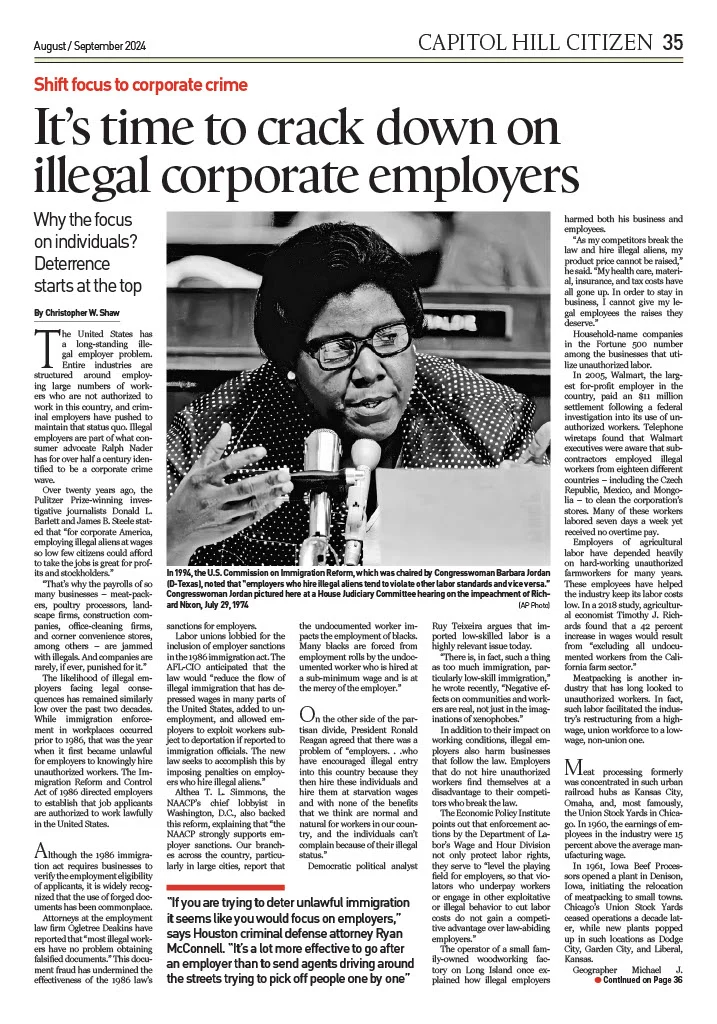
A forthcoming report, "Shift focus to corporate crime: It’s time to crack down on illegal corporate employers," authored by Christopher Shaw for the February/March 2026 issue of the Capitol Hill Citizen, casts a renewed spotlight on this enduring crisis. The report aligns with the long-held assertions of consumer advocate Ralph Nader, who for over half a century has consistently identified such practices as a pervasive element of a broader "corporate crime wave" impacting the nation. This perspective argues that the deliberate employment of workers not authorized to work in the U.S. is not merely an immigration violation, but a calculated business strategy by "criminal employers" designed to maintain a profitable, albeit illegal, status quo.
The Historical Context of Employer Sanctions and Their Shortcomings
The formal legislative framework against illegal employment in the U.S. dates back to the Immigration Reform and Control Act (IRCA) of 1986. Prior to IRCA, workplace immigration enforcement existed, but 1986 marked a pivotal shift, making it explicitly unlawful for employers to knowingly hire or continue to employ unauthorized workers. The act mandated that businesses verify the employment eligibility of all job applicants, a requirement intended to staunch the flow of undocumented immigration by removing the economic incentive for employers to hire such individuals.
However, the efficacy of IRCA was almost immediately challenged by widespread document fraud. Attorneys at the prominent employment law firm Ogletree Deakins have openly acknowledged that "most illegal workers have no problem obtaining falsified documents." This pervasive issue of counterfeit identification and fraudulent eligibility papers severely undermined the intended deterrent effect of the 1986 legislation, creating a significant loophole that employers could exploit, either knowingly or by claiming a lack of knowledge regarding the fraudulent nature of documents.
The issue of employers knowingly exploiting this loophole was highlighted over twenty years ago by Pulitzer Prize-winning investigative journalists Donald L. Barlett and James B. Steele. They asserted that "for corporate America, employing illegal aliens at wages so low few citizens could afford to take the jobs is great for profits and stockholders." Their incisive analysis pinpointed a stark economic reality: the cost savings associated with hiring unauthorized workers—who often accept lower wages, fewer benefits, and tolerate substandard working conditions due to fear of deportation—translate directly into enhanced corporate profits. They further observed that "the payrolls of so many businesses — meat-packers, poultry processors, landscape firms, construction companies, office-cleaning firms, and corner convenience stores, among others — are jammed with illegals. And companies are rarely, if ever, punished for it." This observation from two decades past regrettably mirrors the current state of affairs, with the likelihood of illegal employers facing significant legal consequences remaining persistently low.
Economic and Social Ramifications: A Deeper Dive
The persistent prevalence of illegal employment carries profound economic and social ramifications, extending far beyond the immediate employer-employee relationship.
Wage Depression and Unfair Competition: One of the most critical impacts is the downward pressure on wages across various industries. When employers can access a pool of vulnerable, low-wage labor, it creates an unfair competitive advantage over law-abiding businesses that adhere to minimum wage laws, pay taxes, and offer benefits. The Economic Policy Institute (EPI) consistently underscores this point, noting that robust enforcement actions by agencies like the Department of Labor’s Wage and Hour Division not only safeguard labor rights but also "level the playing field for employers, so that violators who underpay workers or engage in other exploitative or illegal behavior to cut labor costs do not gain a competitive advantage over law-abiding employers." This dynamic forces legitimate businesses to either absorb higher labor costs or face intense pressure to cut corners themselves, leading to a race to the bottom that harms the entire labor market. A 2016 study by the Center for Immigration Studies, for example, estimated that unauthorized immigration reduces the wages of native-born workers by hundreds of billions of dollars annually, with disproportionate impacts on less-skilled workers.
Worker Exploitation and Human Rights: Unauthorized workers are inherently vulnerable to exploitation. Lacking legal protections and fearing deportation, they are often subjected to dangerous working conditions, wage theft, excessive hours, and sexual harassment, with little recourse. The U.S. Commission on Immigration Reform, chaired by Congresswoman Barbara Jordan (D-Texas), noted in 1994 that "employers who hire illegal aliens tend to violate other labor standards and vice versa." This correlation highlights a pattern: employers willing to break immigration laws are often also willing to violate labor laws, creating an environment ripe for systemic abuse. This vulnerability makes them attractive targets for unscrupulous employers seeking to maximize profits at the expense of human dignity and basic labor rights.
Fiscal Impact and Public Services: While unauthorized workers contribute to the economy through consumption and some taxes (e.g., sales tax), the prevalence of off-the-books employment often means significant losses in payroll taxes, income taxes, and social security contributions. This reduces government revenue, placing a greater burden on public services such as education, healthcare, and infrastructure, which must cater to a growing population while facing a diminished tax base from certain segments of the workforce. Estimates from organizations like the Federation for American Immigration Reform (FAIR) have consistently pointed to the net fiscal drain unauthorized immigration places on state and federal budgets, though these figures are often debated and subject to varying methodologies.
Advocacy and the Call for Employer Accountability
The call for stricter employer sanctions and a shift in enforcement focus is not new; it has been a consistent demand from various advocacy groups over the decades.
Labor Unions: Labor unions were instrumental in lobbying for the inclusion of employer sanctions in the 1986 immigration act. The AFL-CIO, the largest federation of unions in the United States, anticipated that the law would "reduce the flow of illegal immigration that has depressed wages in many parts of the United States, added to unemployment, and allowed employers to exploit workers subject to deportation if reported to immigration officials. The new law seeks to accomplish this by imposing penalties on employers who hire illegal aliens." Their stance has remained consistent: robust employer enforcement is crucial for protecting the wages and working conditions of all workers, both documented and undocumented, by removing the economic incentive for employers to exploit a vulnerable workforce.
Civil Rights Organizations: Organizations like the NAACP also historically backed these reforms. Althea T. L. Simmons, the NAACP’s chief lobbyist in Washington, D.C., notably expressed strong support for employer sanctions, citing reports from branches across the country, particularly in large cities, about the negative impacts on communities of color and the broader workforce. Their advocacy underscored the belief that exploiting any segment of the workforce ultimately harms all workers and perpetuates systemic inequalities.
Legal Experts and Enforcement Logic: The strategic logic of focusing enforcement on employers is also echoed by legal professionals. Houston criminal defense attorney Ryan McConnell aptly states, "If you are trying to deter unlawful immigration it seems like you would focus on employers. It’s a lot more effective to go after an employer than to send agents driving around the streets trying to pick off people one by one." This perspective highlights the efficiency and systemic impact of targeting the demand side of illegal employment rather than solely the supply side. A 2020 report from the Center for American Progress reinforced this, arguing that shifting resources to combat employer exploitation and wage theft would be a more effective use of resources than traditional immigration raids.
Enforcement Challenges and the Path Forward
Despite the clear rationale and historical advocacy, effective employer enforcement has remained a significant challenge.
Low Prosecution Rates: The primary obstacle lies in the consistently low prosecution rates for employers who knowingly hire unauthorized workers. While U.S. Immigration and Customs Enforcement (ICE) conducts audits and occasionally levies fines, criminal prosecutions against employers, particularly corporate executives, are rare. Data from Syracuse University’s Transactional Records Access Clearinghouse (TRAC) consistently shows that while individual immigration prosecutions are high, employer sanctions for hiring unauthorized workers remain a tiny fraction of overall federal prosecutions. For example, in recent years, the number of criminal charges brought against employers for hiring unauthorized workers has often been in the dozens, compared to hundreds of thousands of individual immigration-related prosecutions. This disparity sends a clear message that the risk of significant legal repercussions for corporate entities is minimal.
Resource Allocation and Political Will: The allocation of enforcement resources has historically leaned heavily towards border security and individual deportations rather than workplace investigations. This is often a matter of political will, as aggressive employer enforcement can be politically sensitive, especially in industries that rely heavily on unauthorized labor and wield significant economic influence.
Complexities of Proof: Proving "knowing" employment of unauthorized workers can be legally complex. Employers often claim ignorance, relying on the facade of fraudulent documents. While mechanisms like E-Verify exist to improve verification, its mandatory implementation across all sectors and the penalties for non-compliance are still debated. A 2019 report by the DHS Office of Inspector General found that E-Verify, while helpful, still has limitations and does not fully prevent identity fraud.
Inter-agency Cooperation: Addressing this multifaceted problem requires enhanced cooperation between various federal agencies. ICE, responsible for immigration enforcement; the Department of Labor, focused on labor law compliance and wage theft; and the Department of Justice, which handles criminal prosecutions, all have critical roles. A more integrated approach, where labor violations trigger immigration investigations and vice versa, could significantly strengthen enforcement capabilities. The Department of Labor, under recent administrations, has shown an increased willingness to pursue employers for wage theft and labor abuses, sometimes leading to collaborations with immigration authorities.
Broader Implications and The Imperative for Reform
The current landscape of illegal employment in the U.S. is not merely an immigration issue; it is a critical economic, social, and ethical challenge that undermines the integrity of the nation’s labor market and legal system. The continued tolerance of systemic illegal employment incentivizes corporate malfeasance, creates a permanent underclass of vulnerable workers, and disadvantages law-abiding businesses.
To truly address this problem, a comprehensive reform strategy is imperative. This must include:
- Increased Penalties and Prosecutions: Elevating the legal and financial risks for employers who knowingly hire unauthorized workers, including criminal charges for corporate executives, could serve as a powerful deterrent.
- Enhanced Enforcement Resources: Redirecting a greater proportion of enforcement resources towards robust workplace investigations, audits, and prosecutions, rather than solely focusing on individuals.
- Strengthening Worker Protections: Implementing policies that protect unauthorized workers who come forward to report labor abuses, ensuring they are not immediately deported, could significantly aid in identifying and prosecuting exploitative employers. This is often referred to as "deferred action" or U-visa pathways for victims of crime.
- Improving Verification Systems: Refining and potentially expanding mandatory, secure, and user-friendly employment eligibility verification systems, while also addressing the root causes of document fraud.
- Cross-Agency Collaboration: Fostering deeper and more effective collaboration between immigration, labor, and justice departments to tackle the intertwined issues of immigration violations, labor abuses, and corporate crime.
The insights from Christopher Shaw’s forthcoming report in the Capitol Hill Citizen and the long-standing advocacy of figures like Ralph Nader serve as a timely reminder that the issue of illegal employment is fundamentally a corporate crime problem. Until policymakers and enforcement agencies shift their focus decisively towards holding these corporate actors accountable, the cycle of exploitation, unfair competition, and systemic illegality is likely to persist, to the detriment of workers, ethical businesses, and the nation as a whole. The call for a crackdown on illegal corporate employers is not just about immigration; it is about upholding the principles of fairness, justice, and the rule of law in the American economy.




 Jia Lissa
 Yuyun Lusiyani
 Joko Widodo
 Eva Lovia

 Pevita Pearce