
 Jia Lissa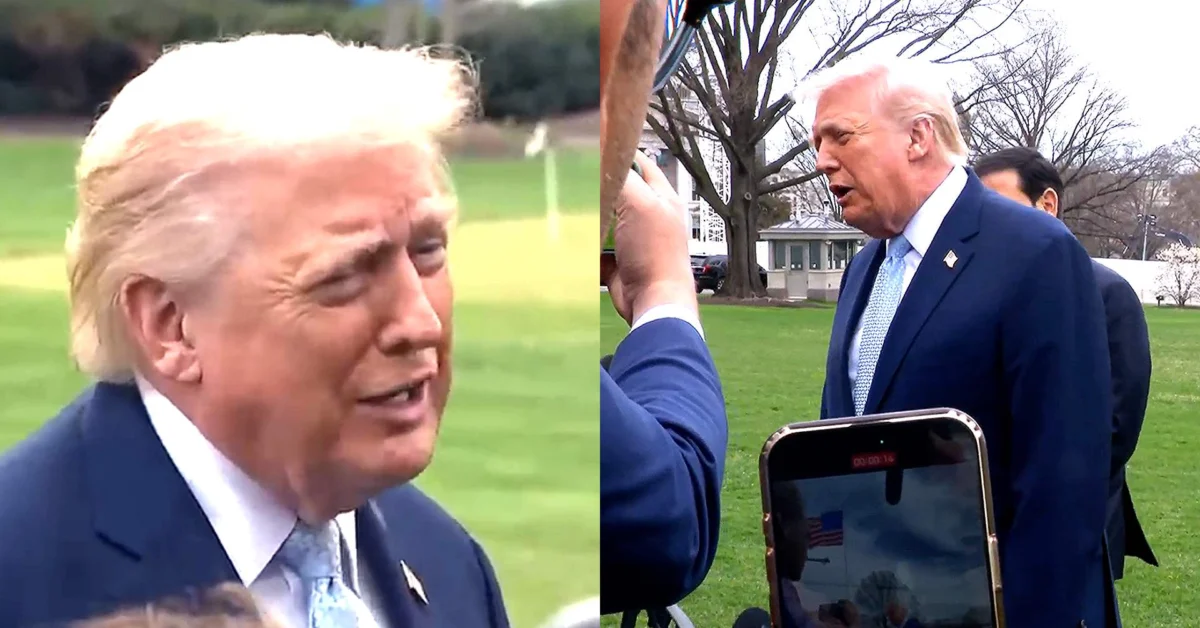
President Donald Trump engaged in a wide-ranging exchange with the White House press corps on Friday, utilizing a recent CNN segment as a metric for his domestic political standing while simultaneously outlining a hardline military posture regarding ongoing tensions with Iran. Standing on the North Lawn alongside Secretary of State Marco Rubio, the President addressed questions concerning troop deployments, the status of Middle Eastern maritime corridors, and his refusal to consider a ceasefire in what he described as a period of military dominance for the United States. The briefing occurred shortly before the President’s departure for his Mar-a-Lago estate in Florida, serving as a platform for both a defense of his administration’s foreign policy and a lighthearted jab at one of his frequent media critics.
The centerpiece of the President’s domestic commentary was a viral segment from CNN featuring data analyst Harry Enten. During the broadcast, Enten highlighted a specific crosstab from a recent NBC News poll which indicated that President Trump held a 100 percent approval rating among respondents who identified as members of the "MAGA Movement." Trump, who has historically maintained a contentious relationship with CNN, laughed as he referenced the report, calling the unanimous support an "honor" and expressing surprise that the network would feature such a statistic.
The Mechanics of the 100 Percent Approval Rating
The poll in question, which gained significant traction on social media earlier in the week, originated from an NBC News survey. CNN’s Harry Enten, often referred to as the network’s "data guru," noted that while high approval ratings among a candidate’s base are common, a literal 100 percent figure is a statistical anomaly in modern political polling. Enten described the numbers as "jumping off the screen," noting that even among the most loyal demographic subsets, there is usually a small margin of dissent or uncertainty.
The "MAGA Movement" has increasingly been treated by pollsters as a distinct demographic or ideological subgroup, separate from broader Republican affiliation. Analysts suggest that the 100 percent figure reflects a total alignment of identity between the movement and its founder. For the President, the statistic served as a rhetorical shield against questions regarding the potential domestic unpopularity of increased military involvement in the Middle East. When asked by reporters if he feared that deploying additional troops might shift public sentiment or operational dynamics, Trump pivoted to the poll as evidence of a mandate.
"I seem to have great support, because CNN came out with a poll today that I’m at 100 percent!" Trump remarked, punctuated by a chuckle. "And they said they’ve never seen a poll like that. The CNN poll said I’m 100 percent, and they’ve never seen that before, which is an honor. I was impressed that CNN would do that."
Escalation and Strategy in the Middle East
Beyond the discussion of domestic polling, the President used the press availability to provide an update on the administration’s "Maximum Pressure" campaign against Iran. The dialogue took place against a backdrop of reported escalations in the region, including rumors of a new deployment of 2,500 U.S. Marines to the Middle East.
When pressed on the intent behind these deployments—specifically whether they were intended for deterrence or to optimize operational capability—Trump remained coy on the specifics of military movements while emphasizing the scale of American resources. He asserted that the United States possesses "unlimited ammunition" and the "greatest equipment in the world," claiming that the U.S. military is currently "decimating" Iranian interests.
"It’s about time," Trump stated. "And frankly, it should have been done long before me. It should have been done before other people."
The President’s rhetoric regarding a ceasefire was particularly stark. Rejecting the notion of a diplomatic pause, he argued that the current military advantage made such a move counterintuitive. "I don’t want to do a ceasefire," he told reporters. "You know, you don’t do a ceasefire when you’re literally obliterating the other side." This stance aligns with Secretary of State Marco Rubio’s long-standing foreign policy philosophy, which prioritizes clear military objectives and the projection of strength over incremental diplomacy in the face of perceived threats to American interests.
The Strait of Hormuz and Global Energy Security
A critical point of concern for international markets and regional stability has been the Strait of Hormuz, a vital chokepoint for the world’s oil supply. In recent weeks, tensions have led to fears of a blockade or significant disruption to maritime traffic. However, President Trump dismissed these concerns with a characteristic display of confidence, suggesting that the pressure exerted by the U.S. would resolve the issue without the need for traditional diplomatic concessions.
"The Strait of Hormuz will open itself," Trump declared. This statement suggests an administration belief that Iranian naval capabilities or threats to block the waterway will be neutralized through sheer kinetic or economic force, rendering any attempt at a blockade unsustainable for Tehran.
The Strait of Hormuz carries roughly one-sixth of the world’s oil production and one-third of the world’s liquefied natural gas. Any prolonged disruption would have immediate and severe impacts on global energy prices. By stating the Strait would "open itself," the President implied that the "obliteration" of the opposing side’s assets would ensure the freedom of navigation through the region.
A Timeline of Recent Tensions
The President’s comments on the North Lawn are the culmination of a week marked by rapid developments in the Middle East.
- Monday: Reports surfaced of increased Iranian proxy activity in the Levant and the Persian Gulf, leading to a heightened alert status for U.S. Central Command (CENTCOM).
- Tuesday: The NBC News poll was released, containing the "MAGA" crosstab that would later go viral.
- Wednesday: CNN’s Harry Enten analyzed the poll on-air, bringing mainstream attention to the 100 percent approval figure among the President’s core supporters.
- Thursday: Unconfirmed reports began circulating within the Pentagon regarding the deployment of an additional 2,500 Marines to the region to bolster "Force Protection" and "Response Capabilities."
- Friday: President Trump, accompanied by Secretary Rubio, confirmed the administration’s aggressive stance, citing the 100 percent poll as a sign of unified domestic backing for his "win" in the conflict.
Analysis of the "100 Percent" Narrative
From a journalistic and sociological perspective, the President’s focus on the 100 percent poll serves a dual purpose. First, it reinforces the narrative of an unbreakable bond between the President and his electoral base. In an era of high political polarization, such statistics—even when limited to a specific subgroup—are used to project an image of invincibility and internal party discipline.
Second, by attributing the poll to CNN, the President practiced a form of media judo. By praising the network for reporting a statistic favorable to him, he momentarily neutralized his standard "fake news" critique to validate the data. This tactic often forces media outlets to clarify the context of their reporting, which in turn keeps the original favorable statistic in the news cycle for a longer duration.
However, political scientists warn that 100 percent approval within a movement often indicates a "closed loop" of feedback. While it signals intense loyalty, it does not necessarily translate to the broader electorate needed for general policy consensus. For the Trump administration, however, the "MAGA" sentiment is viewed as the primary engine of political capital, providing the President with the perceived latitude to engage in high-stakes military maneuvers without fear of a base-level backlash.
Reactions and Implications
While the President expressed confidence, the reaction from Capitol Hill and international allies has been more measured. Democratic leaders have expressed concern over the "obliteration" rhetoric, suggesting that a refusal to consider a ceasefire could lead to an uncontrollable regional war. Conversely, many Republican lawmakers have lauded the President’s "peace through strength" approach, arguing that the previous administration’s policies were too conciliatory toward Tehran.
Secretary of State Marco Rubio, though quiet during the specific exchange regarding the poll, has been a vocal architect of the administration’s current Iran policy. His presence on the North Lawn signaled a unified front between the executive branch’s political identity and its diplomatic/military apparatus.
As the President departed for Mar-a-Lago, the central question remaining for observers is whether the "100 percent" domestic support will remain steadfast if the "obliteration" of the opposition leads to a protracted conflict. For now, the administration appears convinced that they have already "won," and that the American public—or at least the segment that matters most to this White House—is fully behind the mission.
The coming days will likely see further clarification from the Pentagon regarding the specific destination and mission of the 2,500 Marines mentioned during the briefing. Until then, the administration continues to leverage its high internal polling as a mandate for a transformative and aggressive foreign policy shift in the Middle East.


 Yuyun Lusiyani
 Joko Widodo
 Eva Lovia
 Pevita Pearce
 admin
admin
 Lina Irawan