
 Jia Lissa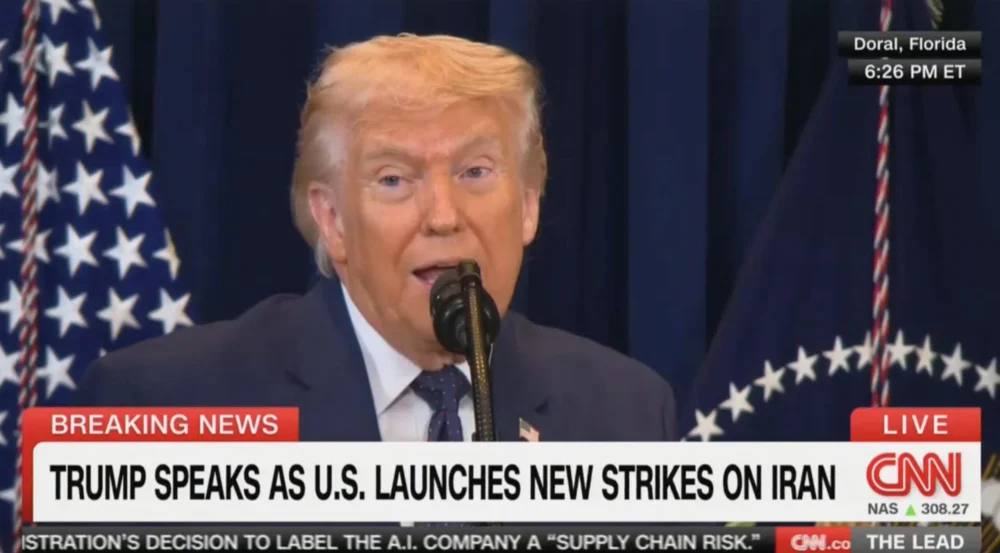
President Donald Trump addressed the nation and the international press corps on Monday evening from his Trump National Doral resort in Florida, providing a status update on the ongoing military conflict with the Islamic Republic of Iran. During the briefing, the President asserted that U.S.-led military operations are progressing at a pace that exceeds the administration’s original strategic forecasts. However, the event was punctuated by a pointed inquiry regarding the human cost of the conflict, specifically concerning the number of American fatalities the administration is prepared to sustain as the war continues.
The press conference followed a period of intense kinetic activity in the region, which began in earnest on February 28. President Trump utilized the platform to signal his administration’s long-term objectives for the Persian Gulf, emphasizing a desire for "internal and eternal" leadership in Iran that aligns with U.S. and regional interests. Despite the optimistic tone regarding tactical successes, the President faced direct questioning about the eight U.S. military personnel who have lost their lives since the inception of the campaign.
The Evolution of the Conflict: A Timeline of Key Events
The current state of hostilities marks a significant escalation in decades of U.S.-Iran tension. The catalyst for the current war was a high-stakes joint operation conducted by U.S. and Israeli forces on February 28. This operation resulted in the death of Iran’s Supreme Leader, Ali Khamenei, a move that decapitated the Iranian leadership and triggered a swift but contested succession.
Following the death of the elder Khamenei, his son, Mojtaba Khamenei, was elevated to the position of Supreme Leader. This transition has been met with both internal resistance within Iran and increased military pressure from the Western coalition. The Trump administration has characterized this period as a necessary transition toward a more favorable governing structure in Tehran, though the transition has not been without significant military friction.
By Monday, the administration’s narrative shifted toward a declaration of near-victory. In a telephone conversation with CBS News White House Correspondent Weijia Jiang earlier that day, President Trump stated that the war was "very complete, pretty much." This statement set the stage for the evening’s press conference at Doral, where reporters sought to reconcile the President’s "complete" assessment with the reality of ongoing casualties and active combat zones.
The Human Cost: Casualties and the Dover Visit
The most significant moment of the press conference occurred during the final question, when an off-camera reporter challenged the President on the sustainability of the conflict’s human toll. The reporter noted that as of Monday, eight U.S. military fatalities have been officially recorded in connection with the war in Iran. Additionally, at least eight other service members have sustained serious injuries, many of whom are receiving treatment for life-altering wounds.
President Trump declined to provide a specific numerical threshold for acceptable casualties. Instead, he framed the loss of life as an inherent, albeit tragic, component of high-stakes military engagement. He referenced a recent visit to Dover Air Force Base, the primary entry point for fallen service members returning to U.S. soil, to illustrate the domestic resolve he believes exists regarding the war.
"Well, as I said before, when you have conflicts like this, you always have casualties," the President stated. He recounted his interactions with the families of the fallen, describing them as "unbelievable people" who shared a singular message: "Finish the job, sir. Please finish the job." By invoking the sentiments of Gold Star families, the President moved the focus away from policy-driven casualty limits and toward a narrative of mission completion and honoring the sacrifice of the deceased.
Strategic Objectives and "Internal Leadership"
The administration’s stated goal of fostering "internal and eternal" leadership in Iran suggests a policy that goes beyond mere containment. Analysts suggest this phrasing indicates a commitment to regime change or, at the very least, a total restructuring of the Iranian political apparatus to ensure long-term stability favorable to U.S. interests.
The assertion that military operations are "ahead of schedule" implies that the initial phases of the war—likely the neutralization of command-and-control centers and the removal of top-tier leadership—were executed with high efficiency. However, the transition from a "complete" war to a stable post-war environment remains a point of contention among military experts and lawmakers. The eight deaths reported thus far are linked to ongoing operations that continue despite the President’s characterization of the war as nearly over.
Regional Data and Military Context
The conflict has not occurred in a vacuum. Supporting data from the Department of Defense and regional partners indicates that the U.S. has significantly increased its troop presence in the Middle East, with a particular focus on assets stationed in Saudi Arabia and the United Arab Emirates. The eight fatalities include personnel identified in recent reports as having been killed in operations involving both Iranian territory and peripheral conflict zones where Iranian proxies remain active.
The joint nature of the February 28 operation with Israel highlights the deep integration of U.S. and Israeli intelligence and strike capabilities. This partnership has been a cornerstone of the Trump administration’s Middle East policy, aimed at dismantling the "land bridge" of Iranian influence stretching through Iraq and Syria to Lebanon. The death of Ali Khamenei served as the ultimate realization of this "Maximum Pressure" campaign, transitioning it from economic and diplomatic isolation to direct kinetic intervention.
Domestic Political Reactions and Analysis
The President’s remarks have elicited a range of reactions across the political spectrum. Supporters of the administration argue that the rapid progress of military operations justifies the risks taken and that the removal of the Supreme Leader has fundamentally altered the regional balance of power in favor of the United States. They point to the President’s visit to Dover as evidence of a Commander-in-Chief who is deeply connected to the consequences of his orders.
Conversely, critics in Congress have raised concerns regarding the lack of a clear exit strategy and the ambiguity of the phrase "finish the job." Questions remain regarding the legal authorization for the conflict, as the War Powers Act requires the President to consult with Congress for sustained military engagements. The refusal to define a casualty limit, combined with the declaration that the war is "pretty much" over while troops continue to die, has created a vacuum of clarity that many lawmakers find troubling.
Military analysts suggest that the "eight deaths" figure may be a preliminary tally, as the fog of war and the nature of special operations often delay the public release of casualty data. The "eight seriously wounded" also represent a significant burden on the military medical infrastructure, with many requiring long-term care for injuries sustained from advanced Iranian weaponry or insurgent tactics.
Geopolitical Implications and the Succession of Mojtaba Khamenei
The rise of Mojtaba Khamenei is a pivotal development in the conflict. For years, Mojtaba was seen as a shadow figure with significant influence over the Islamic Revolutionary Guard Corps (IRGC). His official ascension to Supreme Leader marks a shift toward a potentially more militarized and hardline leadership, even as the country faces existential threats from external forces.
The U.S. objective of "internal leadership" likely hinges on the hope that the Iranian population or factions within the military will move against the younger Khamenei. However, history suggests that external military pressure can often have a "rally around the flag" effect, potentially complicating the Trump administration’s timeline for a final resolution. The "eternal" aspect of the President’s goal implies a desire for a permanent end to the adversarial relationship between Washington and Tehran, a feat that has eluded every U.S. administration since 1979.
Future Outlook: The Definition of Completion
As the Trump administration continues to navigate the complexities of the Iran war, the definition of "completion" will be the primary metric by which the public and the international community judge the effort. If the war is indeed "very complete," the expectation will be a swift reduction in U.S. troop exposure and a cessation of fatalities. If casualties continue to mount, the President’s rhetoric may face increasing scrutiny.
The upcoming weeks are expected to be critical as the U.S. attempts to stabilize the regions under its control and manage the transition of power within Iran. Whether the "finish the job" mandate from the families at Dover can be translated into a sustainable peace remains the central question of the Trump presidency’s foreign policy. For now, the administration remains firm in its stance that the progress made justifies the costs incurred, even as it avoids setting a firm limit on what those costs might eventually be.
The international community continues to monitor the situation closely, with global markets reacting to the volatility in the Persian Gulf. Oil prices, which spiked following the February 28 operation, have remained unstable as traders weigh the President’s "nearly over" claims against the reality of a new Supreme Leader in Tehran and ongoing military engagements. The resolution of this conflict will likely reshape the Middle East for decades, but the path to that resolution is still being paved with the complexities of modern warfare and the heavy burden of human loss.


 Yuyun Lusiyani
 Joko Widodo
 Eva Lovia
 Pevita Pearce
 admin
admin
 Lina Irawan