
 Jia Lissa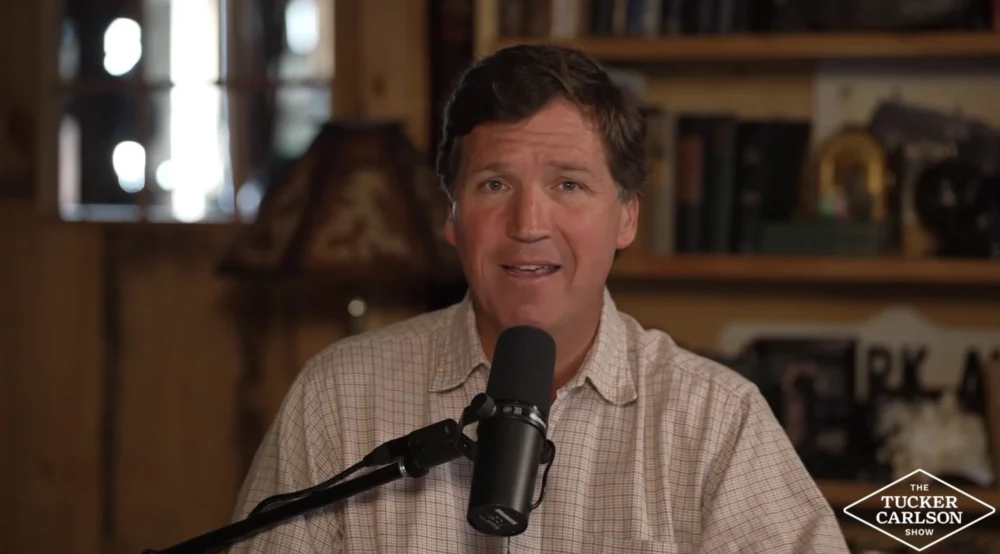
Tucker Carlson, the prominent conservative commentator and host of the Tucker Carlson Network, has issued a stark warning regarding the potential consequences of President Donald Trump’s recent demand for the "unconditional surrender" of the Islamic Republic of Iran. During an extensive interview with Saagar Enjeti on the program Breaking Points, Carlson argued that the rhetoric of total capitulation historically triggers a level of existential resistance that could force the United States to utilize nuclear weapons. Carlson’s commentary centers on the psychological and historical implications of the term "unconditional surrender," which he asserts is synonymous with the total subjugation and physical violation of a conquered population.
The discussion followed a series of escalations in the Middle East, characterized by targeted strikes against the Iranian leadership and a significant shift in the Trump administration’s stated goals for the region. Carlson’s critique highlights a growing rift within the American right regarding interventionist foreign policy and the potential for a large-scale conventional or nuclear conflict. According to Carlson, the demand for unconditional surrender removes any incentive for a diplomatic resolution, as the perceived cost of surrender becomes higher than the cost of total war.
Historical Interpretation and the Rhetoric of Surrender
Carlson’s argument rests on a specific, visceral interpretation of military history. He contended that the term "unconditional surrender" carries a historical weight that implies the complete loss of protection for the civilian population. "Unconditional surrender means foreign troops get to rape your wife and daughter if they want. And everyone knows that," Carlson stated during the interview. He framed this not as a legal definition, but as an "atavistic instinct" that governs how nations respond to the threat of total conquest.
From a historical perspective, the term "unconditional surrender" gained modern prominence during the American Civil War, popularized by General Ulysses S. Grant, and was later adopted as the official policy of the Allied powers during World War II following the Casablanca Conference in 1943. While international legal frameworks, such as the Geneva Conventions, have since been established to protect civilians and prisoners of war, Carlson argued that the perception of such a demand remains unchanged in the minds of those facing it. He suggested that because the Iranian people would expect the worst possible outcomes from a total collapse of sovereignty, they would fight with a ferocity that conventional American ground forces might not be able to overcome without catastrophic loss of life.
The Nuclear Implication and Military Necessity
A central pillar of Carlson’s warning is the belief that the United States currently lacks the conventional ground force necessary to enforce an unconditional surrender on a nation as large and geographically complex as Iran. He argued that the American public is largely unwilling to support the kind of mass mobilization and "ocean of American blood" that would be required for a full-scale occupation. Consequently, Carlson posited that the U.S. government would eventually find itself at a strategic impasse where the only way to achieve the stated goal of unconditional surrender would be through the use of weapons of mass destruction.
"It would require, presumably, nuclear weapons," Carlson noted, suggesting that the current trajectory of U.S. policy is moving toward that eventuality. Saagar Enjeti concurred with this assessment, noting that the "natural choice" for an American president faced with a stalled conventional campaign is often escalation through aerial bombardment. Enjeti characterized the drift toward total war as an "abomination" that does not align with the national interest of the United States.
Timeline of Recent Escalations in Iran
The recent discourse regarding Iran follows a rapid series of military and political developments that have fundamentally altered the landscape of the Middle East. The following timeline outlines the key events leading to the current state of tension:
- Initial Strikes: Joint U.S.-Israeli operations were conducted against high-value targets within the Iranian military and political infrastructure. These strikes targeted command and control centers, air defense systems, and communication networks.
- Death of Ali Khamenei: Last week, a precision strike resulted in the death of Iranian Supreme Leader Ali Khamenei, along with dozens of high-ranking officials within the theocratic regime.
- Trump’s Declaration: Following the strikes, President Trump took to social media and public forums to declare that Iran’s military capabilities had been effectively "wiped out." He asserted that the Iranian army, navy, and air force were non-existent and that no peace deal would be entertained without "UNCONDITIONAL SURRENDER."
- Succession in Tehran: On Sunday, Mojtaba Khamenei, the son of the late Supreme Leader, was officially named the new Supreme Leader of Iran.
- The "Lightweight" Assessment: President Trump responded to the appointment of Mojtaba Khamenei by labeling him a "lightweight," signaling that the U.S. administration does not view the new leadership as a legitimate or formidable partner for negotiation.
Data on Military Capabilities and the Cost of Conflict
While President Trump has claimed that the Iranian military is "gone," independent defense analysts and historical data suggest that the cost of enforcing a total surrender remains prohibitively high. Iran possesses one of the largest missile programs in the Middle East and a deeply embedded network of proxy forces.
According to data from the International Institute for Strategic Studies (IISS), Iran’s military doctrine has long focused on "asymmetric warfare," designed to inflict maximum casualties on a technologically superior invader. Even with a degraded conventional air force, the Iranian Revolutionary Guard Corps (IRGC) maintains significant capabilities for guerrilla warfare and regional disruption.
Furthermore, the economic cost of a full-scale war with Iran is estimated by various think tanks to be in the trillions of dollars. Comparisons are frequently drawn to the Iraq War, which, according to the Watson Institute for International and Public Affairs at Brown University, has cost the United States over $2 trillion. A conflict with Iran, a country with nearly four times the landmass and more than double the population of Iraq, would likely exceed those figures significantly.
Reactions and Official Stances
The rhetoric of "unconditional surrender" has met with a polarized response within the halls of power in Washington and among international allies.
Proponents of the Administration’s View: Supporters of the President’s stance argue that "Maximum Pressure" is the only way to ensure that the Iranian regime cannot rebuild its nuclear ambitions or continue its support for regional militias. They contend that after decades of hostility, a total reset of the Iranian government is the only path to long-term stability in the Middle East.
Critics and Non-Interventionists: Figures like Carlson and Enjeti represent a growing "America First" skepticism toward overseas entanglements. They argue that the primary goal of U.S. foreign policy should be the avoidance of unnecessary wars. Carlson’s description of the strikes as "disgusting and evil" reflects a moral objection to targeted assassinations of foreign heads of state, which he believes undermines international norms and invites retaliation.
International Community: European allies and regional powers such as Turkey and Qatar have expressed concern that the demand for unconditional surrender leaves the new Iranian leadership with "no exit ramp," potentially leading to a desperate "Samson Option" where the regime attempts to destabilize the global energy market or initiate a wider regional war as a final act of defiance.
Strategic Analysis of Implications
The shift from a policy of "behavior change" to "unconditional surrender" represents a fundamental change in U.S. strategy. Historically, diplomatic efforts with Iran—such as the Joint Comprehensive Plan of Action (JCPOA)—were based on the idea of verifiable concessions in exchange for sanctions relief. By demanding unconditional surrender, the Trump administration effectively removes the possibility of a negotiated settlement with the existing power structure.
This approach creates several high-stakes implications:
- Regime Cohesion: Threatened with total destruction, the various factions within the Iranian government may unify around the new Supreme Leader, Mojtaba Khamenei, out of a shared sense of existential survival.
- Radicalization of the Population: As Carlson noted, the fear of foreign occupation and the associated violence can serve as a powerful tool for domestic mobilization, potentially turning a civilian population against any Western-backed "acceptable" leaders.
- Nuclear Proliferation: If Iran perceives that its conventional defeat is imminent and that "unconditional surrender" is the only alternative, the incentive to rapidly develop or deploy a "breakout" nuclear capability increases as a final deterrent.
- Global Economic Impact: Any escalation toward the level of force Carlson describes would likely close the Strait of Hormuz, through which approximately 20% of the world’s petroleum passes, leading to a global economic shock.
The debate sparked by Carlson’s interview underscores the tension between the desire for a definitive victory over a long-term adversary and the pragmatic fears of the costs associated with such a victory. As the United States continues to exert pressure on the newly reorganized Iranian leadership, the international community remains watchful of whether the rhetoric of surrender will lead to a diplomatic breakthrough or the "ocean of blood" that critics of the policy fear is becoming inevitable.


 Yuyun Lusiyani
 Joko Widodo
 Eva Lovia
 Pevita Pearce
 admin
admin
 Lina Irawan