
 Yuyun Lusiyani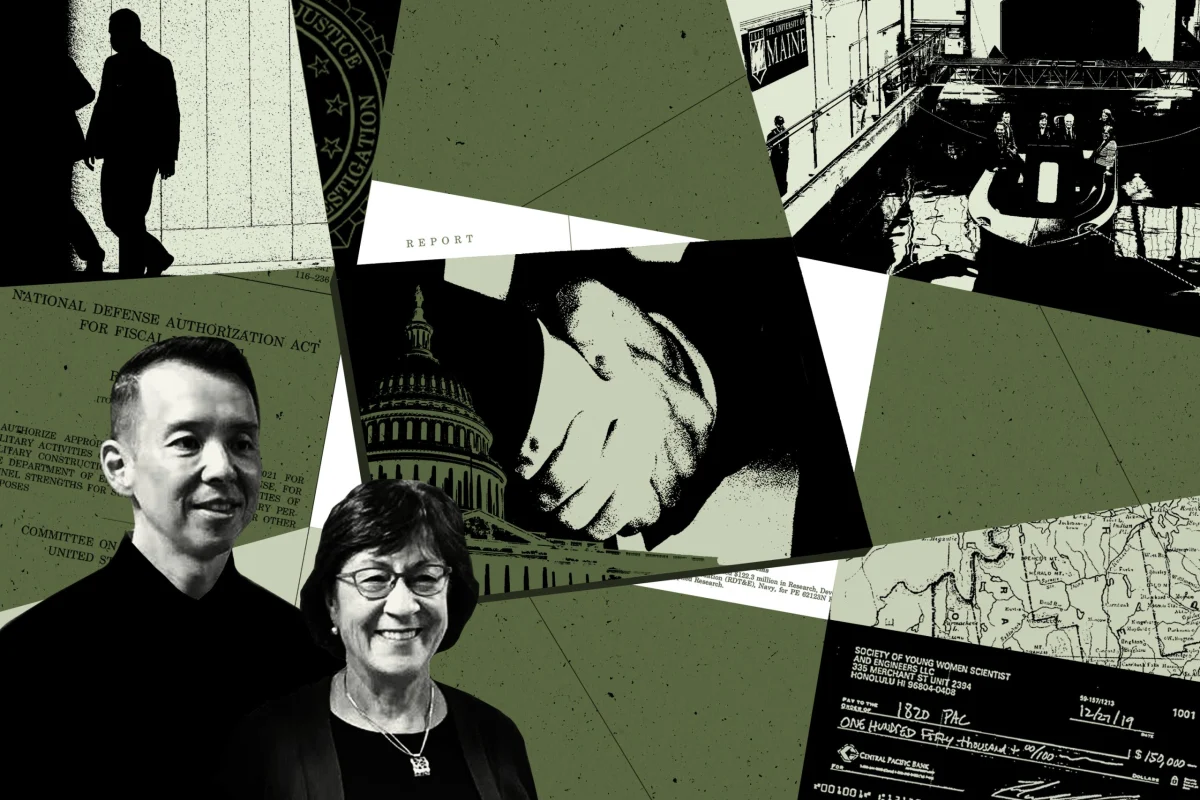
A groundbreaking investigation by ProPublica has brought to light a previously undisclosed federal bribery probe that, as of late 2024, possessed sufficient evidence to potentially implicate top lawmakers, including Senator Susan Collins (R-ME). The extensive inquiry by the Federal Bureau of Investigation (FBI) centered on a complex web of interactions between Senator Collins and Martin Kao, the former CEO of defense contractor Navatek, detailing allegations of illegal campaign contributions and a quid pro quo involving millions in government contracts. This revelation not only casts a shadow over the integrity of political fundraising but also raises critical questions about the independence of federal investigative agencies and the mechanisms of public accountability.
The Genesis of the Investigation: A Donor’s Confession
The intricate narrative of the stalled probe begins in 2019, when, according to Martin Kao, a representative of a super political action committee (PAC) supporting Senator Collins allegedly solicited a substantial $500,000 donation from him and other Navatek executives. This request immediately raised red flags, as federal law explicitly prohibits government contractors from making political contributions. Such donations, particularly if exchanged for official actions, would constitute criminal bribery, a serious felony carrying significant penalties. To circumvent these stringent campaign finance regulations and obscure the true origin of the funds, Kao reportedly funneled an initial $150,000 to the super PAC through a shell company. He claimed to have secured legal counsel for this maneuver, a claim seemingly validated by the super PAC head’s email response, "Very smart," upon learning of Kao’s involvement.
Weeks after this initial illicit contribution, Kao allegedly informed his team that Senator Collins had committed to securing $32 million in naval contracts for Navatek. This alleged direct linkage between the donation and the promise of lucrative government contracts forms the core of the bribery allegation. The FBI, however, eventually uncovered Kao’s sophisticated scheme involving shell companies. In 2022, a grand jury indicted Kao for making illegal campaign contributions. Facing the daunting prospect of a lengthy prison sentence, Kao chose to cooperate with federal authorities, revealing the full extent of his illicit activities. His testimony, which had remained undisclosed until ProPublica’s investigation, provided a comprehensive roadmap to the alleged corruption.
Navatek’s Influence Machine: A Broader Scheme of Political Donations
Kao’s cooperation with the FBI peeled back layers of a much larger influence-peddling operation. He disclosed that he and his close associates had funneled nearly $900,000 to dozens of politicians across the country. This extensive network of political contributions was instrumental in Navatek’s strategy to expand its operations, enabling the defense contractor to establish a presence in half a dozen states and secure more than $40 million annually in government funding. According to Kao, Senator Collins was not merely one of many beneficiaries but Navatek’s "most important patron," highlighting her alleged central role in the company’s efforts to leverage political influence for financial gain.
Navatek, now operating as PacMar Technologies, is a company specializing in advanced maritime technologies, including hull design and hydrodynamics, primarily for naval applications. Its reliance on government contracts makes adherence to ethical standards and campaign finance laws particularly crucial. The scale of Kao’s alleged donations underscores the significant financial investment defense contractors sometimes make in cultivating political relationships, raising persistent concerns about the potential for undue influence in the allocation of taxpayer-funded contracts. The U.S. defense budget, often exceeding $700 billion annually, represents a vast pool of resources, making the competition for contracts intense and the stakes for political influence exceptionally high.
The Legal Framework: Navigating Campaign Finance and Bribery Statutes
Understanding the allegations requires a brief overview of the relevant legal landscape. Federal campaign finance law, specifically the Federal Election Campaign Act (FECA), prohibits corporations and government contractors from making direct contributions to federal candidates or political committees. This ban is designed to prevent quid pro quo corruption and the appearance of undue influence by entities directly benefiting from federal funds. Super PACs, while allowed to raise and spend unlimited amounts of money to overtly advocate for or against political candidates, are legally prohibited from coordinating directly with campaigns or candidates. The use of shell companies to obscure the true source of donations, as alleged in Kao’s case, is a classic tactic to violate these laws and often forms the basis for charges of illegal campaign contributions.
Bribery, under federal law (18 U.S.C. § 201), involves the exchange of something of value (like a campaign contribution) for an official act (like securing government contracts). The key element is the quid pro quo – a specific understanding that an official action will be taken in exchange for the contribution. If Kao’s allegations are proven, that Collins committed to securing $32 million in naval contracts in exchange for the $150,000 contribution, it would constitute a clear instance of criminal bribery, far exceeding simple campaign finance violations. Such cases are notoriously difficult to prove due to the challenge of establishing a direct, explicit link between the contribution and the official act, often relying on witness testimony, emails, and financial records to demonstrate intent and agreement.
A Chronology of Events: From Solicitation to Stalled Investigation
- 2019 (Exact Date Unknown): A representative of a pro-Collins super PAC allegedly meets with Martin Kao and other Navatek executives, soliciting a $500,000 donation.
- Shortly After (2019): Kao sends an initial $150,000 to the super PAC using a shell company, allegedly after consulting his lawyer, to obscure the source of funds. The super PAC head acknowledges Kao’s involvement via email, replying "Very smart."
- Weeks Later (2019): Kao reportedly informs his team that Senator Collins has committed to helping Navatek secure $32 million in naval contracts.
- Between 2019 and 2022: Kao and his associates allegedly make nearly $900,000 in contributions to various politicians, enabling Navatek to expand its operations and secure over $40 million annually in government funds.
- 2022: A federal grand jury indicts Martin Kao for making illegal campaign contributions.
- Post-Indictment (2022): Facing a potentially long prison sentence, Kao cooperates with the FBI, revealing the full scope of the alleged bribery scheme, including details about Senator Collins’s alleged involvement.
- Late 2024 (as reported by ProPublica): FBI investigators reportedly possessed enough evidence, including Kao’s testimony, to launch a sweeping bribery probe that could ensnare top lawmakers.
- Later (Undated, during Trump Administration): The investigation stalls. According to ProPublica, the FBI and Department of Justice teams responsible for public corruption cases were "eviscerated" following the return of President Donald Trump to office, leading to a cessation of contact with the informant (Kao) and effectively halting the probe.
- 2024 (ProPublica Publication): ProPublica reveals the existence and details of the stalled investigation for the first time, based on a comprehensive review of FBI evidence, legal records, and interviews.
The Investigation’s Trajectory and Abrupt Halt
The FBI’s initial pursuit of Kao culminated in his 2022 indictment, a significant step in uncovering the broader alleged scheme. Kao’s subsequent cooperation provided federal investigators with a critical insider’s account, potentially offering a "road map to corruption in Congress." This testimony was reportedly robust enough to warrant a "sweeping bribery probe" that could extend to high-ranking officials. However, the investigation’s momentum seemingly dissipated.
A critical turning point, as highlighted by ProPublica, was the purported "evisceration" of public corruption teams within the FBI and Department of Justice (DOJ) during the Trump administration. This claim suggests a systemic weakening of federal enforcement capabilities against political wrongdoing. Such shifts can occur through various mechanisms, including leadership changes, budget reallocations, or a change in prosecutorial priorities, potentially creating an environment where complex, politically sensitive investigations are deprioritized or allowed to languish. The cessation of communication with a key informant, particularly one offering such extensive details, is a strong indicator of an investigation being wound down or put on indefinite hold. This raises serious concerns about the independence of federal law enforcement and the potential for political interference in cases involving powerful figures.
Senator Collins’ Defense and Counter-Allegations
In response to ProPublica’s revelations, Senator Susan Collins’s office issued a vehement denial. Her deputy chief of staff stated that the office "vigorously" denies allegations of bribery and "pay-for-play" made by Kao, asserting that her office "fully cooperated" with the FBI. Following the publication of ProPublica’s initial report, Senator Collins herself launched a robust defense, characterizing the reporting as a "disgraceful smear job" and accusing ProPublica of prioritizing "the words of a twice-convicted felon over my office, campaign staff and me." She further argued that her defense was "full of incorrect and misleading claims," a counter-accusation that ProPublica subsequently addressed with further evidence.
Collins’s defense strategy centers on discrediting Kao’s testimony due to his criminal record and asserting her office’s full cooperation with previous inquiries. However, the distinction between "cooperating" with an initial inquiry and being subject to a more expansive bribery probe based on new, detailed informant testimony is crucial. The FBI’s statement, while not directly contradicting Kao’s account, noted that it "ultimately found nothing implicating Senator Collins" or her campaign in previous phases of the investigation, a nuance that does not necessarily address the new phase prompted by Kao’s detailed revelations.
Official Responses and External Perspectives
ProPublica’s comprehensive investigation involved reviewing a "trove of evidence" gathered by the FBI, thousands of pages of legal records, and interviews with dozens of individuals familiar with Navatek, its lobbying efforts, and the FBI inquiry. This meticulous approach allowed them to independently corroborate much of Kao’s account.
When approached for comment, the White House referred ProPublica to the FBI. An FBI spokesperson reiterated that the agency "ultimately found nothing implicating Senator Collins" or her campaign, but notably "did not address questions about the new phase of the investigation prompted by Kao’s account." This careful wording leaves open the possibility that Kao’s testimony did indeed open new avenues of inquiry that were not fully pursued or completed. Steven Loui, the founder of Navatek, distanced himself from Kao’s actions, stating that Kao’s methods were "unethical and illegal" and affirming the company’s full compliance with law enforcement.
Broader Implications for Public Trust and Oversight
The alleged bribery scheme and the subsequent stalling of the investigation carry significant implications for public trust in government and the integrity of the political system. Such revelations can erode confidence in the fairness of elections, the impartiality of government contracting, and the ability of federal agencies to hold powerful individuals accountable.
This case also highlights the ongoing debate surrounding campaign finance reform. The use of super PACs and shell companies to funnel money into political campaigns, even if technically legal in some contexts, raises questions about transparency and the potential for "dark money" to influence policy decisions. Critics of the current system often argue that lax regulations allow wealthy donors and special interests to gain undue access and influence, distorting the democratic process.
Furthermore, the claim that federal public corruption teams were "eviscerated" during a specific administration underscores the fragility of institutional safeguards against political misconduct. The perception, or reality, of political interference in federal investigations can have a chilling effect on whistleblowers and prosecutors alike, ultimately undermining the rule of law. Ensuring the independence and robust funding of agencies like the FBI and DOJ is paramount to maintaining a healthy democracy. This case serves as a stark reminder of the continuous need for vigilant oversight and robust investigative journalism to expose potential abuses of power and demand accountability from those entrusted with public office. The pursuit of justice, particularly in cases involving high-ranking officials, is a cornerstone of a functional and trustworthy government.

 Ana Megawati
 Joko Widodo
 Eva Lovia
 Jia Lissa
 Pevita Pearce