
 Eva Lovia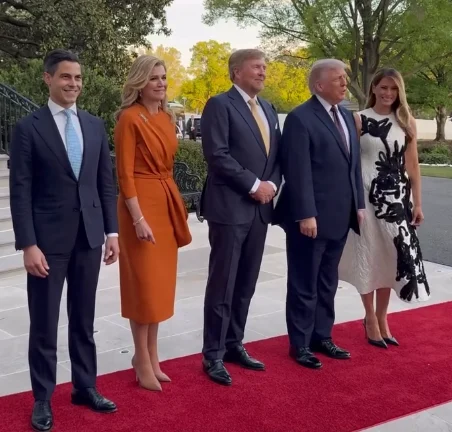
The official visit of Their Majesties King Willem-Alexander and Queen Máxima of the Netherlands to the United States commenced with a significant reception at the White House, underscoring the enduring diplomatic and cultural bonds between the two nations. The Dutch monarch and his consort were formally welcomed by President Donald Trump and First Lady Melania Trump on the initial day of their multi-state tour, a visit strategically timed to coincide with America’s burgeoning preparations for the 250th anniversary of the Declaration of Independence. This high-profile engagement signals a renewed emphasis on the historical connections and future collaborations between the Netherlands and the United States, a relationship stretching back centuries.
A Royal Arrival at the White House
The first evening of the Dutch royal tour saw King Willem-Alexander and Queen Máxima arrive at the President’s official residence in Washington D.C. for a dinner engagement. This was not a State Dinner, a distinction reflected in the attire of the distinguished guests. President Trump and King Willem-Alexander were seen in formal suits, while First Lady Melania Trump and Queen Máxima opted for elegant cocktail dresses. Queen Máxima, known for her fondness for elaborate headwear, eschewed a tiara for this occasion, instead choosing a striking orange gown. Orange, the national color of the Netherlands, served as a subtle yet potent sartorial nod to her homeland. She complemented her ensemble with a dazzling diamond brooch, adding a touch of regal sparkle to the ceremonial welcome. The White House itself acknowledged the significance of the occasion through its social media channels, heralding the arrival as "a royal arrival" and sharing accompanying images of the two couples. This public acknowledgement highlights the diplomatic importance the U.S. administration placed on hosting the Dutch sovereign.
A Journey Through American History and Innovation
The Dutch royal itinerary commenced in Philadelphia, Pennsylvania, a city steeped in the history of American independence. Upon their arrival in the City of Brotherly Love, King Willem-Alexander and Queen Máxima were afforded the opportunity to engage directly with a pivotal symbol of American liberty: the Liberty Bell. This iconic artifact, cast in London in 1752 with the inscription "Proclaim LIBERTY Throughout all the Land unto all the Inhabitants Thereof" from the Book of Leviticus, has long represented the ideals of freedom and independence. Its prominent crack has become as much a part of its legend as its message, a testament to its enduring presence through the nation’s history. The viewing of the Liberty Bell served as a poignant reminder of the shared historical narrative that binds the Netherlands and the United States, particularly in the context of the upcoming 250th anniversary of the Declaration of Independence in 2026.
The visit to Philadelphia also provided a unique glimpse into contemporary American culture and innovation. King Willem-Alexander and Queen Máxima visited the training facilities of the Philadelphia Eagles, a prominent team in the National Football League (NFL). This engagement was not merely a cultural exchange but also a platform to explore economic ties, specifically focusing on innovation within the sports sector. The royal couple received an introduction to the intricacies of American football and were presented with personalized Eagles jerseys, featuring their names on the back. This interaction underscored the multifaceted nature of the royal visit, encompassing historical commemoration, cultural immersion, and the exploration of modern economic partnerships.
Addressing Historical Echoes and Future Aspirations
During his speech in Philadelphia, King Willem-Alexander eloquently articulated the profound historical connection between his nation and the United States. He recognized Philadelphia as "historic ground, for us Dutch as well." His Majesty emphasized that the birth of the United States in 1776 marked a turning point in global history, with Americans establishing "a beacon of hope for all freedom-loving nations." The King further acknowledged the Netherlands’ early recognition and embrace of the transformative shifts brought about by the American experiment, stating, "And the Netherlands was one of the first countries that understood and embraced the signs of the new age." This sentiment resonates deeply, considering the historical support and early diplomatic recognition the Netherlands offered the nascent United States.
The royal tour’s agenda is designed to cover a significant geographical and thematic breadth, extending beyond Pennsylvania to include Washington D.C. and Florida. This strategic selection of states suggests a deliberate effort to engage with diverse aspects of American society, economy, and history. The visit is slated to include discussions and engagements focused on strengthening economic ties, fostering cultural exchange, and exploring opportunities for collaboration in areas such as technology, sustainability, and security. The Dutch royal delegation’s presence in the U.S. serves as a tangible manifestation of the ongoing dialogue and cooperation between the two countries.
A Precedent of Royal Engagements and Diplomatic Nuances
The current visit by the Dutch King and Queen occurs in close proximity to another significant royal engagement in the United States. Just days after their departure, Their Majesties King Charles III and Queen Camilla of the United Kingdom are scheduled to undertake a State Visit to the U.S. The scheduling of these two high-profile royal visits within such a short timeframe underscores the robust diplomatic relationships the United States maintains with its key European allies. Each visit, while distinct in its objectives and historical context, contributes to the broader tapestry of transatlantic diplomacy.
This visit also carries a degree of historical resonance in light of President Trump’s previous visit to the Netherlands. During that encounter, reports emerged of Queen Máxima making a facial expression that garnered media attention, which she subsequently addressed. Such moments, while seemingly minor, can become part of the diplomatic narrative, highlighting the human element within formal state interactions. The current visit, therefore, also presents an opportunity to build upon and solidify the personal rapport between the leaders and their respective nations.
The Broader Implications of Royal Diplomacy
The official visit of King Willem-Alexander and Queen Máxima to the United States transcends mere ceremonial pleasantries. It represents a strategic diplomatic initiative aimed at reinforcing long-standing alliances and exploring new avenues for cooperation in an ever-evolving global landscape. As the United States approaches its semiquincentennial, the presence of European royalty underscores the historical significance of its founding principles and their enduring impact on international relations.
The focus on economic and cultural ties, as exemplified by the visit to the Philadelphia Eagles, points towards a forward-looking agenda. In an era characterized by global economic integration and rapid technological advancement, fostering such connections is crucial for mutual prosperity and innovation. The Dutch royal family, acting as esteemed ambassadors of their nation, plays a vital role in facilitating these connections, bridging cultural divides, and promoting a shared vision for the future.
Furthermore, the timing of this visit, preceding the 250th anniversary of American independence, provides a timely opportunity to reflect on the shared values of liberty, democracy, and human rights that have guided both nations. By engaging with historical landmarks and modern institutions, King Willem-Alexander and Queen Máxima are not only honoring the past but also actively participating in shaping the future of transatlantic relations. The success of this visit will undoubtedly be measured by its ability to strengthen diplomatic ties, foster economic opportunities, and deepen the cultural understanding between the Netherlands and the United States for years to come. The presence of the Dutch monarchy in America serves as a potent reminder of the enduring strength and adaptability of international partnerships forged on a foundation of shared history and common aspirations.


 Yuyun Lusiyani
 Joko Widodo
 Pevita Pearce
 admin
admin
 Lina Irawan