
 Jia Lissa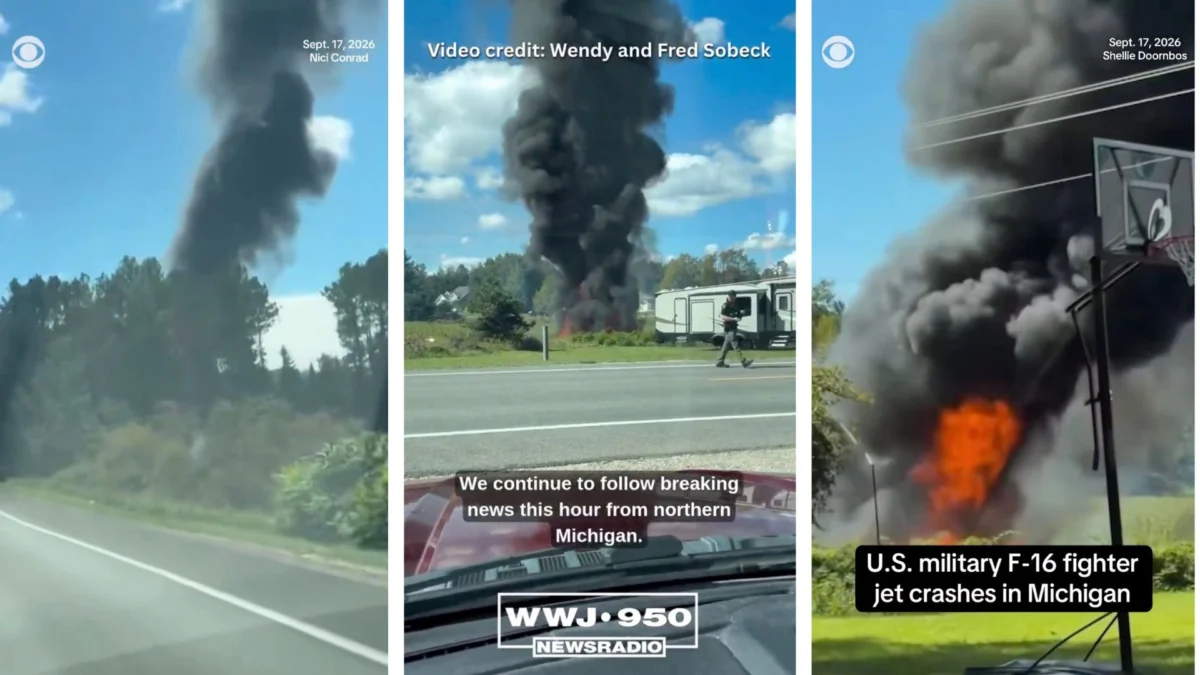
A high-performance F-16 Fighting Falcon assigned to the Texas Air National Guard’s 149th Fighter Wing was destroyed on Thursday afternoon following a catastrophic in-flight mishap over Northern Michigan. The incident, which occurred during a routine training exercise, resulted in the pilot successfully ejecting from the aircraft before it impacted a field in Grand Traverse County. While the multi-million dollar supersonic jet was a total loss, military officials and local emergency responders confirmed that the pilot survived the ordeal and is currently in stable condition at a regional medical facility.
The crash took place in a rural area south of Traverse City, sparking immediate emergency protocols, including a mandatory evacuation for residents living within a one-mile radius of the impact site. As of Thursday evening, the site remained cordoned off by military and state law enforcement as investigators began the arduous process of recovering flight data and securing the wreckage.
Chronology of the Incident
The sequence of events began on the morning of September 17, 2026, as pilots from the 149th Fighter Wing, based at Kelly Field, Lackland Air Force Base in San Antonio, Texas, prepared for a series of tactical maneuvers. The wing was operating out of the Alpena Combat Readiness Training Center (CRTC) in Michigan, a premier site for National Guard training due to its expansive restricted airspace and diverse terrain.
At approximately mid-afternoon, during a sortie involving multiple aircraft, the pilot of the F-16 reported a critical emergency. Audio transmissions captured by LiveATC.net and monitored by aviation enthusiasts revealed the harrowing moments leading up to the crash. A wingman flying in formation with the stricken jet alerted air traffic control to a "possible mayday," stating, "I believe [they] may have taken a bird."
Witnesses on the ground reported hearing a change in the engine’s pitch followed by a loud "pop" or explosion. Shortly thereafter, the pilot initiated the ejection sequence. Air traffic controllers noted observing a significant plume of black smoke rising from the horizon. One controller was recorded stating that the aircraft appeared to have "lost an engine" prior to the pilot’s exit.
The aircraft impacted a field near County Road 633, a few miles from the border of Grand Traverse and Wexford Counties. Ground observers described a massive fireball upon impact, followed by several secondary explosions as the jet’s remaining fuel and internal systems ignited.
Emergency Response and Public Safety Measures
Local first responders from the Grand Traverse County Sheriff’s Office and Michigan State Police were dispatched to the scene within minutes of the initial 911 calls. Upon arrival, they found the wreckage scattered across a wide area, with a thick column of smoke visible for miles.
Due to the nature of military aircraft crashes, which often involve hazardous materials such as hydrazine—a toxic chemical used to power the F-16’s Emergency Power Unit (EPU)—and potentially live ordnance or high-pressure canisters, Grand Traverse County Emergency Management issued a "shelter-in-place" and subsequent evacuation order. Residents within a one-mile radius of the crash site were instructed to leave their homes immediately as a precautionary measure.
Sgt. Derek Gutierrez, a public affairs specialist with the 149th Fighter Wing, confirmed that the pilot had been located by recovery teams shortly after parachuting to safety. The pilot was reportedly conscious and alert when found and was transported to a local hospital. Officials later confirmed the pilot was in stable condition, though the specific nature of any injuries sustained during the high-speed ejection was not disclosed to the public.
The 149th Fighter Wing and the F-16 Fighting Falcon
The 149th Fighter Wing, known as the "Lone Star Gunners," is a premier F-16 training unit. Its primary mission is to produce combat-ready pilots for the United States Air Force and the Air National Guard. The unit’s presence in Michigan was part of a scheduled training rotation designed to provide pilots with experience in different environmental conditions and airspaces.

The F-16 Fighting Falcon is a compact, multi-role fighter aircraft. It is highly maneuverable and has proven itself in air-to-air combat and air-to-surface attack. However, as a single-engine aircraft, it is particularly vulnerable to engine failures caused by foreign object debris (FOD) or bird strikes.
Statistical Context: Bird Strikes and Engine Failure
The preliminary reports suggesting a bird strike as the cause of the crash highlight an ongoing challenge for military aviation. According to data from the Air Force Safety Center, bird strikes cost the U.S. military hundreds of millions of dollars annually in damages and lost airframes.
- Frequency: The U.S. Air Force records approximately 3,000 to 4,000 bird strikes per year.
- Severity: While most strikes result in minor damage, "Class A" mishaps—defined as incidents involving a fatality, permanent total disability, or property damage exceeding $2.5 million—occur periodically when a bird is ingested into a single-engine jet’s intake.
- Cost: The loss of an F-16C/D model represents a financial hit ranging from $18 million to over $60 million, depending on the specific block version and the onboard sensor suites and electronics.
Environmental and Investigatory Procedures
The crash site is currently under the jurisdiction of a military Safety Investigation Board (SIB). In the immediate aftermath of a crash, the Air Force implements a two-tiered investigation process.
- Safety Investigation Board (SIB): This board focuses on the "root cause" of the accident to prevent future occurrences. The findings of the SIB are privileged and used for internal safety improvements.
- Accident Investigation Board (AIB): This is a separate, formal legal investigation that produces a publicly releasable report detailing the facts of the crash, including any findings of human error or mechanical failure.
Environmental crews are also expected to remain on-site for several days. Beyond the immediate fire hazard, the cleanup of an F-16 crash involves mitigating the impact of jet fuel (JP-8) and specialized hydraulic fluids. The evacuation order for local residents will likely remain in place until the site is stabilized and air quality monitoring confirms the absence of toxic vapors from the EPU’s hydrazine tank.
Broader Impact on Training Operations
In the wake of the crash, the Texas Air National Guard took the standard precautionary step of grounding its remaining fleet in Michigan. A military official told ABC News that all 149th Fighter Wing aircraft involved in the training exercise would remain on the ground for at least 24 hours to allow for safety briefings and preliminary inspections.
This "safety stand-down" is a common protocol in military aviation following a major mishap. It allows commanders to ensure that there are no fleet-wide mechanical issues and provides time for pilots to process the event, which is essential for maintaining operational readiness and psychological health within the unit.
Official Statements
The Texas Military Department released a formal statement shortly after the pilot’s condition was stabilized:
"The Texas Air National Guard can confirm that an F-16 assigned to the 149th Fighter Wing was involved in an incident in Michigan today. We are profoundly grateful that our pilot successfully ejected and is safe. The safety of our airmen and the communities in which we operate is our top priority. A full investigation into the cause of the mishap is underway."
Michigan State Police also issued a brief update, confirming that no civilians were injured on the ground and no structures were damaged by the falling wreckage. "We are working closely with military officials to secure the scene and ensure public safety," the department stated via social media.
Conclusion and Future Outlook
The crash in Grand Traverse County serves as a stark reminder of the inherent risks involved in military flight training. While the loss of the aircraft is a significant blow to the 149th Fighter Wing’s inventory, the successful ejection of the pilot is being hailed as a testament to the rigorous training and advanced safety systems—specifically the ACES II ejection seat—integrated into the F-16.
As the investigation progresses, the focus will shift toward confirming the bird strike theory and analyzing the flight data recorder (the "black box"). If a bird strike is indeed confirmed, it may prompt a review of bird aircraft strike hazard (BASH) protocols at the Alpena CRTC and other regional training sites. For now, the residents of Grand Traverse County await the lifting of evacuation orders, while the "Lone Star Gunners" look toward returning to the skies once the investigation permits.




 Yuyun Lusiyani
 Joko Widodo
 Eva Lovia
 Pevita Pearce