
 Jia Lissa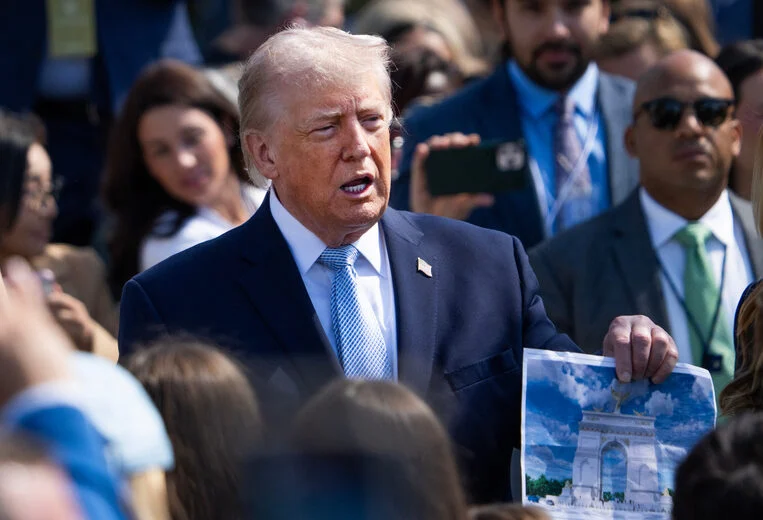
President Donald Trump announced on Sunday a significant shift in the operational scope of his proposed 250-foot Triumphal Arch, stating that the monument will now serve a dual purpose as a "top grade military complex." The announcement, made via a series of posts on Truth Social, marks a pivot from the project’s original conception as a purely commemorative structure to a fortified installation integrated into the national security infrastructure of the District of Columbia. According to the President, the decision to modify the project was made at the "strong request" of the United States military to address evolving security needs in the capital.
The proposed site for the structure is the Receptive Circle, a location adjoining the Arlington Memorial Bridge that serves as a symbolic gateway between the National Mall and Arlington National Cemetery. President Trump asserted that the facility would be peerless in its design and utility, claiming, "No facility like this anywhere in the World" currently exists. The transition to a military-centric model introduces several tactical features, including specialized housing for unmanned aerial vehicles (UAVs), designated positions for precision marksmen, and significant subterranean storage for munitions.
Strategic Integration and Military Capabilities
The revised plans for the Triumphal Arch detail a robust tactical layout designed to provide what the administration describes as "rapid response" capabilities. In his Sunday statement, President Trump specified that the complex would be equipped to "house, store, and have the rapid ability to use large numbers of drones." This focus on drone technology suggests the facility may serve as a central hub for localized aerial surveillance and defense within the capital’s restricted airspace.
In addition to its role as a drone port, the structure is slated to feature elevated platforms for snipers on both the roof and the surrounding plaza areas. The President also highlighted the inclusion of high-capacity storage facilities for "large quantities of sniper ammunition." While the administration has not yet released specific blueprints, the integration of these features into a 250-foot-tall arch suggests a multi-level interior capable of supporting active-duty personnel and long-term logistical operations.
The decision to militarize the monument appears to be a response to modern security threats that require elevated vantage points and localized rapid-deployment units. By placing these assets at the Arlington Memorial Bridge, the complex would command a strategic view of the Potomac River and the primary transit routes connecting Virginia to the heart of Washington, D.C.
Historical Context and Global Comparisons
The concept of a Triumphal Arch in Washington, D.C., is not entirely new, though the scale and military integration of the current proposal are unprecedented. President Trump noted that such a monument had been "planned since the Civil War Era many years ago," referencing historical discussions regarding the commemoration of Union victories. During the late 19th century, various architects proposed arches for the capital, though none reached the stage of formal authorization or construction on the scale currently envisioned.
In his communications, the President emphasized the lack of a major triumphal arch in the U.S. capital compared to other world powers. "Out of the 59 top cities and Capitals, Washington, D.C., IS THE ONLY ONE IN THE WORLD THAT DOES NOT HAVE A TRIUMPHAL ARCH," Trump wrote. He cited this as a primary motivation for the project, arguing that the new structure would be "by far, the greatest of them all."
Global precedents for such structures include the Arc de Triomphe in Paris, the Arch of Constantine in Rome, and the India Gate in New Delhi. However, these historic monuments are primarily ceremonial and do not house active military combat assets. The proposed D.C. arch would represent a significant departure from traditional architectural norms by blending the aesthetics of a classical monument with the functionality of a modern fortress.
Legal Challenges and Veteran Opposition
The project faces significant legal hurdles, most notably a lawsuit filed by a coalition of Vietnam veterans. The plaintiffs argue that the construction of a 250-foot arch at the Receptive Circle would irreparably damage the visual and historical integrity of the region. A primary concern cited in the litigation is the potential for the arch to block the iconic, unobstructed views of Arlington National Cemetery from the Lincoln Memorial and the Arlington Memorial Bridge.
The veterans’ group also contends that the administration has bypassed necessary legislative oversight. Under the Commemorative Works Act of 1986, any new monument on federal land in the District of Columbia requires specific Congressional authorization and must undergo a rigorous multi-agency approval process, including reviews by the National Capital Planning Commission (NCPC) and the Commission of Fine Arts (CFA). The lawsuit alleges that the President is attempting to move forward with excavation work without these requisite permissions.

"The sanctity of Arlington is found in its quietude and its vistas," a spokesperson for the veterans’ coalition stated in a recent press release. "Placing a massive military-industrial structure at its doorstep is an affront to those buried there."
Aviation Safety and the ‘Eternal Flame’ Requirement
In addition to legal and aesthetic concerns, the Federal Aviation Administration (FAA) has raised logistical issues regarding the height of the structure. Given its 250-foot stature and its proximity to the flight paths for Ronald Reagan Washington National Airport (DCA), the FAA announced on Friday that the arch must be equipped with permanent safety lighting.
To satisfy these requirements while maintaining the monument’s aesthetic, the FAA has mandated that a "flame" must remain lit at the top of the arch at all times. This would serve as a high-visibility beacon for pilots navigating the Potomac River corridor. The administration has reportedly integrated this requirement into the design, framing it as a "perpetual flame" that serves both a functional safety purpose and a symbolic role. However, critics have pointed out that a constant open flame of that scale presents its own set of environmental and maintenance challenges, particularly in high-wind conditions near the river.
Administration Admissions and Environmental Impact
The Trump administration has not denied that the project will significantly alter the capital’s landscape. In recent filings and public statements, officials have acknowledged that the Triumphal Arch would have "adverse effects" on the surrounding environment and the historic viewshed. However, the administration’s position is that these effects "cannot be fully avoided" if the goal of national security and the completion of a long-delayed historical monument are to be met.
A report from the Department of the Interior suggests that the construction would involve significant excavation at the Receptive Circle, potentially impacting the root systems of historic trees and the structural integrity of existing infrastructure near the bridge. The transformation of the plaza into a military zone would also likely result in permanent closures of certain pedestrian pathways, further changing the way tourists and residents interact with the area.
Timeline and Project Development
The timeline for the Triumphal Arch has moved rapidly since its initial proposal.
- Early 2025: Initial concept of a "Victory Arch" is introduced by the administration as part of a broader capital beautification project.
- Late 2025: The Receptive Circle is identified as the preferred location; preliminary designs are leaked showing a neoclassical structure.
- March 2026: Vietnam veterans’ groups file the first of several injunctions to halt the project.
- July 2026: Reports surface of subterranean surveys being conducted near the Arlington Memorial Bridge.
- September 18, 2026: The FAA issues its ruling on the mandatory safety flame.
- September 20, 2026: President Trump announces the conversion of the project into a "Military Complex," citing drone and sniper integration.
Broader Implications and Analysis
The decision to house snipers and drones within a public monument has sparked a debate among urban planners and civil liberties advocates. Critics argue that the project represents a "militarization of public space," turning a site of reflection and tourism into a tactical combat position. They point out that the presence of large quantities of ammunition in a high-traffic area could pose risks to public safety.
From a tactical perspective, some defense analysts suggest that the arch could fill a gap in the capital’s low-altitude defense grid. The ability to launch drones from a central, elevated location would provide rapid surveillance of the National Mall and the Pentagon. However, others question whether a stationary monument is the most effective platform for such technology, given the availability of existing government buildings and mobile units.
The political implications are equally significant. By framing the arch as a military necessity, the administration may be seeking to utilize national security provisions to bypass the standard, often lengthy, approval processes for commemorative works. If the project is classified as a military installation rather than a monument, it may fall under different regulatory jurisdictions, potentially complicating the legal efforts to stop it.
As the controversy continues, the Triumphal Arch stands as a symbol of a broader debate over the identity of the nation’s capital—whether it should remain a city defined by open, accessible monuments or evolve into a more fortified "command center" designed for the realities of 21st-century security. With construction equipment already reportedly moving toward the site, the coming weeks will likely see a decisive clash between the executive branch’s vision and the legal challenges mounted by those seeking to preserve the historic landscape of the Potomac.




 Yuyun Lusiyani
 Joko Widodo
 Eva Lovia
 Pevita Pearce