
 Eva Lovia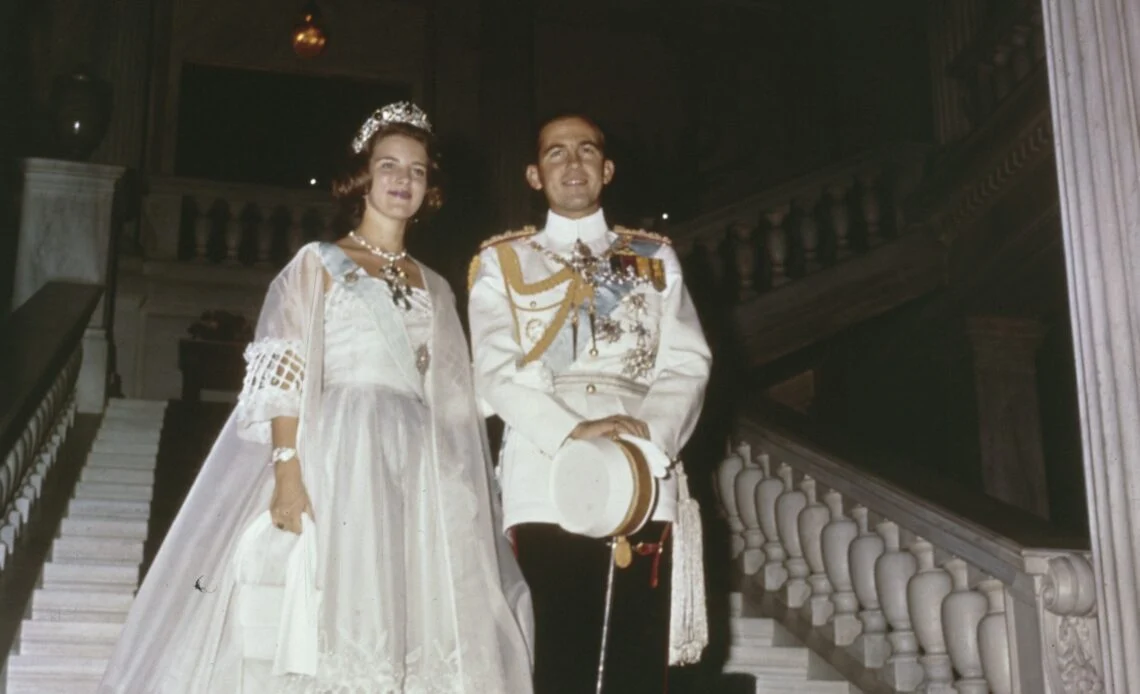
The opulent marriage of Crown Prince Constantine II of Greece and Princess Anne-Marie of Denmark on September 18, 1964, was far more than a union of two young royals; it was a pivotal moment that signaled the ascent of a new monarch and solidified a love story that would navigate the turbulent waters of politics and exile. This grand ceremony, held in the heart of Athens, drew together a constellation of European royalty, underscoring the significance of the event not only for the two nations involved but for the broader European monarchical landscape. The wedding, a spectacle of tradition and grandeur, marked the culmination of a courtship that had captured the imagination and set the stage for a reign that would be as dramatic as it was enduring.
The Genesis of a Royal Romance
The path to the altar for Constantine and Anne-Marie began five years prior, in 1959, during a State Visit by King Paul and Queen Frederica of Greece to Denmark. The young Crown Prince Constantine, the sole male heir to the Greek throne, found himself in the company of King Frederik IX and Queen Ingrid of Denmark, and their three daughters. It was during this visit that the seeds of a future connection were sown. While the initial encounter was formal, fate would intervene again. Two years later, in 1961, Constantine and Anne-Marie’s paths crossed once more in Denmark. The spark ignited then, and by May 1962, when Anne-Marie served as a bridesmaid to Constantine’s sister, Princess Sofia, in Athens, their mutual affection had blossomed into a profound romance. The Athenian setting, steeped in Hellenic history and royal tradition, became the backdrop for their burgeoning love.
The engagement was formally proposed by the then Crown Prince Constantine to the Danish princess during that summer of 1962. However, the paternal wisdom of King Frederik IX introduced a necessary pause. Still only sixteen, Anne-Marie was encouraged to complete her education before embarking on the responsibilities of marriage and a royal engagement. This decision reflected a commitment to ensuring that the young princess was adequately prepared for her future role, while also allowing the couple time to mature and for their engagement to be publicly announced with the appropriate gravitas.
The Announcement and Accelerated Plans
The official confirmation of the impending union arrived on January 23, 1963. A twenty-two-year-old Constantine traveled to Copenhagen for the momentous announcement. He appeared alongside his fiancée and her family on the balcony of the magnificent Amalienborg Palace, a symbol of Danish royal power. The initial plan was for the wedding to take place two years hence, in 1965. This timeline allowed for ample preparation and a period of public acclimatization to the news.
However, destiny had a swifter agenda. The sudden death of King Paul of Greece in March 1964 dramatically altered the course of events. His passing elevated the young Crown Prince Constantine to the throne, making him King Constantine II of Greece. This seismic shift in the Greek monarchy necessitated an acceleration of the wedding plans. The responsibilities of kingship now rested upon his shoulders, and his marriage, once envisioned for a future date, was brought forward to September of that same year, a mere six months after his accession. This compressed timeline added an element of urgency and perhaps a touch of bittersweetness to the preparations, as the young king navigated both the profound grief of losing his father and the immense pressures of his new role, alongside the joyous anticipation of his wedding.
A Week of Celebrations and Royal Attendance
In the week leading up to the September 18th ceremony, Princess Anne-Marie arrived in Greece, her new homeland. Her arrival was preceded by several days of festive celebrations held in Denmark, a testament to the warm regard in which she was held and the excitement surrounding her union with the Greek heir. These Danish festivities likely included public appearances, traditional music and dance, and gatherings with her extended family and the Danish populace, offering a final glimpse of her as a Danish princess before her transition to a Greek queen.
Upon her arrival in Athens, the celebrations continued, focusing on welcoming the royal couple and their distinguished guests. A lavish gala dinner was hosted at the Royal Palace a few days before the wedding, providing an opportunity for the assembled royalty and dignitaries to mingle and to celebrate the forthcoming marriage in a more intimate setting. This event would have been a crucial moment for diplomatic exchanges and the strengthening of international royal ties, with heads of state and their representatives engaging in conversations that extended beyond the personal joy of the occasion.
The Solemn Vows: A Metropolitan Cathedral Ceremony
On the day of the wedding, Princess Anne-Marie, radiant and poised, walked down the aisle of the Metropolitan Cathedral of the Annunciation in Athens, her father, King Frederik IX, by her side. The choice of this historic cathedral, a cornerstone of the Greek Orthodox faith, was deeply symbolic. Princess Anne-Marie had already undertaken the significant step of converting to the Greek Orthodox faith in preparation for her marriage, demonstrating her commitment to her future husband’s country and its religious traditions. This conversion was not merely a formality but a profound personal undertaking, aligning her spiritual life with her royal destiny in Greece.
The ceremony was a magnificent display of ecclesiastic and royal tradition, attended by approximately 1,200 guests. The guest list read like a who’s who of European royalty, highlighting the interconnectedness of the continent’s ruling families. Notable attendees included Prince Charles of Wales, representing the British monarchy; King Baudouin and Queen Fabiola of the Belgians; Queen Juliana of the Netherlands; King Olav V of Norway; and King Gustaf VI Adolf of Sweden. The presence of such esteemed figures underscored the political and cultural significance of the marriage, acting as a powerful statement of solidarity and continuity among European monarchies in a post-war era. The solemn vows exchanged within the hallowed walls of the cathedral echoed the weight of their responsibilities and the hopes vested in their union. Following the religious ceremony, the newlyweds and their guests proceeded to the Royal Palace for a grand reception, a continuation of the day’s festivities and a chance for further celebration and diplomatic engagement.
The Bride’s Ensemble: A Symphony of Danish Design and Heirloom Jewels
Princess Anne-Marie’s bridal attire was a masterpiece of elegance, reflecting both contemporary fashion and enduring family heritage. Her wedding gown was designed by the renowned Danish couturier Jorgen Bender. The creation featured a graceful rounded neckline, three-quarter length sleeves, and a flattering empire line waist that transitioned into a voluminous skirt. The skirt culminated in a train measuring an impressive twenty feet, adding a dramatic flourish as she moved through the cathedral. The choice of a Danish designer was a poignant nod to her heritage, weaving a thread of her homeland into the fabric of her new life.
The bride’s bouquet was a delicate arrangement, predominantly featuring lily of the valley. This sweet-scented flower carries a rich symbolic meaning in the language of flowers, signifying a "return to happiness," a sentiment that would have resonated deeply with the young couple embarking on their married life.
No royal bride’s ensemble is complete without a tiara, and Anne-Marie’s choice was steeped in family history and sentiment. She selected an exquisite all-diamond diadem that had belonged to her mother, Queen Ingrid. This particular tiara held a significant lineage, having been inherited by Queen Ingrid from her own mother, Princess Margaret of Connaught, following Margaret’s untimely death in 1920. The tiara, a gift to Princess Margaret from the Khedive of Egypt upon her marriage in 1905, is adorned with intricate swirling scrolls of diamonds. It had become a cherished heirloom, worn by all of Queen Ingrid’s female descendants on their wedding days, thus connecting Anne-Marie to generations of royal women.
Further enhancing this connection to her maternal lineage, Anne-Marie wore another treasured family heirloom that linked her directly to her grandmother, Princess Margaret, whom she never had the opportunity to know. The tiara secured in place an Irish lace veil, a piece of exquisite craftsmanship that Princess Margaret had worn at her own wedding. This veil had subsequently been chosen by her daughter, Queen Ingrid, for her wedding attire, creating a beautiful continuity of tradition and a tangible link across generations. These carefully chosen elements of her bridal look were not merely decorative but served as powerful symbols of her heritage, her family’s enduring legacy, and her deep connection to her roots.
A Honeymoon Interrupted: The Onset of Political Turmoil
Following the wedding and the subsequent reception, the newly crowned King Constantine II and Queen Anne-Marie embarked on their honeymoon, a period of idyllic respite in Corfu. This island paradise offered a tranquil escape, allowing the young couple to begin their married life away from the public gaze and the pressures of their royal duties. The early days of their honeymoon were likely filled with the joy and intimacy of a newlywed couple, a fairytale beginning to their shared journey.
However, the reality of their responsibilities and the volatile political climate of Greece loomed large. Upon their return to the mainland, the couple was immediately confronted with significant political unrest. King Constantine II’s reign was to be characterized by a series of tumultuous events, marked by political instability and significant challenges to his authority. These pressures would ultimately lead to a period of profound personal and political difficulty, culminating in the family’s exile from Greece. Despite the eventual hardships and the forced departure from their homeland, the royal wedding itself remains a luminous moment, a testament to a love that was forged amidst the splendor of tradition and the weight of destiny. Their story, from the grandeur of their wedding to the resilience they demonstrated through exile, continues to captivate, embodying a compelling narrative of love, duty, and the enduring power of the human spirit in the face of adversity. The enduring nature of their bond, which continued until Constantine’s passing in early 2023, stands as a profound testament to the strength of their commitment, a love story that weathered storms and remained a constant in their extraordinary lives.




 Yuyun Lusiyani
 Joko Widodo
 Jia Lissa
 Pevita Pearce
 admin
admin
