
 Jia Lissa
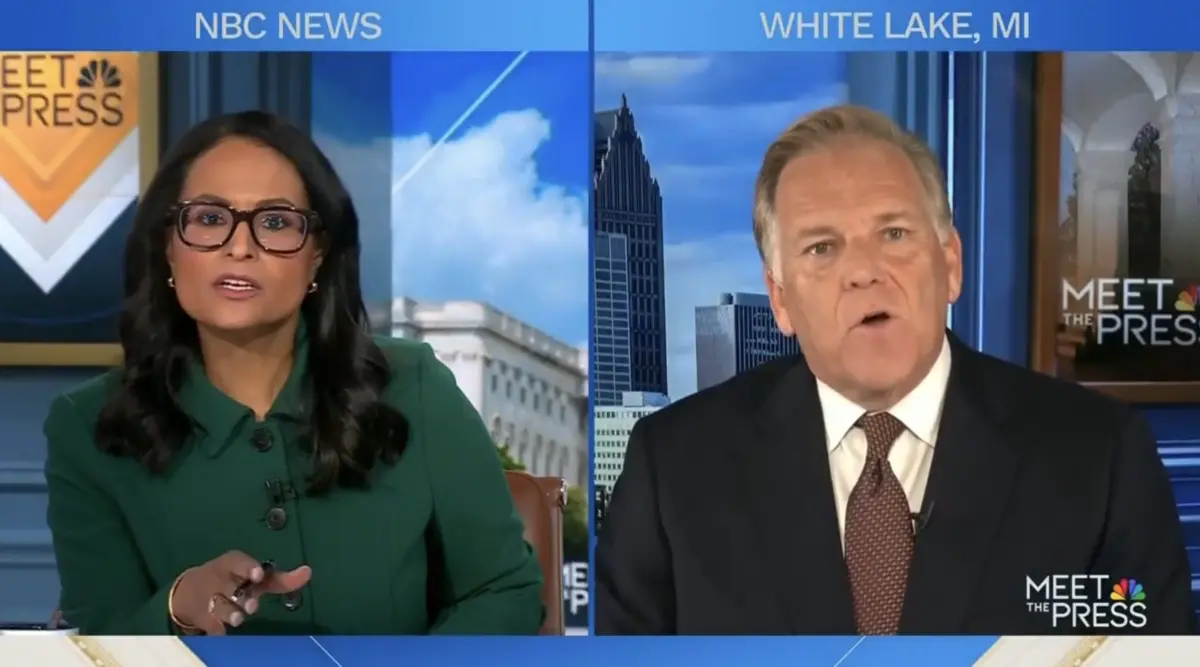
The political landscape in Michigan, a critical battleground state in the 2024 general election, reached a point of heightened tension this Sunday as former Congressman and Republican Senate candidate Mike Rogers appeared on NBC’s Meet the Press. During a pointed exchange with moderator Kristen Welker, Rogers repeatedly declined to clarify whether he considers himself a "MAGA Republican," a term synonymous with the political movement led by former President Donald Trump. The interview, which quickly gained national attention, highlighted the delicate balancing act Republican candidates must perform in swing states: maintaining the support of the Trump-aligned base while appealing to a broader, more moderate general electorate.
The confrontation began when Welker asked a direct question regarding Rogers’ political identity, specifically inquiring if he identified with the "Make America Great Again" (MAGA) label. Rogers, who has received a high-profile endorsement from Donald Trump, opted not to provide a "yes" or "no" answer. Instead, he shifted the focus of the conversation toward internal divisions within the Democratic Party and local issues affecting Michigan voters in cities like Detroit, Flint, and Pontiac. This strategic pivot resulted in a series of interruptions and a visible sense of frustration from both the interviewer and the candidate, underscoring the high stakes of the Michigan Senate race.
The Meet the Press Exchange: A Study in Political Deflection
The core of the controversy centered on a brief but intense window of the broadcast where Welker pressed Rogers on his ideological alignment. "Let me just ask you, big picture, do you consider yourself to be a MAGA Republican?" Welker asked. Rogers responded by criticizing the nature of national media coverage rather than addressing the label. "Listen, I’m going to tell you something," Rogers replied. "I get you guys on the national press, but this is a little bit disgusting to me. You know what you don’t cover? The chairman of the Democrat Party just came out and said he cannot… vote for [Abdul El-Sayed]. This current senator’s Finance chairman came out and said, ‘I can’t vote—’"
Welker interjected to redirect the candidate, stating, "Congressman, I’m asking you about you." Rogers maintained his stance, arguing that the focus should be on the coalitions he is building within the state. He claimed that Jewish Democrats and African American voters in urban centers are increasingly alienated by the current Democratic platform, suggesting that his campaign is focused on these "fastest-growing coalitions" rather than national political labels.
When Welker asked for a third time, "Are you a MAGA Republican?" Rogers claimed he had already answered the question, despite not having used either the term "MAGA" or "Republican" in direct reference to his personal identity during that segment. He concluded by inviting Welker to Michigan to speak with voters, asserting that the national press has a "very different opinion" of the state’s political climate than what is reflected on the ground.
Background and Evolution of Mike Rogers’ Political Career
To understand the significance of this exchange, one must look at Mike Rogers’ long history in Michigan and national politics. Rogers served in the U.S. House of Representatives from 2001 to 2015, representing Michigan’s 8th congressional district. During his tenure, he rose to become the Chairman of the House Intelligence Committee, where he earned a reputation as a traditional "hawk" on national security and foreign policy.
Following his retirement from Congress, Rogers was at times a vocal critic of Donald Trump. In the aftermath of the 2020 election and the events of January 6, 2021, Rogers expressed concerns about the direction of the Republican Party and the rhetoric used by the former President. However, as he entered the race for the U.S. Senate seat being vacated by retiring Democrat Debbie Stabenow, Rogers’ stance shifted. In March 2024, Donald Trump officially endorsed Rogers, a move seen as an effort to consolidate the Republican field and avoid a bruising primary.
This endorsement was a turning point for the Rogers campaign. It effectively cleared the path for him to become the GOP frontrunner, but it also tethered him to Trump’s polarizing brand in a state where Trump’s favorability has fluctuated significantly. By refusing to adopt the MAGA label on Sunday, Rogers appeared to be attempting to retain the benefits of Trump’s endorsement without alienating the suburban and independent voters who may be wary of the MAGA movement.
Michigan’s Political Climate and Polling Data
The electoral math in Michigan is notoriously complex. While Trump won the state in 2016, he lost it to Joe Biden in 2020. Current data suggests that the state remains a toss-up, but some metrics indicate a difficult path for Trump-aligned candidates. Recent polling cited during the discussion suggests that Donald Trump is roughly 27 points "underwater" in Michigan, meaning his unfavorable ratings significantly outweigh his favorable ones among the general population.
However, the Republican Party sees an opportunity in the Senate race due to the retirement of Senator Debbie Stabenow, a fixture in Michigan politics for decades. The likely Democratic nominee, Congresswoman Elissa Slotkin, is a formidable fundraiser with a background in the CIA and a reputation as a moderate. For Rogers to be competitive, he must perform well in the "tri-county" area around Detroit (Oakland, Macomb, and Wayne counties), where moderate voters often decide the outcome of statewide elections.
The Rogers campaign is betting that economic concerns, particularly those related to the automotive industry and inflation, will outweigh concerns about political labels. By mentioning Detroit, Flint, and Pontiac during the interview, Rogers was signaling a focus on the "kitchen table" issues that resonate with blue-collar workers, a demographic that both parties are fighting to claim.
Timeline of the 2024 Michigan Senate Race
The road to the November election has been marked by several key developments:
- January 2023: Senator Debbie Stabenow announces she will not seek re-election, creating the first open Senate seat in Michigan in a decade.
- August 2023: Mike Rogers officially enters the race, returning to Michigan after living in Florida for several years.
- March 2024: Donald Trump posts on Truth Social, giving Rogers a "Full and Total Endorsement," praising his background in the FBI and his "toughness."
- May 2024: Other Republican contenders, including former Representative Peter Meijer, exit the race, leaving Rogers as the clear favorite for the GOP nomination.
- June 2024: Rogers appears on Meet the Press, where the "MAGA" label becomes a central point of contention.
Analysis of Implications for the General Election
The refusal of a Trump-endorsed candidate to embrace the MAGA label is a calculated risk. For Rogers, the primary goal is to avoid being "pigeonholed" by Democratic attack ads that seek to paint him as an extremist. By focusing on Democratic "disarray"—specifically mentioning the "Uncommitted" movement and dissatisfaction among Jewish and Black voters—Rogers is attempting to go on the offensive.
Political analysts suggest that Rogers’ strategy mirrors that of other Republican candidates in swing states, such as Dave McCormick in Pennsylvania or Sam Brown in Nevada. These candidates often accept Trump’s endorsement to secure the base but focus their public messaging on the economy, border security, and "common sense" governance.
However, the "Meet the Press" interview demonstrates the difficulty of maintaining this distance. In a media environment that demands ideological clarity, a candidate’s refusal to answer a direct question can often become the story itself. Democrats are likely to use the footage of Rogers "waffling" to argue that he is either hiding his true allegiances or is too politically opportunistic to stand by his endorsements.
Broader Impact on the GOP National Strategy
The Michigan Senate race is one of a handful of contests that will determine control of the U.S. Senate in 2025. Republicans currently need a net gain of just two seats (or one, if they win the presidency) to take the majority. With West Virginia almost certain to flip Republican, Michigan represents a top-tier pickup opportunity.
The national Republican Party, through the National Republican Senatorial Committee (NRSC), has been supportive of Rogers’ "big tent" approach. They recognize that winning in the Rust Belt requires a candidate who can speak to the concerns of union workers and suburban parents simultaneously. The challenge for Rogers remains whether he can successfully navigate the "MAGA" shadow without losing the enthusiasm of the very voters Donald Trump brought into the party.
As the campaign progresses toward the August primary and the November general election, Mike Rogers will likely continue to face questions about his relationship with Donald Trump. His performance on Sunday suggests a campaign strategy centered on redirection and a focus on local Michigan grievances, even as the national political climate remains focused on the identity and future of the Republican Party. Whether this strategy will resonate with a diverse Michigan electorate remains to be seen, but it undoubtedly sets the stage for one of the most watched and expensive Senate races in the country.


 Nila Kartika Wati

 Eva Lovia

 Lina Irawan

 Yuyun Lusiyani

 Ana Megawati

 Joko Widodo
