
 Jia Lissa
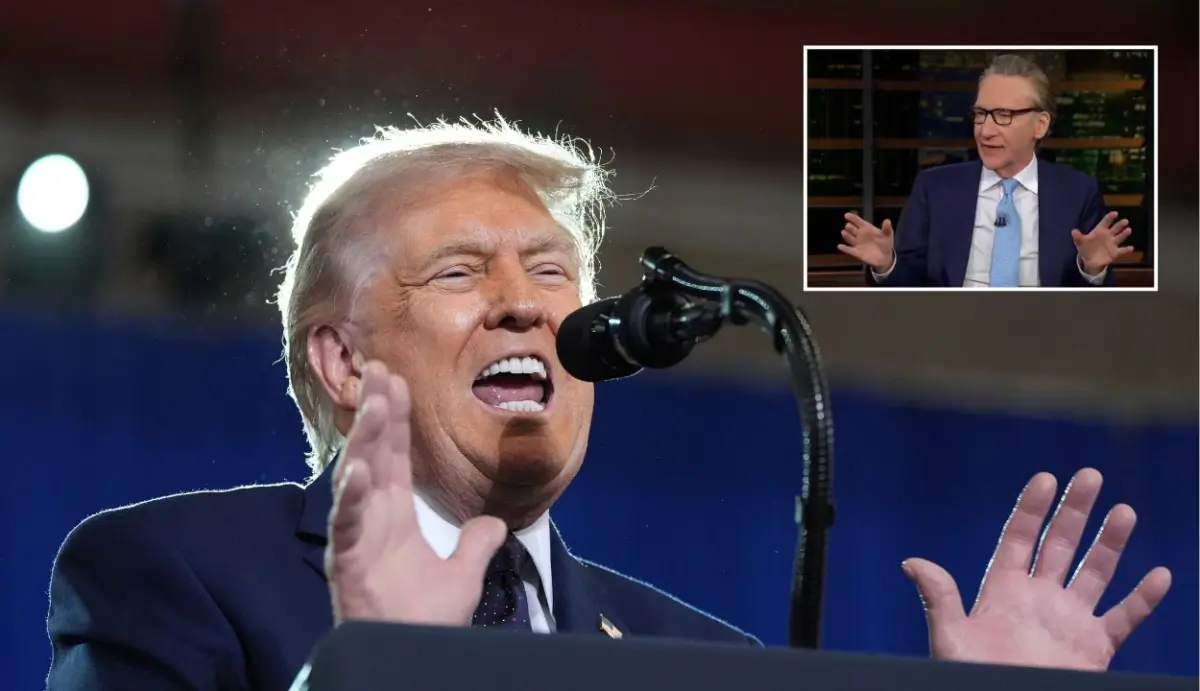
President Donald Trump issued a comprehensive and sharply worded 1,323-word statement on Truth Social late Sunday night, targeting veteran comedian and HBO host Bill Maher. The diatribe, which characterized Maher as a "loser," a "major POTHEAD," and a "dumb SLEAZEBAG," arrived just two days after Maher used his program, Real Time with Bill Maher, to defend his recent dinner with the President at the White House. This meeting marked the second such engagement between the two figures since Trump’s return to the presidency in early 2025, signaling a volatile and increasingly public rift between the Commander-in-Chief and one of late-night television’s most prominent political commentators.
The social media post serves as a significant escalation in the long-standing, often contradictory relationship between Trump and Maher. Despite their historical ideological opposition, the two have engaged in private dialogues that Maher has described as "productive" and "measured." However, the President’s latest communication suggests that the window for such civil discourse may have closed, as he explicitly instructed Maher to cease further contact and directed Republican officials to avoid appearing on his HBO program.
The Catalyst: A Defense of Dialogue and Ensuing Criticism
The immediate spark for the President’s late-night response was the October 23 episode of Real Time, during which Maher addressed the backlash he received from his liberal audience regarding his hospitality toward the President. Maher, who has frequently criticized Trump’s policies while simultaneously attacking "woke" culture, defended his decision to dine with the President alongside ESPN personality Stephen A. Smith and musician Kid Rock.
"Yeah, I did it again, b*tches! I know! I’m the bad guy because I go and say face-to-face to the man the things you write in articles he’ll never read," Maher told his studio audience. He further characterized the President as a "gracious" host who "never interrupts" and "listens" when engaged in private conversation. Maher argued that maintaining a line of communication with the executive branch was essential for a healthy democracy, regardless of political disagreements.
Despite Maher’s praise for the President’s personal demeanor during the meal, other segments of the show drew Trump’s ire. Specifically, the President took issue with Maher’s skepticism regarding claims of widespread illegal voting in California and his critiques of the administration’s stance on international nuclear policy.
A Chronology of the Trump-Maher Relationship
The relationship between Donald Trump and Bill Maher spans several decades, rooted in the New York media landscape and the rise of reality television. In his Sunday post, Trump highlighted the role of Chuck LaBella, a former associate on The Apprentice and a current associate of Maher, as a primary intermediary. Trump alleged that LaBella had been "nonstop" in his efforts to facilitate meetings between the two, claiming that Maher "desperately" wanted the President to appear on his show—a request Trump stated he has repeatedly denied.
The first significant meeting of the current term occurred in late 2025, shortly after Trump’s inauguration. Following that initial dinner, Maher offered a surprisingly balanced review of the encounter, which Trump nonetheless met with digital criticism. The pattern repeated itself this month. Following the second dinner, which reportedly lasted approximately two hours, Maher again praised the President’s listening skills while interviewing former White House Press Secretary Karoline Leavitt.
Trump’s response on Sunday, however, painted a vastly different picture of the encounter. He alleged that Maher appeared "nervous," "insecure," and "drunk," even claiming the comedian had "alcohol in his hand as he walked through the White House." Trump further asserted that he only agreed to the meetings because of the persistence of LaBella and Kid Rock, ultimately concluding that the sessions were a "waste of time."
Specific Policy Grievances and Fact-Checking Claims
A substantial portion of the President’s 1,323-word post was dedicated to rebutting Maher’s on-air assertions regarding election integrity and foreign policy. Trump focused heavily on California, a state he described as "Radical controlled, decrepit, and devastated." He claimed that "20,000" illegal voters had been discovered in recent days and suggested the number could eventually exceed one million.
While the President did not provide specific documentation for these figures, they align with his administration’s broader narrative regarding the 2024 and 2026 election cycles. California election officials have historically maintained that their systems are secure, noting that while administrative errors in voter rolls can occur, there is no evidence of mass illegal voting on the scale described by the President.
Additionally, Trump defended his administration’s withdrawal from the Iran nuclear deal, a move Maher has frequently criticized as destabilizing. Trump argued that his policies prevented Iran from obtaining a nuclear weapon, stating that the world would be a "different place" had he not acted.
The President also challenged Maher’s reporting on internal Republican polling. While Maher suggested that Trump’s influence within the GOP might be waning, Trump cited CNN polling—which he noted came from a network "not exactly in love with me"—showing his support within the party at 98% to 99%. He further referenced commentary from CNN’s Harry Enten, who reportedly described him as the "most influential President of the last century."

The "Laugh Machine" and Media Criticism
Beyond policy, Trump’s critique extended to the technical production of Real Time. He accused Maher of using a "Laugh Machine" to simulate audience approval for jokes he deemed "not funny." This accusation taps into a broader critique of late-night comedy, which the President and his supporters often view as an extension of the Democratic Party’s messaging apparatus.
"Also, turn your Laugh Machine off," Trump wrote. "It’s a joke when they laugh uncontrollably, even when you say nothing funny."
The President’s criticism of HBO itself was also notable. He described the network as having once been a "Network of Quality and Excitement" that is no longer "HOT." This reflects a recurring theme in Trump’s media criticism, where he frequently laments the perceived decline of traditional media institutions that do not offer him favorable coverage.
Official Responses and Implications for Future Discourse
The President concluded his statement by announcing a shift in strategy regarding Republican engagement with Maher’s program. He stated that he would discourage members of the GOP from appearing on Real Time, arguing that doing so grants Maher a "transformative" status he does not deserve.
"I’m going to have the Republicans not cover you anymore," Trump declared, labeling the show "nothing more than FAKE NEWS."
This directive could have significant implications for the show’s format. Real Time has long branded itself as a venue for cross-partisan debate, frequently hosting conservative lawmakers, strategists, and journalists. If the President’s directive is followed by the Republican National Committee and individual members of Congress, it could result in a more homogenous guest list, potentially altering the show’s appeal to moderate and independent viewers.
Karoline Leavitt, who was a guest on the episode that prompted the rant, was praised by the President for her performance but was also described as being put in an "uncomfortable" position. "She defended me, and herself, so well, but couldn’t be comfortable going against Lie after Lie," Trump noted.
As of Monday morning, Bill Maher has not issued a formal response to the President’s Truth Social post. Historically, Maher has used such attacks as comedic fodder for his opening monologues, often leaning into the "feud" to drive viewership. However, given the personal nature of the President’s latest comments—specifically the allegations of intoxication and the "POTHEAD" label—the tone of Maher’s response may shift.
Analysis of the Broader Political Impact
The public breakdown of the Trump-Maher "truce" illustrates the persistent difficulties in maintaining civil discourse between the executive branch and the media in a polarized era. While Maher’s attempt to engage in "dinner table diplomacy" was initially seen as a rare bridge across the political divide, the President’s reaction suggests that such bridges remain fragile.
From a strategic standpoint, the President’s attack serves to solidify his base by reinforcing his opposition to the "Hollywood elite" and the "liberal media." By targeting Maher specifically, Trump is engaging with a critic who possesses significant influence among independent-minded voters who may be weary of traditional partisan rhetoric.
Conversely, for Maher, the President’s ire provides a form of validation. In the current media climate, being "attacked from both sides"—by liberals for having the dinner and by Trump for the subsequent show—often serves to bolster a commentator’s brand as an independent voice.
The President’s decision to ban Republican appearances on the show, if enforced, would represent a return to a more siloed media environment. It remains to be seen whether high-profile Republicans, many of whom value the platform Maher provides for reaching a non-traditional audience, will adhere to the President’s request. In the meantime, the 1,323-word rant stands as one of the most detailed and aggressive critiques of a media figure ever issued from the White House, ensuring that the tension between the administration and late-night television will remain a central fixture of the national conversation.


 Nila Kartika Wati

 Eva Lovia

 Lina Irawan

 Yuyun Lusiyani

 Ana Megawati

 Joko Widodo
