
 Jia Lissa
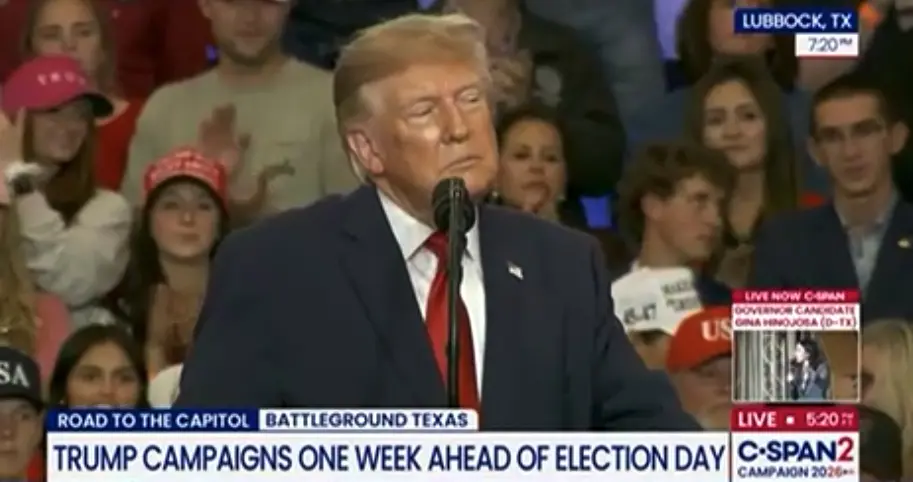
President Donald Trump, addressing a capacity crowd during a campaign rally in Lubbock, Texas, on Tuesday night, proposed a unconventional strategy for filling future vacancies on the United States Supreme Court by suggesting he would nominate Senator Ted Cruz (R-TX) to the high court. The President’s remarks, characterized by his signature blend of political commentary and humor, centered on the belief that Senator Cruz’s unique standing among his colleagues in the upper chamber would guarantee a unanimous confirmation vote, albeit for reasons that highlight the deep-seated interpersonal tensions within the halls of Congress.
The proposal comes at a time of heightened scrutiny regarding the future composition of the Supreme Court, despite the lack of an immediate vacancy. While the President’s comments were met with cheers from the Texas audience, they underscored a broader conversation about the ideological trajectory of the judiciary and the increasingly contentious nature of the Senate confirmation process. President Trump noted that during his first term, he successfully appointed three conservative justices—Neil Gorsuch, Brett Kavanaugh, and Amy Coney Barrett—a feat he described as one of the most challenging yet significant aspects of his presidency.
The Strategy of Unanimous Confirmation
During the rally, President Trump explained his reasoning for considering Senator Cruz for a potential future opening on the Court. He framed the hypothetical nomination as a pragmatic solution to the partisan gridlock that has defined judicial confirmations over the last decade. Trump praised Cruz’s legal acumen, citing his academic background and professional credentials as a "brilliant lawyer" who graduated at the top of his class and possesses "top credentials." However, the crux of the President’s argument rested on the senator’s reputation among his peers.
"I have an answer to not being able to get it past the Democrats or the Republicans together," Trump told the crowd. "I would pick Ted Cruz to be the next Supreme Court justice. And I wouldn’t have to worry about it. I wouldn’t even have to make a phone call."
The President elaborated on this theory by suggesting that the personal animosity toward Cruz from both sides of the aisle would serve as a catalyst for a swift confirmation. "The Democrats will 100% vote for it because they hate the guy and they want to get rid of him," Trump remarked. "And the Republicans would 100% vote for it because they can’t stand him. They would like to get rid of him. So, I’d get 100% of the vote, and he would be a Supreme Court justice and he’d do a great job."
A Career Defined by Constitutional Jurisprudence
While the President’s remarks focused on the political mechanics of the Senate, legal analysts note that Senator Ted Cruz possesses a resume that, on paper, aligns with the profiles of many historical Supreme Court nominees. Before his election to the Senate in 2012, Cruz served as the Solicitor General of Texas from 2003 to 2009. In that role, he argued nine cases before the U.S. Supreme Court, making him one of the most experienced appellate advocates in the country.
Cruz’s legal background is rooted in elite institutions; he earned his undergraduate degree from Princeton University and his Juris Doctor from Harvard Law School. Following law school, he served as a law clerk for Judge J. Michael Luttig of the U.S. Court of Appeals for the Fourth Circuit and later for Chief Justice William Rehnquist of the U.S. Supreme Court. As a member of the Senate Judiciary Committee, Cruz has been a leading voice in the vetting of judicial nominees, often championing originalist and textualist interpretations of the Constitution.
Despite these qualifications, his tenure in the Senate has been marked by a combative style that has frequently alienated both political opponents and members of his own party. This reputation was famously summarized in 2016 by Senator Lindsey Graham (R-SC), who remarked, "If you killed Ted Cruz on the floor of the Senate, and the trial was in the Senate, nobody could convict you."
The Context of the High Court and Potential Vacancies
The President’s comments regarding a Cruz nomination are currently speculative, as there are no active vacancies on the Supreme Court. However, the political landscape is heavily influenced by the possibility of future retirements. Much of the recent speculation has centered on Justice Samuel Alito, a stalwart of the Court’s conservative wing.
Earlier this year, rumors circulated that the 74-year-old Alito might consider stepping down to allow a younger conservative successor to be confirmed while Republicans hold a favorable position in the Senate. Legal observers have pointed to the 2026 midterm elections as a potential pivot point. If Democrats were to regain control of the Senate, the window for a smooth conservative confirmation would likely close, potentially prompting a "lame duck" retirement scenario.
Justice Alito, however, has publicly signaled his intention to remain on the bench. Sources close to the Court indicate that Alito remains committed to his judicial duties and is resistant to pressure campaigns aimed at timing his retirement for political expediency. The precedent set by the late Justice Ruth Bader Ginsburg, who faced similar calls to retire during the Obama administration, serves as a cautionary tale for those attempting to forecast judicial transitions.
The Evolution of the Confirmation Process
The "unanimous" confirmation Trump joked about stands in stark contrast to the reality of the modern Senate. The era of justices being confirmed with 90 or more votes—such as Antonin Scalia (98-0) or Anthony Kennedy (97-0)—is largely considered over. The confirmation of Justice Clarence Thomas in 1991 (52-48) signaled the beginning of a more polarized era, which reached a fever pitch during the 2018 confirmation of Brett Kavanaugh (50-48).
President Trump’s three appointments were achieved through the use of the "nuclear option," a parliamentary procedure that allowed the Senate to override the 60-vote filibuster threshold for Supreme Court nominees with a simple majority. This change has fundamentally altered the strategy of both the White House and Senate leadership, making the ideological purity of a nominee more important than their broad bipartisan appeal.
In this environment, a nominee like Ted Cruz would represent a lightning rod for controversy. While Trump’s theory suggests Democrats would vote for him to remove him from the Senate, historical precedent suggests that the ideological impact of a lifetime appointment to the Supreme Court far outweighs the temporary benefit of removing a political rival from the legislative branch.
Broader Political and Legal Implications
The mention of Senator Cruz highlights the ongoing influence of the Federalist Society and other conservative legal organizations in shaping the President’s judicial shortlist. Cruz has long been a favorite of the conservative grassroots, and his elevation to the Court would likely solidify a 6-3 (or potentially 7-2) conservative majority for decades.
From a jurisprudential standpoint, a Justice Cruz would likely be a staunch defender of the "Major Questions Doctrine," a legal theory used to limit the power of federal agencies. He has also been a vocal proponent of expansive Second Amendment rights and strict limits on federal spending power. His presence on the Court would likely accelerate the current trend of revisiting long-standing precedents, a movement that gained significant momentum with the Dobbs v. Jackson decision in 2022.
Furthermore, the President’s remarks in Lubbock serve a dual purpose: they energize his base in a key Republican stronghold and signal to the Senate that he intends to remain aggressive in his judicial philosophy. By floating the name of a sitting senator, Trump also reminds the legislative branch of his willingness to disrupt traditional norms.
Official Responses and Congressional Reaction
While Senator Cruz has not issued a formal statement regarding the President’s latest comments, he has previously expressed both an interest in the high court and a commitment to his current role in the Senate. In past interviews, Cruz has stated that while he is honored to be considered, he believes he can be "most effective" fighting for constitutional principles within the legislative branch.
Democratic leadership has largely dismissed the President’s comments as rally rhetoric. However, aides to Senate Minority Leader Chuck Schumer have previously noted that any nominee with Cruz’s ideological profile would face "the most rigorous opposition possible." The suggestion that Democrats would vote for Cruz simply to remove him from the Senate is viewed by many in Washington as a humorous exaggeration rather than a viable political forecast.
Conclusion and Future Outlook
As the 2024 political cycle intensifies, the future of the federal judiciary remains a central issue for voters. President Trump’s assertion that he could achieve a 100% confirmation vote for Ted Cruz, while delivered with a sense of irony, underscores the deep fractures within the U.S. government. Whether or not a vacancy arises, the discussion highlights the high stakes involved in judicial appointments and the unconventional strategies the executive branch may employ to navigate a divided Congress.
The Supreme Court currently maintains a stable bench, but the history of the institution suggests that change can occur unexpectedly. Until a vacancy is officially announced, the names on the President’s shortlist—including those mentioned in the heat of a Texas rally—remain a subject of intense speculation and a reflection of the broader battle for the soul of the American legal system. For now, Senator Cruz remains one of the most influential and polarizing figures in the Senate, while the Supreme Court continues to navigate a term filled with landmark cases that will test the very constitutional principles Cruz has spent his career defending.



 Nila Kartika Wati

 Eva Lovia

 Lina Irawan

 Yuyun Lusiyani

 Ana Megawati

 Joko Widodo
