
 Jia Lissa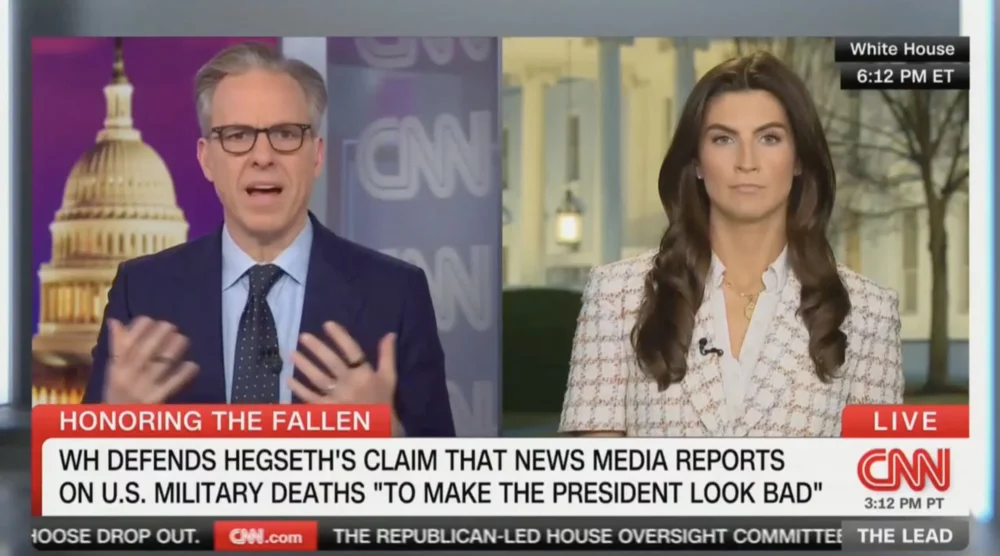
The intersection of military reporting and political communication reached a point of intense friction on Wednesday as CNN anchor Jake Tapper issued a stinging rebuke of high-ranking Trump administration officials. The conflict centers on the White House’s assertion that the news media is emphasizing the deaths of American service members in Iran primarily to damage the political standing of President Donald Trump. During a broadcast of The Lead, Tapper characterized these claims as the height of solipsism and narcissism, arguing that such a perspective fundamentally misconstrues the purpose of journalism and disrespects the families of the fallen.
The controversy began following a series of statements from White House Press Secretary Karoline Leavitt and Secretary of Defense Pete Hegseth. Both officials suggested that the recent surge in media coverage regarding American casualties in the Middle East was motivated by partisan bias rather than a commitment to public information. Tapper, joined by Chief White House Correspondent Kaitlan Collins, devoted a significant portion of Wednesday’s program to addressing what he described as a warped way of looking at the world, particularly as it relates to the reporting of military sacrifice.
The Evolution of Operation Epic Fury and Rising Casualties
The current tension is rooted in the escalating military activity within the Iranian theater. On Saturday, the Trump administration launched a significant military initiative designated as Operation Epic Fury. The operation, described by the Pentagon as a strategic effort to neutralize immediate threats to U.S. interests and allies in the region, has resulted in high-intensity engagements. Since the commencement of the operation, at least six American service members have been confirmed killed in action.
The loss of life has prompted a wave of national reporting, as news outlets fulfill their traditional role of documenting the human cost of foreign policy decisions. However, the administration’s reaction to this coverage has been one of vocal pushback. Secretary of Defense Pete Hegseth, during a Pentagon briefing on Wednesday, initially leveled the accusation that the media was treating these deaths as "front-page news" specifically to undermine the Commander-in-Chief. Hegseth asserted that the focus on casualties was disproportionate and intended to create a narrative of failure surrounding the ongoing operation.
This sentiment was echoed hours later by Karoline Leavitt during a White House press briefing. When questioned by Kaitlan Collins about the administration’s stance on the reporting of fallen troops, Leavitt maintained that there was a concerted effort by the press to weaponize military deaths against the President.
Chronology of the Dispute
The timeline of the verbal exchange highlights a rapidly deteriorating relationship between the press corps and the administration’s communications team regarding national security reporting.
On Wednesday morning, Secretary Hegseth addressed reporters at the Pentagon. His remarks focused on the tactical successes of Operation Epic Fury, but he quickly pivoted to criticize the media’s focus on American fatalities. He argued that Iran is not a "fair fight" and that the U.S. military is currently "punching them while they’re down," suggesting that the focus should remain on American dominance rather than American losses.
By Wednesday afternoon, the focus shifted to the White House. During the daily briefing, Kaitlan Collins challenged Karoline Leavitt on Hegseth’s earlier comments. Leavitt doubled down, claiming there was "a lot of misreporting" and that the media’s framing of the Iran conflict was inherently biased. She suggested that the emphasis on the six dead service members was a tactical choice by news organizations to create a negative public perception of the Trump administration’s foreign policy.
On Wednesday evening, Jake Tapper responded directly to these claims on CNN. Tapper first utilized social media to release a video statement before expanding on his critique during his live broadcast. He reiterated that the duty of the press to report on the deaths of service members is a sacred responsibility that transcends whoever occupies the Oval Office.
Statistical Context and Historical Precedents in Casualty Reporting
The reporting of military casualties has historically been a point of contention between the government and the press, but Tapper’s critique highlights a perceived shift in how the current administration views this transparency. Data from the Department of Defense indicates that casualty reporting is a standardized procedure, with the identities of the fallen typically released 24 hours after the notification of next of kin.
In previous conflicts, such as the wars in Iraq and Afghanistan, media outlets consistently prioritized the names and stories of the fallen. For example, during the 2021 withdrawal from Afghanistan, the deaths of 13 service members at Abbey Gate received exhaustive coverage across all major networks. At that time, many critics of the Biden administration—including some who are now part of the current administration—argued that such coverage was essential for holding the government accountable.
Tapper pointed out this inconsistency, noting that the media’s obligation to the public remains the same regardless of the political party in power. He argued that the suggestion that journalists only care about fallen soldiers when it serves a political agenda is an insult to the profession and, more importantly, to the military community.
Analysis of "Solipsism and Narcissism" in Political Rhetoric
Tapper’s choice of the words "solipsism" and "narcissism" suggests a deeper concern regarding the administration’s worldview. In a journalistic context, solipsism refers to a perspective where the only thing that matters or exists is one’s own self-interest or point of view. By applying this to Leavitt and Hegseth, Tapper is arguing that the administration is viewing a national tragedy—the death of soldiers—exclusively through the lens of how it affects their own political image.
"It really is the height of solipsism and narcissism to think that our coverage of fallen warriors has anything to do with our—how we cover a president," Tapper stated during the broadcast. He contended that the administration’s reaction suggests they believe the media is the protagonist in a political drama, rather than a chronicler of reality.
This rhetoric marks a significant escalation in the tension between the executive branch and the Fourth Estate. While previous administrations have complained about "negative" coverage, the accusation that reporting on combat deaths is a coordinated political hit job represents a departure from traditional norms of civil-military-press relations.
Impact on Gold Star Families and the Military Community
Beyond the political back-and-forth, Tapper emphasized the human element of the controversy. He argued that the administration’s comments were "offensive" to the families of the six service members killed in Iran. For Gold Star families, the public recognition of their loved one’s sacrifice is often a critical part of the grieving and honoring process.
Tapper suggested that by dismissing the coverage as a political ploy, the administration was effectively devaluing the lives of the soldiers themselves. "I don’t care what they think about us," Tapper said, referring to the administration’s view of the media. "It’s so offensive to the families who deserve coverage."
He further argued that, if anything, the American media and the nation at large do not pay enough attention to the sacrifices made by the volunteer force. He posited that the coverage of fallen veterans should be more robust, regardless of which president is in the "building behind" the reporters. This sentiment touches on a long-standing debate within the veteran community regarding the "civil-military divide," where a small percentage of the population bears the entire burden of the nation’s wars while the rest of the country remains largely disconnected from the consequences.
Broader Implications for National Security and Press Freedom
The clash between Tapper and the Trump administration officials raises critical questions about the future of national security reporting. If the administration continues to frame the reporting of military losses as an act of political hostility, it could lead to increased secrecy or attempts to restrict the flow of information from combat zones.
Journalistic organizations argue that transparency in military operations is essential for a functioning democracy. Without accurate reporting on the costs of war—both financial and human—the public cannot make informed decisions about the nation’s foreign policy. The current administration’s stance appears to prioritize "information dominance" and the maintenance of a narrative of strength, which can sometimes come into conflict with the messy and often tragic realities of military engagement.
Furthermore, the involvement of the Secretary of Defense in these political critiques is notable. Traditionally, the Pentagon has attempted to remain somewhat insulated from domestic political bickering to maintain the non-partisan image of the U.S. military. Hegseth’s direct attack on the media’s motives signals a more integrated approach between the Department of Defense and the White House’s political communications strategy.
Official Responses and Potential Outcomes
As of Wednesday night, the White House has not retracted Leavitt’s or Hegseth’s comments. Instead, surrogates for the administration have continued to argue that the media’s focus is imbalanced. They point to the tactical objectives achieved in Iran as evidence that the operation is a success, suggesting that the "negative" focus on casualties is a choice made by editors to drive ratings and hurt the President’s approval ratings.
Conversely, press freedom advocacy groups have rallied behind the right of journalists to report on all aspects of military operations. The consensus among major news organizations is that the names and stories of the six service members killed since Saturday will continue to be a central part of the ongoing coverage of Operation Epic Fury.
The standoff serves as a stark reminder of the volatile relationship between the current administration and the press. As military operations in Iran continue, the debate over how those operations are framed, and who gets to define the "truth" of the conflict, is likely to intensify. For now, the focus remains on the six individuals who lost their lives, and the growing divide between those who report the news and those who make the policy.



 Yuyun Lusiyani
 Joko Widodo
 Eva Lovia
 Pevita Pearce
 admin
admin