
 Jia Lissa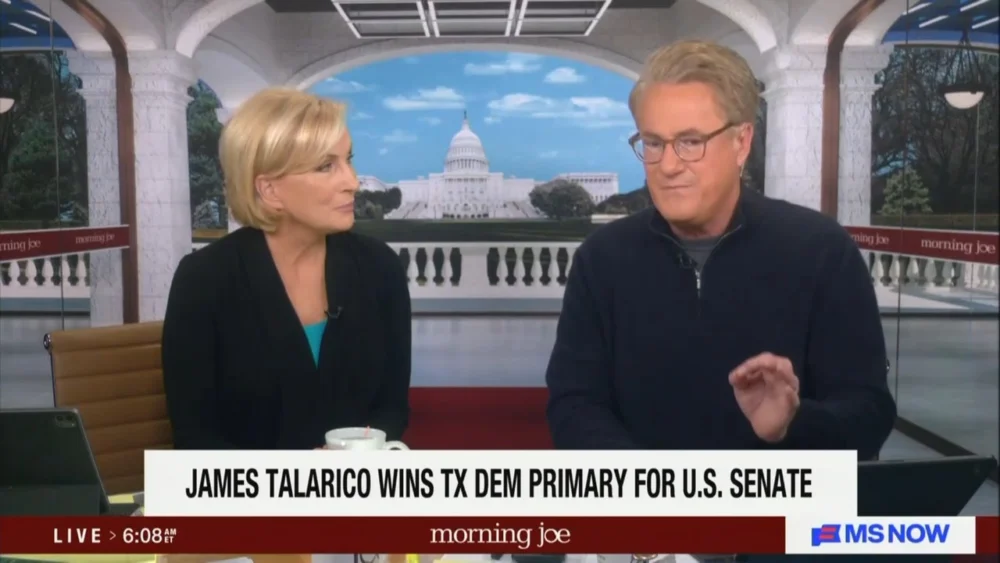
The political landscape of Texas shifted significantly on Tuesday evening as Democratic voters selected State Representative James Talarico as their nominee for the United States Senate, an outcome that has sparked intense debate regarding the influence of media suppression and Republican strategy. Talarico, a rising star in the Texas legislature known for his progressive yet faith-rooted rhetoric, secured a decisive victory over U.S. Representative Jasmine Crockett, who had entered the race with the high-profile endorsement of Vice President Kamala Harris. The primary results have not only set the stage for a contentious general election but have also prompted Joe Scarborough, host of MSNBC’s Morning Joe, to argue that the Republican Party’s own attempts to marginalize Talarico were the primary catalyst for his late-surge success.
The Morning Joe Analysis: A Republican "Own Goal"
On Wednesday morning’s broadcast, Joe Scarborough offered a blistering critique of the Republican strategy in Texas, suggesting that conservatives inadvertently "gifted" Talarico the nomination. Scarborough characterized Talarico as the candidate "Republicans feared the most," citing his ability to communicate progressive values through a lens of moral and religious conviction—a rhetorical style that has historically resonated with a segment of the Texas electorate that remains skeptical of traditional partisan messaging.
Scarborough argued that the GOP’s attempts to "game the system" by leveraging regulatory concerns to suppress Talarico’s national media exposure backfired. "I swear, I just wish these Republicans weren’t so stupid," Scarborough remarked during the segment. "I’m trying to help them out a little bit here, just to make it a fair fight in the fall. But what did we say? When they took Colbert off the air, you’re going to pay for it."
The host’s comparison of Talarico’s rise to that of former President Barack Obama highlighted the potential for a relatively unknown state official to capture national attention through a singular moment of perceived unfairness. Scarborough’s thesis centered on the "Streisand Effect," where the attempt to hide or suppress information results in the unintended consequence of publicizing that information more widely.
The Colbert Controversy and the FCC Equal Time Rule
Central to the primary’s closing narrative was a controversy involving The Late Show with Stephen Colbert. Weeks before the election, Colbert informed his audience that an interview with Talarico had been pulled from the broadcast. According to Colbert, CBS executives expressed concerns regarding the "Equal Time Rule," a regulation enforced by the Federal Communications Commission (FCC).
The Equal Time Rule, codified in Section 315 of the Communications Act of 1934, requires broadcast stations to provide equivalent opportunities to opposing political candidates who request it. The controversy was amplified by the public stance of FCC Commissioner Brendan Carr, a Trump appointee, who has been vocal about the enforcement of these rules during election cycles. While CBS denied that it had been directly silenced by the FCC, the network acknowledged it had sought legal counsel to avoid potential litigation or regulatory penalties.
This decision sparked a firestorm of criticism from media advocates and Democratic strategists, who accused the network of "preemptive compliance" with Republican-led regulatory pressure. Data from digital analytics firms showed a massive spike in Google searches for "James Talarico" immediately following Colbert’s announcement. Scarborough noted that even Talarico’s opponent, Jasmine Crockett, acknowledged the shift in momentum, reportedly stating that her internal polling showed her in the lead until the media controversy galvanized Talarico’s base and introduced him to a national audience.
Chronology of a High-Stakes Primary
The path to Talarico’s victory was marked by several pivotal moments that transformed a local legislative career into a national political story:
- Early Campaign Phase: Jasmine Crockett enters the race with significant name recognition and the backing of the Democratic establishment, including a key endorsement from the Vice President.
- The Legislative Record: Talarico gains traction by highlighting his work on school funding and his background as a public school teacher, positioning himself as a "new generation" Democrat.
- The Media Blackout: In mid-February, the scheduled interview on The Late Show is cancelled, leading to accusations of censorship and a subsequent surge in grassroots donations for Talarico.
- The Final Debate: Talarico leans into the "suppression" narrative, framing his candidacy as a challenge to both the Republican establishment and the regulatory hurdles placed in his way.
- Primary Night: Talarico defeats Crockett by a margin that exceeded most late-stage polling projections, securing the Democratic nomination without the need for a runoff.
Republican Internal Turmoil: Cornyn vs. Paxton
While Democrats have solidified their ticket, the Republican side remains in a state of flux. Neither incumbent Senator John Cornyn nor Texas Attorney General Ken Paxton secured the necessary majority to win the GOP primary outright, triggering a high-stakes runoff.
This internal Republican conflict presents a unique opportunity for Talarico. Senator Cornyn represents the traditional "establishment" wing of the party, while Ken Paxton is a staunch ally of former President Donald Trump and has been a central figure in legal challenges regarding election integrity and conservative social policy. Scarborough suggested that a Paxton victory in the runoff would be the "best-case scenario" for Democrats, as it would pit a polarizing figure against Talarico’s more moderate, faith-based appeal.
"If Ken Paxton wins his primary, it may set up the Democrats’ first decent chance of getting competitive in Texas in decades," Scarborough noted. The host emphasized that the infighting within the GOP, combined with the "unforced error" of the Colbert controversy, has created a volatile environment where a Democratic upset is no longer a statistical impossibility.
Legal Hurdles and Voting Access
The primary was also shadowed by a significant legal battle regarding voting hours in Dallas County. A lower court judge had initially granted an extension of voting hours due to technical issues at several polling locations. However, the Texas Supreme Court, which is composed entirely of Republican justices, intervened and overruled the extension.
Scarborough flagged this "confusion" as a harbinger for the general election. He warned that the Democratic Party must be prepared for similar legal maneuvers in the midterms, characterizing the incident as a "test run" for Republican efforts to limit turnout in Democratic strongholds. "Republicans will try to do whatever they can to stop Democratic voters from turning out," Scarborough asserted, echoing concerns from civil rights groups who argue that Texas’s voting laws are among the most restrictive in the nation.
Data and Demographic Shifts in Texas
The viability of a Talarico candidacy is supported by shifting demographic data in the Lone Star State. Texas has seen a massive influx of new residents from more liberal states, and its urban centers—Houston, Dallas, Austin, and San Antonio—continue to grow in both population and Democratic leanings.
Recent election data shows a narrowing gap between the two parties:
- 2014 Senate Race: Republican victory by 27.2 points.
- 2018 Senate Race: Republican victory by 2.6 points (Beto O’Rourke vs. Ted Cruz).
- 2020 Presidential Race: Republican victory by 5.6 points.
Talarico’s strategy appears aimed at the "suburban shift," targeting moderate voters who may be disillusioned by the hard-right turn of the state’s executive leadership. By framing his platform around "justice, mercy, and humility," Talarico seeks to bridge the gap between progressive policy and traditional Texas values.
Official Responses and Broader Implications
Following the primary results, James Talarico issued a statement emphasizing unity and the need to focus on "the common good." He refrained from directly attacking his Republican opponents, instead focusing on the "unprecedented energy" of the Democratic base.
"The people of Texas are tired of the politics of division," Talarico stated. "Whether it’s in the halls of the legislature or on the national stage, we are proving that a message of hope and shared humanity can overcome any attempt to silence our voices."
Spokespersons for the Republican candidates have dismissed Scarborough’s analysis as "partisan theater." A representative for the Cornyn campaign stated that the Senator remains focused on "protecting the Texas miracle" from "radical policies," while the Paxton camp doubled down on its commitment to "fighting the liberal agenda at every turn."
The broader implications of this race extend beyond the borders of Texas. If Talarico remains competitive through the summer and fall, national Democratic donors may shift resources to the state, potentially forcing Republicans to spend heavily in a territory they once considered safe. The narrative of the "suppressed candidate" has provided Talarico with a potent fundraising tool and a shield against accusations of being an "establishment" figure.
As the Republican runoff approaches, the political world will be watching to see if the GOP can consolidate its base or if the "stupid" mistakes Joe Scarborough highlighted will continue to pave the way for a historic Democratic challenge in the heart of the American South. For now, James Talarico stands as a testament to the fact that in the modern media age, an attempt to pull a candidate off the air might be the very thing that puts them in the winner’s circle.


 Yuyun Lusiyani
 Joko Widodo
 Eva Lovia
 Pevita Pearce
 admin
admin
 Lina Irawan