
 Amara Maple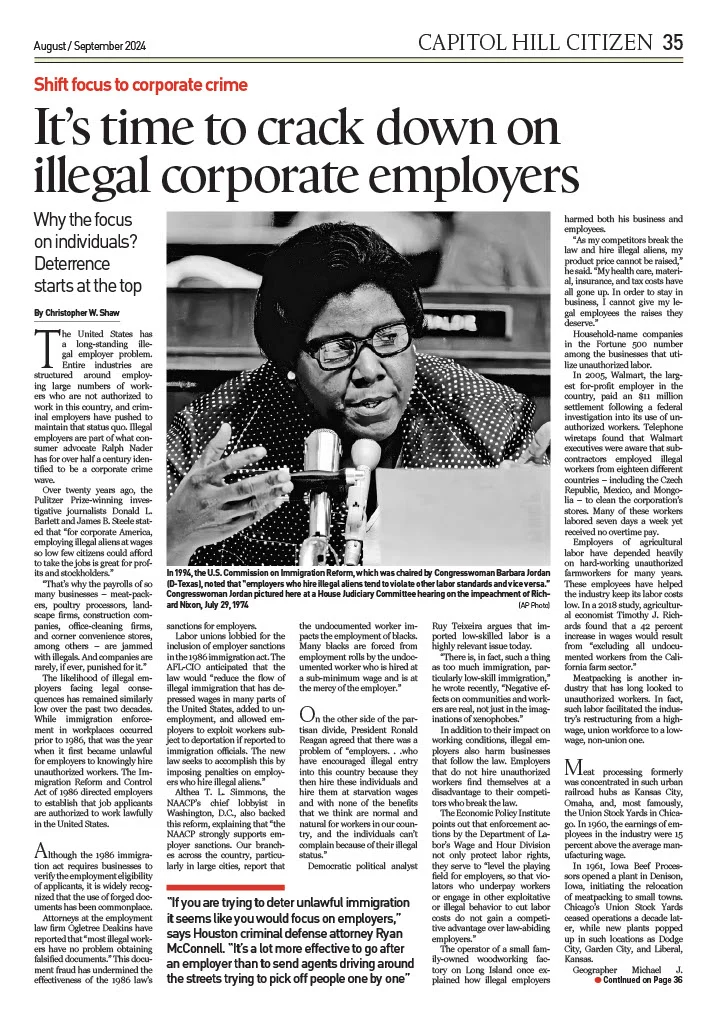
The United States grapples with a deeply entrenched issue of illegal employment, a problem that permeates numerous industries and has persisted for decades. This systemic challenge, identified by consumer advocate Ralph Nader for over half a century as a significant facet of corporate crime, underscores a critical need for a paradigm shift in enforcement strategies. A recent report, "Shift focus to corporate crime: It’s time to crack down on illegal corporate employer" by Christopher Shaw in the February/March 2026 issue of the Capitol Hill Citizen, re-emphasizes the urgency of holding corporations accountable for knowingly hiring unauthorized workers.
Shaw’s report highlights how entire sectors of the U.S. economy have become structurally dependent on a labor force operating outside legal parameters. From agriculture and construction to hospitality and cleaning services, the reliance on undocumented workers allows "criminal employers" to depress wages, cut costs, and gain an unfair competitive advantage, effectively pushing to maintain this status quo. This practice not only exploits vulnerable individuals but also undermines labor protections and fair competition for law-abiding businesses and authorized workers.
The Economic Imperative and Its Cost
The motivation behind illegal employment is overwhelmingly economic. As Pulitzer Prize-winning investigative journalists Donald L. Barlett and James B. Steele articulated over two decades ago, "for corporate America, employing illegal aliens at wages so low few citizens could afford to take the jobs is great for profits and stockholders." They pointed out that payrolls across diverse industries – meat-packers, poultry processors, landscape firms, construction companies, office-cleaning firms, and corner convenience stores – are "jammed with illegals." Crucially, they noted, "And companies are rarely, if ever, punished for it." This observation remains largely pertinent today, with the likelihood of illegal employers facing significant legal consequences remaining remarkably low despite the clear legal frameworks in place.
The economic ramifications extend far beyond corporate balance sheets. Studies from organizations like the Economic Policy Institute (EPI) consistently demonstrate that the prevalence of unauthorized labor can depress wages for all low-wage workers, including U.S. citizens and legal residents. When employers can access a pool of workers who, due to their undocumented status, are less likely to report labor violations or demand fair wages, it creates a downward pressure on labor costs across the board. This erosion of labor standards not only harms individual workers but also contributes to income inequality and strains public services without commensurate tax contributions from those illicit earnings.
The EPI further underscores that robust enforcement actions by divisions such as the Department of Labor’s Wage and Hour Division are not just about protecting individual labor rights. They are vital for "leveling the playing field for employers, so that violators who underpay workers or engage in other exploitative or illegal behavior to cut labor costs do not gain a competitive advantage over law-abiding employers." This principle is fundamental to a fair market economy, yet it is consistently undermined by the widespread practice of illegal employment.
A Legislative History of Unfulfilled Intentions
While immigration enforcement in workplaces existed prior, a pivotal moment arrived in 1986 with the passage of the Immigration Reform and Control Act (IRCA). This landmark legislation made it explicitly unlawful for employers to knowingly hire unauthorized workers, marking a significant shift in U.S. immigration policy. IRCA mandated that employers verify the employment eligibility of all job applicants, requiring them to inspect specific documents establishing identity and work authorization. The intent was clear: to reduce the "pull factor" of employment that drew undocumented immigrants to the U.S. by imposing penalties on employers.
However, the effectiveness of IRCA was almost immediately compromised by systemic challenges, primarily the widespread use of fraudulent documents. As attorneys at the employment law firm Ogletree Deakins have reported, "most illegal workers have no problem obtaining falsified documents." This document fraud has proven to be a persistent loophole, allowing employers to claim plausible deniability while continuing to employ unauthorized workers. Despite the legal requirement for verification, the practical reality has often rendered the law’s intent ineffective.
A U.S. Commission on Immigration Reform, chaired by Congresswoman Barbara Jordan (D-Texas) in 1994, explicitly acknowledged this interconnected problem, noting that "employers who hire illegal aliens tend to violate other labor standards and vice versa." This observation highlighted a crucial link: employers willing to flout immigration laws are often also those who disregard minimum wage laws, safety regulations, and other worker protections, creating a cycle of exploitation.
Advocacy for Employer Accountability
The inclusion of employer sanctions in the 1986 immigration act was not without significant lobbying efforts from organized labor. The AFL-CIO, representing a broad coalition of unions, anticipated that the law would "reduce the flow of illegal immigration that has depressed wages in many parts of the United States, added to unemployment, and allowed employers to exploit workers subject to deportation if reported to immigration officials." They believed that imposing penalties on employers who hire illegal aliens was the most direct and effective way to achieve these goals.
Similarly, civil rights organizations like the NAACP threw their weight behind the reform. Althea T. L. Simmons, the NAACP’s chief lobbyist in Washington, D.C., affirmed strong support for employer sanctions, citing reports from their branches across the country detailing the negative impacts of illegal employment on communities and authorized workers. Both labor and civil rights groups recognized that the exploitation inherent in illegal employment disproportionately affects vulnerable populations and undermines the economic stability of working-class families.
This perspective continues to resonate with legal experts today. Houston criminal defense attorney Ryan McConnell aptly summarizes the strategic logic: "If you are trying to deter unlawful immigration it seems like you would focus on employers. It’s a lot more effective to go after an employer than to send agents driving around the streets trying to pick off people one by one." This viewpoint argues for a shift from a primary focus on individual undocumented workers to a more impactful strategy targeting the corporate entities that create the demand for such labor.
The Broader Implications: Social, Ethical, and Policy Challenges
The persistence of illegal employment poses complex challenges that extend beyond economic metrics and legal frameworks. Socially, it creates a deeply vulnerable population of workers who are often afraid to report abuses, wage theft, or unsafe working conditions for fear of deportation. This vulnerability is exploited by unscrupulous employers, leading to widespread human rights issues and a sub-class of labor operating in the shadows. It also fosters resentment and division within communities, pitting different groups of workers against each other in a competition for scarce jobs and decent wages.
Ethically, the issue raises fundamental questions about corporate responsibility and the rule of law. When businesses are allowed to systematically circumvent labor and immigration laws with minimal repercussions, it erodes public trust in regulatory systems and sends a message that profit can supersede legal and ethical obligations. This not only harms workers but also disadvantages honest businesses that adhere to regulations, creating an uneven playing field.
From a policy perspective, the challenge lies in designing and implementing enforcement mechanisms that are both effective and fair. The current system, despite the existence of laws like IRCA, has proven inadequate. Enforcement actions against employers, while sometimes high-profile, have historically been sporadic and insufficient to deter widespread practices. Data from agencies such as Immigration and Customs Enforcement (ICE) and the Department of Labor often shows a relatively low number of significant employer audits or convictions compared to the estimated scale of the problem. For instance, while ICE conducted thousands of workplace investigations in certain years, the number of actual criminal indictments or convictions against employers for hiring unauthorized workers remained a small fraction.
One of the significant hurdles for enforcement agencies is proving "knowing" employment. Employers often use the defense of document fraud, claiming they were presented with seemingly legitimate documents and could not reasonably have known they were false. This legal technicality often shields them from prosecution, shifting the burden of responsibility away from the hiring entity. Strengthening employer verification systems, perhaps through mandatory E-Verify or biometric identification, has been proposed as a solution, but these measures also raise concerns about privacy, civil liberties, and the potential for discrimination.
A Path Forward: Comprehensive Enforcement and Reform
Addressing the illegal employer problem requires a multi-pronged approach that goes beyond sporadic raids or symbolic fines. It necessitates a strategic shift towards comprehensive enforcement that targets the root causes and corporate actors. This includes:
- Increased Penalties and Enforcement: Levying significantly higher fines and pursuing criminal charges against corporate executives and owners who knowingly and systematically employ unauthorized workers. The penalties must be substantial enough to outweigh the economic benefits of illegal hiring.
- Enhanced Inter-Agency Cooperation: Fostering stronger collaboration between immigration enforcement agencies (like ICE), labor departments (like the Wage and Hour Division), and state labor agencies. This would allow for a more holistic approach, addressing both immigration violations and associated labor abuses simultaneously.
- Strengthening Verification Systems: Re-evaluating and potentially reforming employment eligibility verification systems to make them more robust and fraud-resistant, while also safeguarding worker rights and preventing discrimination.
- Protecting Whistleblowers: Implementing stronger protections and incentives for workers who report illegal employment practices and associated labor violations. This would empower vulnerable workers and provide crucial intelligence to enforcement agencies.
- Targeted Industry Investigations: Focusing resources on industries historically known for high rates of illegal employment and implementing sustained, sector-wide investigations rather than isolated actions.
- Addressing Demand and Supply: Recognizing that while employer sanctions are critical, they are part of a larger immigration debate. Any truly comprehensive solution must also consider pathways to legal employment, worker protections, and broader immigration reform that aligns labor needs with legal avenues.
The call from Christopher Shaw and others to "shift focus to corporate crime" is not merely an academic exercise; it is a pragmatic recognition that tackling the demand side of illegal employment is arguably the most effective way to address the issue. By holding corporate entities fully accountable, the United States can begin to dismantle the exploitative systems that perpetuate illegal employment, protect all workers, and restore integrity to its labor markets and immigration system. The challenge is immense, but the economic, social, and ethical imperatives for action are undeniable.




 Yuyun Lusiyani
 Joko Widodo
 Eva Lovia
 Pevita Pearce
 admin
admin
 Lina Irawan