
 Jia Lissa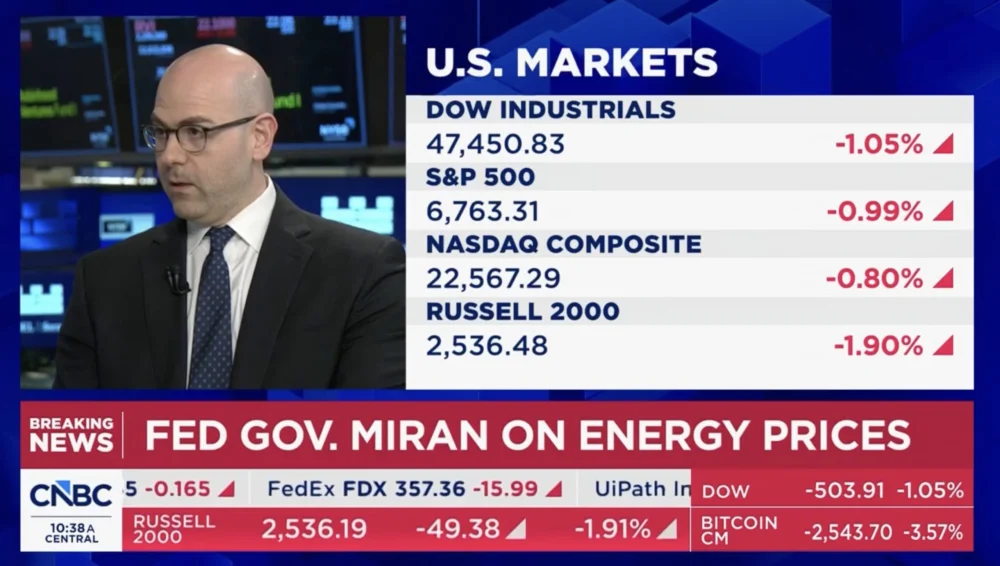
The United States labor market faced a significant and unexpected contraction in February, according to the latest data released by the Bureau of Labor Statistics (BLS). The February Employment Summary revealed a loss of 92,000 jobs, a figure that stood in stark contrast to the modest growth of 50,000 jobs projected by many Wall Street analysts. Compounding the negative sentiment were substantial downward revisions to previous months, totaling 69,000 jobs, suggesting that the labor market’s cooling trend may be more entrenched than previously understood. In the wake of these figures, Federal Reserve Governor Stephen Miran appeared on CNBC to provide the central bank’s perspective, seeking to calm anxieties regarding the potential role of artificial intelligence (AI) in driving structural unemployment.
During the broadcast, Miran engaged in a rigorous debate with CNBC hosts regarding the underlying causes of the volatility. The central point of contention was whether the sudden drop in employment figures served as an early indicator of technological displacement—specifically, the replacement of human labor by rapidly advancing AI systems. Miran, however, urged caution against over-interpreting a single month of data and maintained a staunchly optimistic view of long-term technological integration, drawing on historical precedents of human evolution and industrial shifts to support his thesis.
Analysis of the February Employment Summary
The February jobs report has sent ripples through the financial markets, as the miss of nearly 142,000 jobs (when accounting for both the actual loss and the missed projection) represents one of the most significant deviations from expectations in recent years. The downward revision of 69,000 jobs from prior months further indicates that the economic momentum observed in late last year may have been overstated. Economists typically view such revisions as a sign of a weakening trend, where the initial "noise" of the data eventually settles into a clearer picture of contraction.
The data suggests that the labor market is no longer in the "tight" state that characterized the post-pandemic recovery. Instead, the loss of 92,000 positions points to a potential shift in employer sentiment, likely driven by high interest rates, cooling consumer demand, and perhaps, as discussed on CNBC, a shift in how companies utilize technology to streamline operations. While the headline unemployment rate remained relatively stable due to fluctuations in the labor force participation rate, the absolute loss of payrolls remains a primary concern for the Federal Open Market Committee (FOMC) as it weighs future interest rate decisions.
The CNBC Exchange: AI and Technological Displacement
Senior Markets Correspondent Dominic Chu pressed Governor Miran on whether the dismal jobs numbers were "incremental clues about displacement through technology." The question reflects a growing anxiety among both the workforce and investors that the current wave of generative AI is fundamentally different from previous technological revolutions because it targets cognitive, rather than just manual, labor.
Miran responded by framing the current unemployment trends within a "classic textbook" economic framework. He argued that the current pain is being felt most acutely by new entrants into the job market—young professionals and recent graduates who are finding it increasingly difficult to secure their first roles. According to Miran, this is the specific type of economic friction that the Federal Reserve is equipped to handle. He suggested that "looser monetary policy"—referring to potential interest rate cuts—could help accommodate the transition as the economy adjusts to new technological realities.
"Technology destroys jobs, but it always creates new jobs, too," Miran stated during the interview. He emphasized the concept of "sectoral reallocation," the process by which labor shifts from declining industries (the "old jobs") to emerging ones (the "new jobs"). From the Federal Reserve’s perspective, this reallocation is a natural byproduct of a dynamic economy, and the role of the central bank is to provide the liquidity and stable environment necessary for that shift to occur without triggering a broader systemic collapse.
The Historical Argument: From Tools to Algorithms
One of the more unique moments of the interview occurred when Miran attempted to place the current AI revolution into a multi-millennial context. Addressing Chu’s skepticism about what the "new jobs" would actually be if AI can replicate cognitive work, Miran admitted that predicting the future of labor is notoriously difficult. He used the term "ex-ante"—referring to a forecast made before the results are known—to explain why humans struggle to visualize the future economy.
Miran’s explanation delved into evolutionary history, noting that humans, and even their hominid ancestors, have been using tools for hundreds of thousands of years. "We have a hard time imagining what the new jobs can be because they don’t exist yet," Miran noted. He argued that throughout history, every major technological leap—from the invention of the wheel and the steam engine to the internet—was met with fears of permanent mass unemployment. In each instance, however, the increased productivity afforded by the technology led to the creation of entirely new industries and job categories that were previously unimaginable.
While Miran admitted that he is not a "futurist" and could not name the specific job titles that will dominate the 2030s or 2040s, he relied on the "thousands of years of technological progress" as evidence that the labor market is resilient. This perspective aligns with the "Lump of Labor" fallacy—the erroneous belief that there is a fixed amount of work to be done in an economy, and that if a machine does some of it, there is less for humans to do.
The Role of Monetary Policy in a Changing Labor Market
The implications of Miran’s comments suggest a potential pivot in Federal Reserve strategy. If the Fed views the current job losses as a symptom of sectoral reallocation rather than a standard recessionary spiral, its approach to interest rates may shift. Miran explicitly mentioned that monetary policy can "accommodate" this transition.
In practical terms, "looser monetary policy" involves lowering the federal funds rate, which in turn lowers borrowing costs for businesses and consumers. By making capital cheaper, the Fed hopes to encourage entrepreneurs to invest in the "new jobs" Miran spoke of. Lower rates can also provide a cushion for companies undergoing digital transformations, allowing them to retrain workers or expand into new AI-augmented service lines rather than simply cutting payrolls to maintain margins.
However, this approach is not without risk. If the Fed cuts rates too early or too aggressively in response to job losses, it risks reigniting inflation, which has only recently begun to stabilize. The FOMC must balance its dual mandate of maximum employment and price stability. Miran’s comments suggest that the Fed may be becoming more sensitive to the "employment" side of that mandate as the data begins to soften.
Broader Economic Impact and Implications
The debate over AI-driven unemployment is no longer theoretical. Major firms in the tech and financial sectors have already begun citing "AI efficiency" as a reason for hiring freezes or targeted layoffs. The February jobs report may be the first macro-level evidence that these micro-level corporate decisions are beginning to move the needle on national employment statistics.
Impact on Cognitive and White-Collar Work
Unlike the industrial automation of the 20th century, which primarily affected manufacturing and manual labor, AI is increasingly capable of performing tasks in law, accounting, coding, and administrative support. The "imagination gap" Miran mentioned is particularly wide in these sectors. If an AI can draft a legal brief or write a functional software script, the traditional entry-level roles for humans in those fields may vanish. The challenge for the economy will be whether the "new jobs" created are of equal or higher value and whether the current workforce can be retrained quickly enough to fill them.
Challenges for First-Time Job Seekers
Miran’s observation that new entrants are "bearing the brunt" of the current market is supported by recent labor data showing a decline in campus recruiting and entry-level postings. If companies can use AI to do the work of three junior associates, the "ladder" of career progression is effectively broken. This could lead to a generation of underemployed youth, which carries long-term risks for social mobility and consumer spending.
The Global Perspective
The United States is not alone in this transition. Central banks around the world are watching the U.S. labor market as a bellwether for how AI will impact global economies. If the Federal Reserve successfully navigates this "sectoral reallocation" through monetary accommodation, it may provide a blueprint for the European Central Bank and the Bank of Japan. Conversely, if the job losses accelerate despite rate cuts, it may indicate that the AI revolution requires a more robust fiscal response, such as universal basic income or massive federal retraining programs, rather than just monetary adjustments.
Conclusion: A Cautious Path Forward
Governor Stephen Miran’s appearance on CNBC serves as a pivotal moment in the public discourse surrounding the future of work. By acknowledging the "dismal" nature of the February jobs report while simultaneously defending the long-term benefits of technological progress, he attempted to strike a balance between empathy for the displaced and confidence in economic theory.
As the Federal Reserve moves toward its next policy meeting, the shadow of the February Employment Summary will loom large. The central bank appears ready to use its tools to support the labor market, but the fundamental question remains: Can monetary policy truly bridge the gap between the "old jobs" that are disappearing and the "new jobs" that have yet to be imagined? For now, the Fed is betting on history, trusting that the same human ingenuity that turned tools into civilization will turn algorithms into a new era of prosperity. However, for the 92,000 individuals who lost their jobs in February, the "ex-ante" promise of future employment offers little immediate relief.




 Yuyun Lusiyani
 Joko Widodo
 Eva Lovia
 Pevita Pearce
 admin
admin
 Lina Irawan