
 Jia Lissa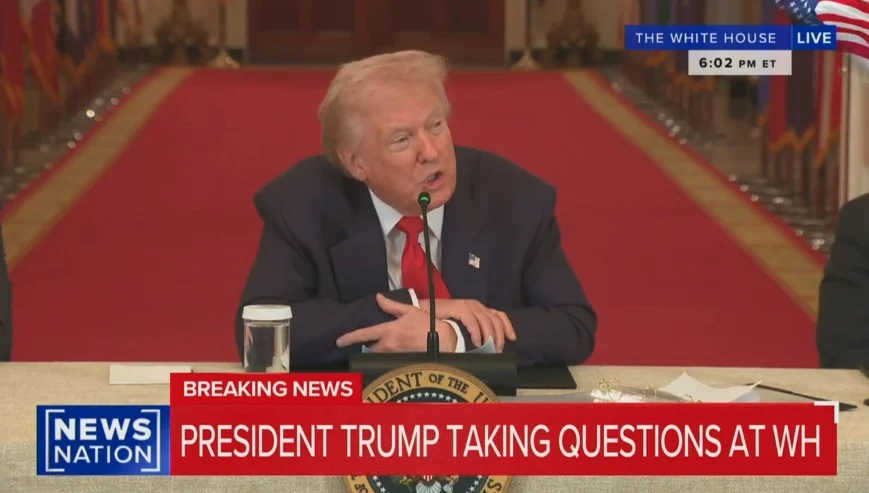
President Donald Trump convened a high-profile roundtable at the White House on Friday, ostensibly focused on the evolving landscape of collegiate athletics and the controversial Name, Image, and Likeness (NIL) policies currently reshaping the NCAA. However, the event was quickly overshadowed by the escalating military conflict between the United States, Israel, and Iran, leading to a series of sharp exchanges between the President and members of the White House press corps. Surrounded by a contingent of sports icons and political allies—including golf legend Tiger Woods, legendary former Alabama football coach Nick Saban, Secretary of State Marco Rubio, and Florida Governor Ron DeSantis—the President used the platform to both address the future of college sports and issue a forceful defense of his administration’s military strategy in the Middle East.
The roundtable occurred against a backdrop of significant international tension following a series of coordinated strikes by U.S. and Israeli forces against Iranian targets that commenced the previous Saturday. Despite the administration’s attempt to focus on domestic policy and the commercialization of amateur sports, the presence of senior foreign policy figures like Secretary Rubio signaled the gravity of the global situation. The dual-purpose nature of the gathering highlighted the complexities of the current political moment, where domestic cultural shifts and high-stakes international warfare frequently compete for the administration’s immediate attention.
A Confrontation Over Intelligence and Strategy
The proceedings took a contentious turn during the question-and-answer portion of the event. Fox News Senior White House Correspondent Peter Doocy attempted to steer the conversation toward recent reports concerning foreign interference and military intelligence. Specifically, Doocy queried the President regarding allegations that the Russian government had been providing the Iranian military with intelligence concerning U.S. military movements and assets.
The President’s reaction was immediate and dismissive. "I have a lot of respect for you. You’ve always been very nice to me," Trump began, before pivoting to a sharp critique of the journalist’s timing. "What a stupid question that is to be asking at this time. We’re talking about something else." The President’s refusal to engage with the intelligence report initially appeared to be an effort to maintain the focus on the sports-related agenda, yet he eventually returned to Doocy for a follow-up interaction that provided more insight into the administration’s view of the Iran conflict.
Upon granting Doocy a second opportunity to speak, the President remarked, "Peter, I’ll give you one more chance because that was a bad question you asked before. Go ahead." Doocy then asked what was motivating the President to hold a roundtable on collegiate athletics given the magnitude of the "other stuff going on in the world," referring to the ongoing hostilities in the Middle East.
Military Assessments and the "12 to 15" Scorecard
In response to the inquiry regarding his motivations and the status of the conflict, President Trump offered a highly optimistic assessment of the U.S. and Israeli military campaign against Iran. Utilizing his characteristic rhetorical style, the President quantified the success of the operation using a numerical scale that exceeded traditional bounds.
"In Iran, we’re doing very well," the President stated. "Somebody said, ‘How would you score it from 0 to 10?’ I said, ‘I’d give it a 12 to 15.’" He went on to claim that the Iranian military infrastructure had been essentially dismantled in the days following the initial strikes. "Their army is gone. They’re just about—look, their navy is gone. Their communications are gone. Their leaders are gone."
While the President did not provide specific intelligence data to support the total dissolution of the Iranian military during the roundtable, his comments suggested a campaign of unprecedented intensity. The assertion that Iran’s communications and leadership tiers have been neutralized aligns with a strategy of "decapitation" and "systemic degradation" often favored in modern aerial and cyber warfare. However, military analysts typically caution that assessing the total "erasure" of a national military force requires extensive post-strike verification and long-term monitoring.
Historical Justification: The Legacy of Roadside Bombs
The President’s remarks then shifted from current tactical assessments to a historical justification for the current hostilities. He specifically referenced the long-standing grievance the U.S. military holds against Iranian-backed groups for their role in the Iraq War. According to U.S. government data and reports from organizations such as the Council on Foreign Relations, Iranian-manufactured Explosively Formed Penetrators (EFPs) were responsible for hundreds of American casualties during the Iraq conflict.
"The situation with a very bad and very sick group of leaders, who were killing a lot of people," Trump said, referring to the Iranian leadership. "A lot of our people were being killed. They were being maimed. They were being destroyed with their bombs all over the place, planted in roads, and we called them the roadside bombs. Walking around without legs, without arms, face blasted. Killed many, many people."
By invoking the imagery of "roadside bombs" (Improvised Explosive Devices or IEDs), the President sought to frame the current military action as a necessary response to decades of Iranian-sponsored aggression against U.S. service members. This narrative serves to consolidate domestic support for the conflict by linking modern strikes to the widely recognized trauma of the Iraq and Afghanistan campaigns.
The Roundtable Context: NIL and the Future of the NCAA
While the geopolitical exchange dominated the headlines, the stated purpose of the meeting—the NCAA’s Name, Image, and Likeness policies—remains a critical domestic issue. The presence of Nick Saban and Tiger Woods underscored the high stakes of the discussion. Saban, who recently retired from a storied career at the University of Alabama, has been a vocal critic of the current "pay-for-play" environment, arguing that the lack of a federal framework has created an unsustainable and unregulated marketplace.
The NCAA has been under immense pressure to reform its amateurism rules following the 2021 Supreme Court decision in NCAA v. Alston, which opened the door for athletes to profit from their personal brands. Since then, a patchwork of state laws has emerged, creating what many coaches and administrators describe as a "Wild West" scenario. The roundtable participants, including Governor DeSantis and Senator Rubio, discussed the possibility of federal legislation to codify NIL rules, provide antitrust protection for the NCAA, and establish a uniform standard for athlete compensation.
Supporting data indicates that the NIL market has grown into a billion-dollar industry in just a few years. Top-tier collegiate athletes in football and basketball are reportedly earning seven-figure annual incomes through collective agreements and corporate sponsorships. Critics of the current system, like Saban, argue that this detracts from the educational mission of universities, while proponents argue it is a long-overdue recognition of the economic value athletes bring to their institutions.
Political Implications and Regional Stability
The presence of Ron DeSantis and Marco Rubio at the roundtable also signaled a strategic alignment within the Republican party regarding both sports and foreign policy. DeSantis, who has frequently positioned Florida as a leader in both collegiate sports and aggressive foreign posturing, provided a domestic political anchor for the event. Rubio, in his capacity as Secretary of State, represented the bridge between the domestic concerns of the roundtable and the international crisis.
The broader implications of the President’s "12 to 15" assessment of the Iran conflict are significant. If the Iranian military capabilities are indeed as degraded as the President suggests, the region may be entering a period of forced realignment. However, a total power vacuum in Tehran could also lead to unpredictable insurgencies or the intervention of other regional powers.
Furthermore, the President’s dismissal of the Russia-Iran intelligence report highlights the ongoing tension between the administration and certain sectors of the intelligence community and the press. The allegation that Russia—a nuclear-armed power—is actively assisting Iran with military intelligence suggests a widening of the conflict that could potentially draw in the broader NATO alliance or further strain U.S.-Russia relations, which are already at a post-Cold War low.
Timeline of Recent Events
To understand the weight of the Friday roundtable, a brief chronology of the preceding week is essential:
- Saturday: The United States and Israel launch a series of joint air and missile strikes against Iranian military installations, citing "imminent threats" and long-term regional destabilization efforts by Tehran.
- Sunday – Tuesday: Reports emerge of significant damage to Iranian air defense systems and naval assets in the Persian Gulf. International markets react with volatility as oil prices fluctuate.
- Wednesday: Secretary of State Marco Rubio issues a statement emphasizing that the U.S. does not seek "regime change" but demands a "total cessation of proxy-funded terrorism."
- Thursday: Intelligence reports begin to circulate in Washington regarding Russian satellite data being shared with Iranian commanders to track U.S. naval movements.
- Friday: President Trump hosts the White House roundtable, dismissing questions about the Russia-Iran link while declaring the Iranian military "gone."
Conclusion: A Dual-Track Presidency
The White House roundtable served as a vivid illustration of the "dual-track" nature of the current administration. On one track, the President is engaged in a fundamental restructuring of domestic institutions, such as collegiate sports, by bringing together cultural icons and legislative leaders. On the second track, the administration is overseeing an aggressive and transformative military campaign in the Middle East that seeks to settle decades-old scores and redefine regional security.
By labeling Peter Doocy’s inquiry a "stupid question," the President signaled his intent to control the narrative of his administration’s priorities. However, by subsequently providing a detailed (if hyperbolic) update on the war, he acknowledged that the "other stuff going on in the world" cannot be easily separated from the domestic agenda. As the U.S. moves forward with both NIL reform and the military campaign against Iran, the intersection of sports, politics, and war continues to define the national discourse. The coming weeks will determine if the President’s "12 to 15" score reflects a lasting strategic victory or a prelude to a more complex and protracted regional struggle.

 Yuyun Lusiyani
 Joko Widodo
 Eva Lovia
 Pevita Pearce