
 Pevita Pearce
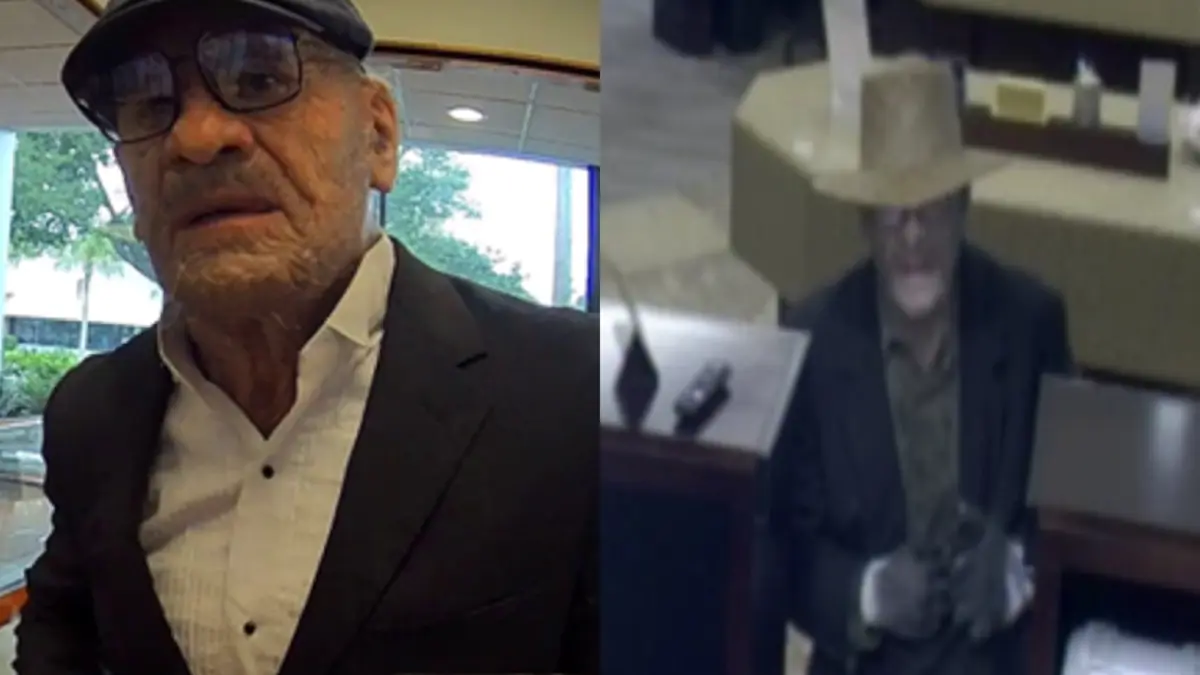
Federal authorities in Florida have announced the arrest and indictment of 40-year-old David Sartin Jr., a man whose criminal history is inextricably linked to a specific and unsettling theatricality. Sartin, who was currently on supervised release following a series of high-profile bank robberies in Texas, now faces new federal charges for allegedly reprising his role as a "disguise artist" to target financial institutions in the Tampa Bay area. According to the United States Department of Justice and a detailed police affidavit, Sartin is accused of robbing two banks in Largo and St. Petersburg while wearing a sophisticated prosthetic "old man" mask—a signature move that mirrors the methods used in his previous convictions.
The case against Sartin highlights a rare and persistent pattern of recidivism that has spanned nearly two decades and multiple states. Despite previous incarcerations and the watchful eye of federal probation officers, Sartin allegedly returned to a life of crime, utilizing the same specific tools and psychological tactics that led to his downfall in the past. The recent series of events has reignited discussions regarding the effectiveness of supervised release for career criminals and the evolving challenges law enforcement faces when confronting suspects who use high-quality prosthetics to evade facial recognition and witness identification.
The Largo and St. Petersburg Heists: A Pattern Re-emerges
The most recent allegations against Sartin stem from two robberies occurring in late 2024. The first took place in Largo, Florida, where a man matching Sartin’s description entered a local bank branch. Witnesses and surveillance footage described a suspect who appeared to be an elderly male with thinning grey hair and a weathered complexion. However, investigators quickly suspected the "old man" was a younger individual wearing a professional-grade prosthetic mask.
According to the police affidavit, the suspect’s approach was methodical. He arrived at the scene on a bicycle, a tactic often used by robbers to navigate through areas where a car might be easily spotted or blocked by traffic. After entering the bank, the suspect presented a demand for cash. He specifically instructed the bank tellers not to include dye packs—small radio-controlled devices that explode and spray permanent ink on the money and the thief shortly after leaving the premises. This detail suggested to investigators that the perpetrator was someone with significant experience in the mechanics of bank security.
After securing the funds, the suspect fled the scene on the bicycle. Law enforcement later determined that the bicycle was merely a "bridge" vehicle used to reach a getaway car parked a short distance away. This multi-layered escape plan was designed to break the trail for any immediate pursuit.
The second robbery occurred shortly thereafter in St. Petersburg. The modus operandi was nearly identical: the prosthetic mask, the specific instructions regarding dye packs, and the use of a bicycle. However, it was during this second heist that Sartin’s luck began to unravel. Advanced surveillance technology and local traffic cameras captured a vehicle returning to a residence shortly after the robbery. The footage reportedly showed a man resembling Sartin unloading a bicycle from the vehicle—a bicycle that matched the description of the one used in the Largo heist.
Investigation and the "Uncle Henry" Evidence
The Federal Bureau of Investigation (FBI) and local Florida police departments launched a coordinated effort to monitor Sartin’s residence. The day after the St. Petersburg robbery, surveillance teams observed Sartin engaging in what appeared to be an amateur attempt at forensic countermeasures. He was seen spray-painting the white roof of his vehicle black, an apparent effort to alter the car’s appearance and distance it from the descriptions provided by witnesses and captured on traffic cameras.
Following this observation, federal agents executed a search warrant on Sartin’s home and a storage unit he owned. The results of the search were described by officials as a "treasure trove" of incriminating evidence. Inside the storage unit, investigators discovered the "old man" mask, complete with realistic grey hair and dark-framed glasses. Beside the mask lay a fake handgun and clothing—including two suits—that matched the attire worn by the suspect in both the Largo and St. Petersburg surveillance videos.
Perhaps the most startling discovery was a handwritten journal found among Sartin’s possessions. The journal, dated January 1, 2021, featured a cover title that read: “God’s Best friend is a Bank Robber! Uncle Henry Cops and Robbers the world through the eyes of a Bank Robber.” The journal was explicitly signed "by: David Sartin."
Inside the notebook, Sartin had reportedly drawn a sketch of a person holding a mask. Accompanying the illustration was the phrase, “My face holding up Uncle Henry, looking at it, Face to Face.” This evidence suggests a deep psychological attachment to the "Uncle Henry" persona, treating the disguise not just as a tool for crime, but as a secondary identity. The journal provides a rare window into the mindset of a serial offender, indicating that Sartin may have been planning his return to bank robbery for years while still under the supervision of the justice system.
A History of Theatrical Thefts: 2008 and 2016
To understand the gravity of the current charges against Sartin, one must look back at his extensive criminal history. His penchant for disguises was evident as early as 2008. In that year, Sartin and a co-conspirator were arrested for an attempted bank robbery in which they wore Halloween masks. While that attempt was unsuccessful, it established a pattern of behavior that would escalate in complexity and severity over the following years.

In 2016, Sartin gained notoriety for a string of five bank robberies across Texas. It was during this spree that he first perfected the use of the prosthetic "old man" mask. The robberies were so similar in execution to the recent Florida crimes that federal investigators were able to draw immediate parallels. In the Texas cases, Sartin also utilized professional-looking disguises to bypass the initial suspicions of bank staff and security. He was eventually apprehended, convicted, and sentenced to federal prison.
At the time of the 2024 Florida robberies, Sartin was on supervised release for the 2016 Texas convictions. Supervised release is a period of community-based oversight that follows a prison term in the federal system, intended to help reintegrate former inmates into society while ensuring they adhere to strict behavioral guidelines. Sartin’s alleged return to the exact same criminal methods while under federal supervision represents a significant failure of the rehabilitative process and a bold defiance of legal authority.
Statistical Context and the Evolution of Bank Robbery
The case of David Sartin Jr. occurs at a time when bank robberies in the United States are undergoing a shift. According to FBI Uniform Crime Reporting (UCR) data, the total number of bank robberies has generally declined over the last two decades. This trend is attributed to several factors, including the hardening of bank targets with bullet-resistant glass, the ubiquity of high-definition digital surveillance, and the decreasing reliance on physical cash in the modern economy.
However, the use of high-quality prosthetic masks represents a "counter-evolution" in criminal tactics. While traditional masks (such as the Halloween masks Sartin used in 2008) are easily identifiable as disguises, silicone prosthetics can move with the wearer’s facial muscles, making them appear lifelike from a distance or on lower-resolution cameras. This can lead witnesses to provide inaccurate descriptions to police, such as reporting an elderly suspect when the perpetrator is actually in his 30s or 40s.
Furthermore, Sartin’s use of "note-passing" and specific instructions regarding dye packs reflects a sophisticated understanding of bank protocols. Statistics show that "note-passing" remains the most common method of bank robbery, as it minimizes the immediate commotion and reduces the likelihood of a violent confrontation that could trigger a more rapid police response.
Legal Proceedings and Potential Sentencing
Sartin now faces two counts of bank robbery under federal law. If convicted on both charges, he faces a maximum penalty of 20 years in federal prison for each count, totaling a potential 40-year sentence. Because he was on supervised release at the time of the alleged crimes, he also faces additional penalties for violating the terms of his prior sentence. Under federal sentencing guidelines, "points" are added to an offender’s score for committing crimes while under judicial supervision, which often leads to harsher sentences.
The U.S. Attorney’s Office for the Middle District of Florida is prosecuting the case. In statements regarding the indictment, officials emphasized the collaborative effort between the FBI, the Largo Police Department, and the St. Petersburg Police Department. The ability of local and federal agencies to share data and link the 2016 Texas crimes to the 2024 Florida incidents was instrumental in securing the arrest.
Analysis of Broader Implications
The Sartin case raises critical questions for the criminal justice system, particularly regarding the monitoring of high-risk recidivists. The fact that an individual with a documented history of using specific disguises was able to acquire those same tools and allegedly commit new crimes while on supervised release suggests a need for more intensive oversight of specialized offenders.
Additionally, the psychological aspect revealed by Sartin’s "Uncle Henry" journal suggests that for some offenders, the act of robbery and the adoption of a persona provide a sense of identity that traditional rehabilitation programs may struggle to address. The "Uncle Henry" persona appears to have been a long-gestating fixation, one that Sartin maintained throughout his time in prison and into his release.
As the legal process moves forward, the focus will remain on the strength of the physical evidence—the mask, the journal, and the surveillance footage of the vehicle modification. For the communities of Largo and St. Petersburg, the arrest brings an end to a period of uncertainty, but for the justice system, it serves as a stark reminder of the challenges posed by those who view the world, in Sartin’s own words, "through the eyes of a bank robber."
The trial for David Sartin Jr. is expected to begin in the coming months. Given the volume of physical evidence and the defendant’s prior history, legal experts anticipate a complex case that will delve deeply into both the forensic and psychological dimensions of these theatrical heists. For now, the man who allegedly sought to hide behind the face of "Uncle Henry" remains in federal custody, facing the prospect of spending the better part of his remaining years behind bars.




 Nila Kartika Wati

 Eva Lovia

 Lina Irawan

 Yuyun Lusiyani

 Ana Megawati

 Joko Widodo
