
 Jia Lissa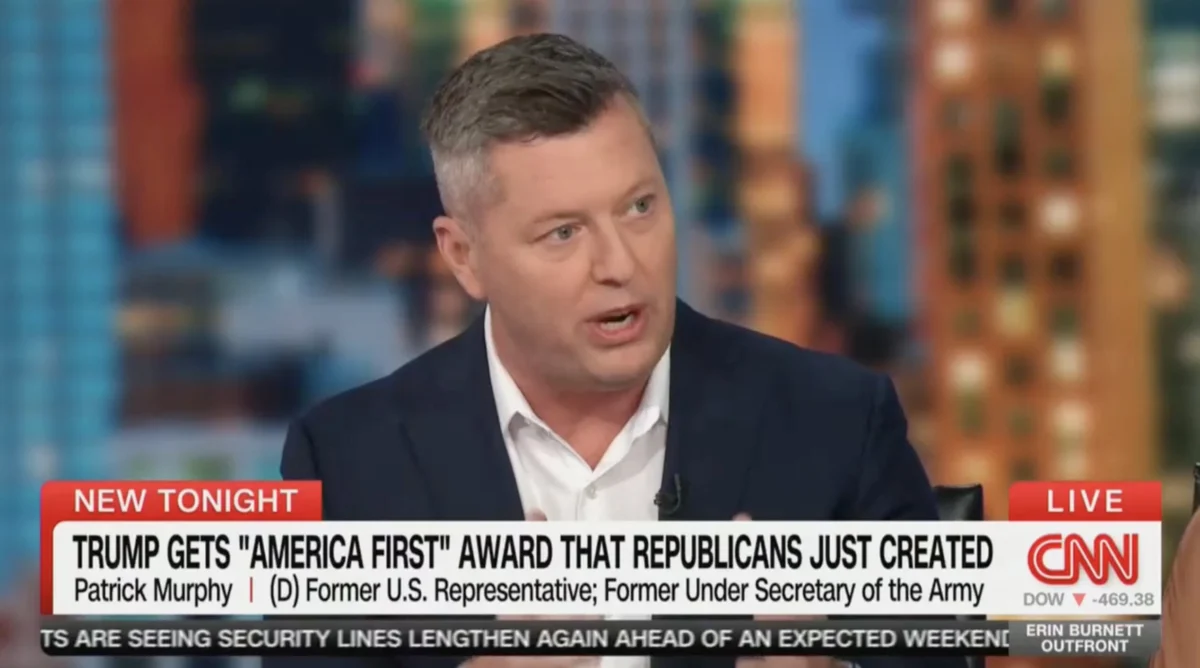
The intersection of military protocol, constitutional law, and partisan politics took center stage this week following a high-profile exchange involving former Under Secretary of the Army Patrick Murphy and Speaker of the House Mike Johnson. The controversy stems from a recent National Republican Congressional Committee (NRCC) fundraising dinner where Speaker Johnson presented former President Donald Trump with a newly inaugurated award, physically manifested as a golden statue. The gesture, intended to honor Trump’s leadership within the Republican Party, has ignited a fierce debate regarding the decorum of the Speaker’s office and the perceived "fawning" nature of modern political alliances.
Patrick Murphy, a combat veteran who served in Iraq with the 82nd Airborne Division and later represented Pennsylvania’s 8th congressional district before becoming the 32nd Under Secretary of the Army, appeared on CNN’s "Erin Burnett OutFront" to express his sharp disapproval. Murphy’s critique was not merely political but rooted in his background as a West Point instructor of constitutional law and a former military officer. He characterized the presentation of the award as a "participation trophy" and argued that such an act is fundamentally "beneath the office" of the Speaker of the House.
The Event and the Award: A Chronology of the NRCC Fundraiser
The event in question took place on Wednesday during the NRCC’s annual March Dinner, a premier fundraising event for the House Republican campaign arm. The dinner, which serves as a critical venue for donors and party leaders to strategize for upcoming election cycles, featured Donald Trump as the keynote speaker. During the proceedings, Speaker Mike Johnson took the stage to announce the creation of a new honor designed specifically for the former president.
Johnson described the golden statue as a "token of our appreciation for his leadership," emphasizing Trump’s role in shaping the current trajectory of the Republican Party and his influence on House GOP efforts. The statue, which depicts a stylized figure, was presented to Trump amidst cheers from the assembled donors and lawmakers. However, as images and videos of the presentation circulated online, the response from outside the room was markedly different.
The timeline of the backlash began almost immediately on social media, where critics likened the statue to a "Golden Calf," a biblical reference to idolatry. By Thursday, the discourse had shifted to national news outlets. Murphy’s appearance on CNN provided a platform for a more structured critique, focusing on the institutional damage he believes such gestures inflict on the legislative branch’s independence.
Constitutional and Institutional Concerns
A primary pillar of Murphy’s argument rests on the constitutional relationship between the branches of the United States government. As a former professor of law at the United States Military Academy at West Point, Murphy highlighted the concept of coequal branches. The Speaker of the House is not merely a party leader but the head of the legislative branch, which, under Article I of the Constitution, serves as a check on the executive branch.
Murphy contended that the Speaker’s subservient posture toward a former (and potentially future) president undermines this balance. "The Speaker of the House is one of the congressional leaders of a coequal branch of government," Murphy stated during his interview. "It’s beneath that office to kiss ass."
This perspective touches on a broader scholarly debate regarding the "imperial presidency" and the gradual ceding of legislative authority to the executive. Critics of the award ceremony argue that when the Speaker of the House treats a president or former president with the level of deference seen at the NRCC dinner, it signals a shift from oversight to personal loyalty. This, Murphy suggests, is a departure from the historical norms where Speakers, even those of the same party as the president, maintained a degree of institutional distance to preserve the integrity of the House.
Military Discipline and Political Conduct
Murphy’s most provocative comments involved a comparison between political behavior and military standards. Drawing on his experience as a JAG (Judge Advocate General) officer and a combat veteran, Murphy suggested that the level of sycophancy displayed by some members of Congress would be grounds for disciplinary action in the armed forces.
"If they were in the military like I was in Iraq, I would court-martial their asses," Murphy remarked, expressing his embarrassment over the current state of Congress. This comparison highlights the "blood oath" that military members take to support and defend the Constitution, rather than an individual leader. Murphy argued that the "celebratory nature" of the GOP’s relationship with Trump contrasts sharply with the somber realities of military service and national security.
The mention of the 82nd Airborne Division and the ongoing tensions involving Iran served to ground Murphy’s critique in real-world stakes. He pointed to the thousands of young men and women currently deployed or facing potential conflict, arguing that the leadership in Washington appears to be treating governance and war as a "video game" or a "joke" while families at home pray for the safety of their loved ones.
The Briefing Controversy: From Intelligence to Entertainment
The discussion on CNN also touched upon recent reports regarding the nature of the daily briefings provided to Donald Trump during his presidency and in his current capacity as a candidate. Reports have surfaced suggesting that Trump’s preference for briefings included high-intensity visual content, sometimes described as "stuff blowing up," particularly in relation to military operations in the Middle East.
Murphy found this particularly troubling, linking it back to the "golden statue" as evidence of a lack of seriousness. "This is life and death," Murphy said. "This is as serious as a heart attack. And these guys think it’s a joke."
The implication of Murphy’s analysis is that the gamification of military intelligence and the creation of "participation trophies" for political leaders reflect a broader decline in the gravitas required for high office. From a national security perspective, the concern is that an emphasis on optics and personal accolades could distract from the rigorous analysis required to manage complex international crises, such as those involving Iran or other adversarial powers.
Political Context and the Speaker’s Strategy
To understand Speaker Mike Johnson’s motivations, one must look at the internal dynamics of the House Republican Conference. Johnson, who assumed the Speakership following the historic ouster of Kevin McCarthy, presides over a slim and often fractious majority. His political survival and the success of the NRCC depend heavily on the mobilization of the "MAGA" base, for whom Donald Trump remains the undisputed leader.
For Johnson, presenting the award may be viewed as a pragmatic move to solidify his standing with Trump and ensure the former president’s support in the 2024 election cycle. The NRCC’s goal is to raise the hundreds of millions of dollars necessary to defend and expand their majority; in this context, the golden statue serves as a symbolic bridge between the party’s legislative wing and its populist base.
However, the "participation trophy" label used by Murphy and other critics suggests that this strategy may come at the cost of the Speaker’s broader credibility. While the award may please donors and the core base, it provides political ammunition to opponents who portray the GOP as being more focused on "personality cult" politics than on substantive policy or constitutional governance.
Broader Implications for the 2024 Election and Beyond
The fallout from the golden statue incident reflects the deep polarization of the American electorate. For supporters of the former president, the award is a well-deserved recognition of a leader who they believe has been unfairly targeted by the political establishment. For critics like Murphy, it is a symptom of a systemic failure in political leadership.
Data from recent polling suggests that institutional trust in Congress remains at historic lows. Actions that are perceived as placing partisan loyalty above constitutional duty often contribute to this decline. As the 2024 election approaches, the role of the Speaker will continue to be a focal point of scrutiny, particularly regarding how the legislative branch manages its relationship with the executive candidates.
Furthermore, Murphy’s comments highlight a growing rift between the traditional military/national security establishment and the populist wing of the Republican Party. The tension between "Old Guard" views on decorum and "New Guard" views on political disruption is likely to remain a central theme in the national discourse.
Conclusion: The Weight of Symbolism in Washington
While a golden statue may seem like a minor footnote in the grander scheme of American politics, the reaction it elicited from a former high-ranking Army official and congressman underscores the weight of symbolism in Washington. Patrick Murphy’s critique serves as a reminder of the standards of conduct expected of those in high office, particularly those who hold the power to send citizens into harm’s way.
As the NRCC continues its fundraising efforts and Speaker Johnson navigates the challenges of a divided Congress, the "participation trophy" controversy will likely stand as a case study in the modern blurring of lines between party leadership and constitutional responsibility. Whether this moment is remembered as a harmless gesture of political theater or a significant breach of institutional decorum will depend largely on the long-term impact on the office of the Speaker and the legislative branch’s ability to maintain its coequal status in the American system of government.


 Yuyun Lusiyani
 Joko Widodo
 Eva Lovia
 Pevita Pearce