
 Jia Lissa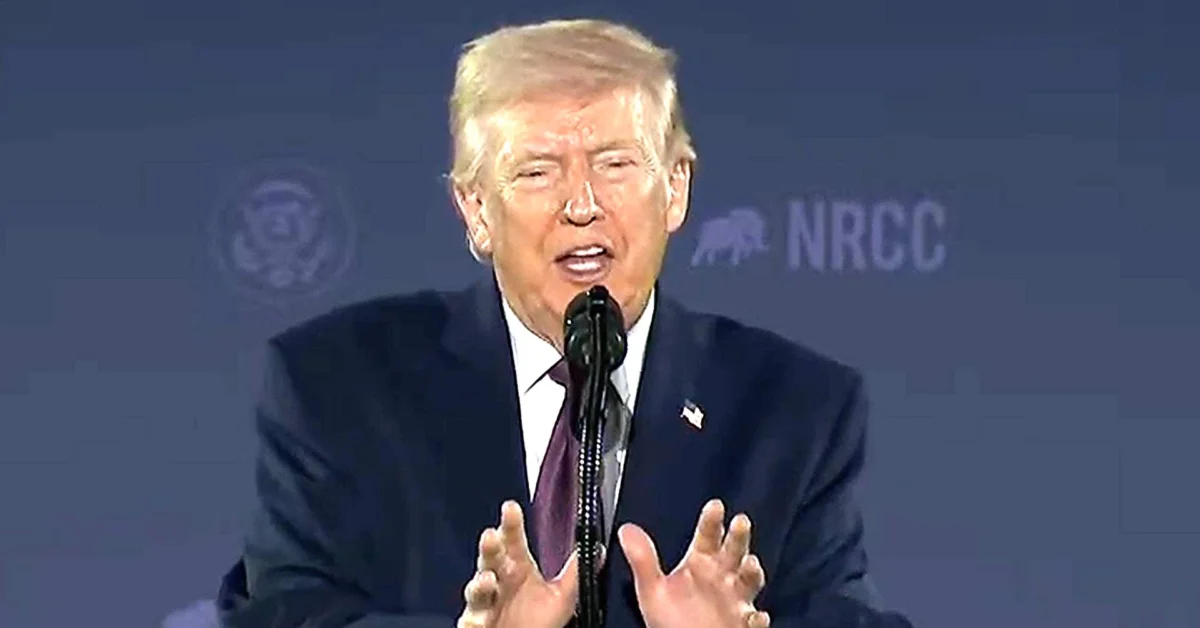
During a high-profile address at the National Republican Congressional Committee’s (NRCC) 2026 Annual Fundraising Dinner on Wednesday night, former President Donald Trump delivered a speech characterized by sharp critiques of the mainstream media and the promotion of a series of claims regarding his standing in public opinion polls and the outcomes of various legal disputes. Central to the former president’s remarks was a claim that a recent poll conducted by CNN showed him with a 100 percent approval rating, alongside assertions that major television networks ABC and CBS had been forced to pay him tens of millions of dollars in legal settlements.
The address, delivered to a room of Republican donors and lawmakers, highlighted the ongoing friction between the Trump campaign and established media organizations. While the former president utilized the platform to project an image of total dominance within his political movement, an examination of the underlying data and legal records provides a more nuanced picture of the figures cited during the event.
The Origin of the 100 Percent Poll Claim
The "100 percent" figure cited by the former president appears to have originated from a segment aired on CNN featuring data reporter Harry Enten. During the segment, which subsequently went viral on social media, Enten analyzed a specific "crosstab" or subgroup from an NBC News poll conducted earlier in the month.
The NBC News poll asked respondents a specific qualifying question: "Do you consider yourself to be a supporter of the MAGA movement?" According to the poll’s data, 30 percent of the total respondents identified as "yes," while 68 percent identified as "no." Within that 30 percent subgroup—those who explicitly identify as supporters of the "Make America Great Again" movement—the approval rating for Donald Trump was recorded at 100 percent.
In his analysis, Enten noted that such a figure was statistically remarkable, stating that the numbers "jump off the screen." However, he also contextualized the data by explaining that it represented a tautology: individuals who identify as supporters of a specific movement are, by definition, supporters of the movement’s leader. When looking at the full sample of the NBC News poll, the former president’s standing was more divided, with a 44 percent approval rating and a 54 percent disapproval rating among the general electorate.
During his speech on Wednesday, Trump repeatedly referenced the poll but incorrectly attributed it to CNN rather than NBC News. He also blurred the distinction between the 30 percent subgroup and the broader Republican Party or the American public. "I got one yesterday from CNN," Trump told the audience. "The number was 100 percent. Do you believe it? In fact, he [Harry Enten] went wild. It may be the last time he ever does the show, but these are okay. It was 100 percent. Even I was surprised at that."
Statistical Analysis and Polling Methodology
To understand the implications of the 100 percent figure, it is necessary to examine the methodology used by NBC News and the nature of "crosstab" reporting in modern political science. The poll, which surveyed a representative sample of registered voters nationwide, utilized a margin of error of approximately 3.1 percentage points for the full sample. However, for subgroups like "MAGA supporters," the sample size is smaller, which typically increases the margin of error.
In this instance, the 100 percent result indicates a total lack of dissent within the self-identified MAGA cohort. Political analysts suggest that this reflects the high degree of polarization and brand loyalty within the modern political landscape. While traditional political figures often see a small percentage of "soft" supporters within their base who may disapprove of specific actions, the MAGA movement, as defined by this poll, appears to have become synonymous with personal support for Trump himself.
Despite the former president’s claim that CNN "fired" those responsible for the poll, there has been no evidence of any personnel changes at CNN or NBC News related to the reporting of these figures. Harry Enten continues to serve as a senior data reporter for CNN, and the NBC News poll remains a part of the public record.
Claims Regarding ABC and CBS Legal Settlements
Beyond the polling data, the former president used the NRCC dinner to highlight his ongoing legal battles with major media corporations. He claimed that ABC News and CBS News had been forced to pay him significant sums following lawsuits he initiated against them.
Specifically, Trump asserted that ABC News and anchor George Stephanopoulos "had to pay me $16 million for what they said," and that CBS "had to pay me $38 million." These claims stem from defamation lawsuits filed by the Trump legal team over the past several years.
In the case of ABC News, the litigation centered on comments made by George Stephanopoulos during an interview with Representative Nancy Mace. The lawsuit alleged that Stephanopoulos defamed Trump by stating he had been found "liable for rape" in the civil trial involving writer E. Jean Carroll. While a jury found Trump liable for sexual abuse and defamation, they did not find him liable for the specific charge of rape under New York’s narrow legal definition. The presiding judge later clarified that the jury’s finding of sexual abuse was consistent with the common understanding of the term "rape" in a non-legal context.
While reports have surfaced regarding settlements in various legal matters involving media entities, the specific figures cited by Trump—$16 million and $38 million—have not been verified by public court filings or official statements from the networks. In many high-profile defamation cases, settlements are reached voluntarily and are often accompanied by non-disclosure agreements regarding the financial terms. Furthermore, legal analysts have noted that the amounts claimed by the former president exceed the typical settlements seen in similar defamation cases involving public figures, where the "actual malice" standard creates a high bar for recovery.
Chronology of Events Leading to the Speech
The rhetoric at the NRCC dinner follows a specific timeline of media interactions and data releases:
- March 8, 2024: NBC News releases its national poll results, including the crosstab showing 100 percent approval among self-identified MAGA supporters.
- Early March 2024: CNN’s Harry Enten highlights the 100 percent figure in a televised segment, focusing on the intensity of Trump’s base. The segment goes viral on social media platforms.
- Mid-March 2024: Donald Trump begins referencing the poll in Truth Social posts and at campaign rallies, frequently misidentifying the source as a "CNN poll."
- March 20, 2024: During the NRCC Annual Fundraising Dinner, the former president expands on these claims, integrating the polling data with assertions of legal victories over ABC and CBS.
The Context of the NRCC Fundraising Dinner
The NRCC dinner is a cornerstone of the Republican Party’s efforts to build a financial "war chest" for the upcoming 2026 midterm elections. The event serves as a primary gathering for the party’s leadership, including Speaker of the House Mike Johnson and other ranking members of the House of Representatives.
The 2026 cycle is viewed as a critical juncture for the GOP as it seeks to maintain or expand its majority in the House. The former president’s presence at the event underscores his continued role as the party’s most significant fundraiser and its de facto leader. His focus on media "corruption" and personal vindication through polls and lawsuits resonates with a donor base that has grown increasingly skeptical of traditional journalistic institutions.
Broader Implications for Political Discourse
The former president’s speech highlights a growing trend in American politics where data is used as a rhetorical tool rather than a neutral metric of public sentiment. By focusing on the 100 percent figure within a specific subgroup, the Trump campaign is able to project an image of absolute unity to its supporters, even if that figure does not reflect the broader national consensus.
This strategy of "data-driven rhetoric" serves several purposes:
- Base Mobilization: It reinforces the commitment of core supporters by showing them they belong to a unanimous and powerful movement.
- Media Delegitimization: By framing a factual poll as a "mistake" or an "accident" by a "crooked network," the campaign further erodes trust in media reporting that may be less favorable.
- Narrative Control: By citing specific (though unverified) settlement amounts, the former president creates a narrative of legal and financial triumph over his perceived institutional enemies.
As the 2024 and 2026 election cycles progress, the tension between political messaging and statistical reality is expected to remain a central theme. Media organizations face the ongoing challenge of reporting on these claims in a way that provides necessary context without amplifying potential misinformation.
Official Responses and Network Statements
As of Thursday morning, neither ABC nor CBS has issued a public confirmation of the settlement amounts claimed by the former president. Historically, networks have resisted paying large settlements in defamation cases involving public figures due to the protections afforded by the First Amendment.
CNN has not issued a formal response to the former president’s claim that Harry Enten or other staff members were fired. Enten’s continued presence on the network’s airwaves suggests that the former president’s assertions regarding personnel changes are inaccurate.
The NRCC has also declined to comment on the specific factual accuracy of the former president’s remarks, instead focusing on the fundraising success of the evening. A spokesperson for the committee stated that the event raised record-breaking funds that would be "instrumental in securing a Republican majority in 2026."
Conclusion: The Persistence of Media Criticism
Donald Trump’s address at the NRCC dinner represents a continuation of a media strategy that has been a hallmark of his political career since 2015. By blending factual data points—such as the NBC poll crosstab—with hyperbolic claims and unverified financial figures, the former president maintains a high level of engagement with his audience while simultaneously challenging the authority of the press.
For voters and political observers, the event serves as a reminder of the importance of verifying claims through primary sources and understanding the nuances of polling data. As the political landscape becomes increasingly fragmented, the interpretation of "the numbers" remains a contested territory in the battle for public opinion.

 Yuyun Lusiyani
 Joko Widodo
 Eva Lovia
 Pevita Pearce