
 Jia Lissa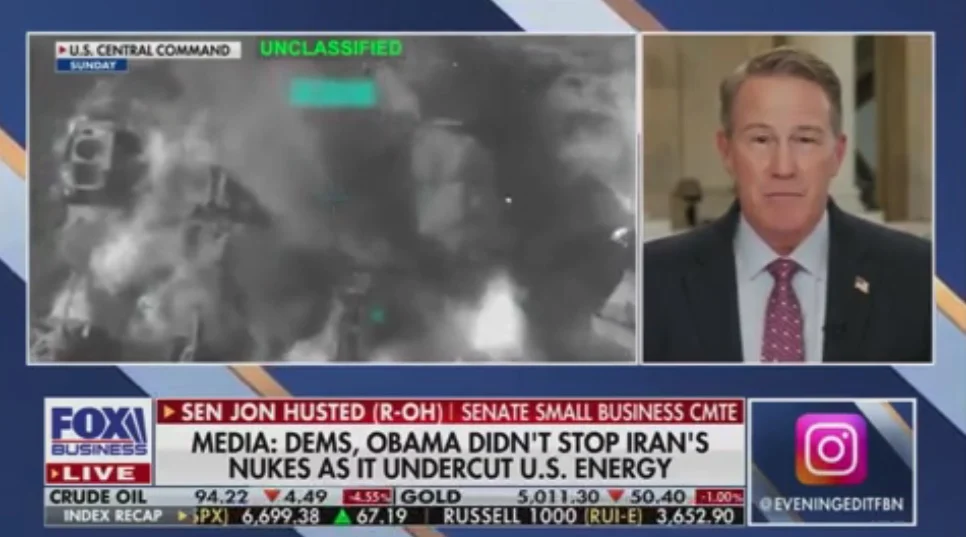
The geopolitical landscape of the Middle East shifted violently on February 28, 2026, when a joint military operation by the United States and Israel launched a series of targeted aerial bombardments against Iranian infrastructure. In the weeks following the commencement of hostilities, the global economy has been sent into a tailspin as Iran retaliated by effectively closing the Strait of Hormuz, a narrow waterway through which approximately 20 percent of the world’s crude oil supply passes. While the Trump administration faces mounting domestic and international pressure over the escalation, Republican Senator Jon Husted of Ohio has introduced a contentious narrative, placing the onus for the current maritime blockade on the policies of former President Joe Biden and his predecessor, Barack Obama.
Appearing on Fox Business on Monday, Senator Husted argued that the strategic vulnerabilities currently being exploited by Tehran are the direct result of "years of Democratic appeasement." Husted’s remarks come at a critical juncture as the price of West Texas Intermediate (WTI) and Brent Crude oil surge to record highs, threatening to undo the economic promises of the current administration. According to Husted, the Biden administration’s focus on the "Green New Deal" and a perceived failure to enforce diplomatic "red lines" provided Iran with the financial and military latitude to prepare for the current blockade.
The Strategic Importance of the Strait of Hormuz and the 2026 Crisis
The Strait of Hormuz is widely regarded as the world’s most sensitive oil transit choke point. Connecting the Persian Gulf with the Gulf of Oman and the Arabian Sea, the strait is the primary artery for petroleum exported from Saudi Arabia, Iran, the United Arab Emirates, Kuwait, and Iraq. In 2025, the U.S. Energy Information Administration (EIA) estimated that an average of 21 million barrels of oil per day flowed through the passage.
The closure of the strait began shortly after the February 28 strikes, when Iranian Revolutionary Guard Corps (IRGC) forces deployed naval mines and utilized shore-to-ship ballistic missiles to target tankers attempting to navigate the narrow passage. This marks the first time in modern history that the strait has been completely rendered impassable for commercial traffic.
President Donald Trump, who reportedly ignored warnings from intelligence aides that an attack on Iranian soil would lead to a maritime shutdown, has spent the last week attempting to rally a coalition of NATO allies to provide naval escorts for tankers. However, the response from European and Asian allies has been lukewarm at best, with many leaders citing the unilateral nature of the initial U.S. strikes as a reason for their hesitation to commit military resources to a potential wider conflict.
Senator Husted’s Critique of Democratic Foreign Policy
In his interview, Senator Husted framed the current crisis not as a failure of the Trump administration’s recent military decisions, but as a systemic failure of the previous decade of Democratic governance. He specifically targeted the Joint Comprehensive Plan of Action (JCPOA), often referred to as the Iran Nuclear Deal, which was brokered under the Obama administration and briefly revived in spirit, though not in full form, during the Biden years.
"Essentially, Joe Biden and his entire team, with their focus on the Green New Deal, helped empower groups like Iran," Husted stated. "They allowed Iran to finance wars and failed to stand up to them as they crossed red lines time after time. Now, President Trump is having to fix the problems of the past. It was the failures of two Democrat presidents that put us in a position today where Iran had the capacity to make a nuclear weapon, the ability to send ballistic missiles into their neighbors, and the drones and capacity to cut off the Strait of Hormuz."
Husted’s assertion that Iran has the capacity to make a nuclear weapon is a point of significant contention. While the International Atomic Energy Agency (IAEA) has noted increased enrichment levels following the U.S. withdrawal from the JCPOA in 2018, independent analysts and arms control organizations have maintained that Iran has not yet produced weapons-grade uranium. During the Obama administration, the JCPOA implemented a rigorous inspection regime designed to ensure Iran’s nuclear program remained purely civilian. The subsequent withdrawal from the deal by the first Trump administration in 2018 is viewed by many diplomatic historians as the catalyst for Iran’s resumed enrichment activities.
A Timeline of Escalation: February to March 2026
The path to the current blockade was marked by a series of rapid escalations that caught many international observers off guard:
- February 15, 2026: Tensions spike following reports of a cyber-attack on Israeli electrical grids, which Tel Aviv attributes to Iranian-backed actors.
- February 20, 2026: The Trump administration issues an ultimatum to Tehran, demanding a complete cessation of support for regional proxies in Lebanon and Yemen.
- February 28, 2026: U.S. and Israeli forces launch "Operation Desert Resolve," striking dozens of sites within Iran, including suspected drone manufacturing plants and command centers.
- March 1, 2026: Iran announces the closure of the Strait of Hormuz, declaring it a "hostile military zone."
- March 5, 2026: Global oil prices jump by 15 percent in a single trading session. Trump aides reportedly leak that the President had been briefed on the possibility of a blockade but dismissed it as a "bluff."
- March 10, 2026: Iranian-linked militias launch retaliatory strikes against U.S. bases in Iraq and Syria. Simultaneously, Israeli ground forces enter southern Lebanon to target Hezbollah positions.
- March 15, 2026: The Iranian U.N. envoy reports that 1,332 Iranian civilians have been killed in the ongoing strikes, sparking international protests.
Economic Implications and Global Market Reaction
The closure of the Strait of Hormuz has had an immediate and devastating impact on global energy markets. With 20 percent of the world’s oil supply effectively trapped in the Persian Gulf, the price of gasoline in the United States has surged past $6.00 per gallon in many regions. This spike threatens to reignite inflationary pressures that the Federal Reserve had only recently brought under control.
Market analysts have expressed amazement at the current situation. Many have pointed out the irony of the Trump administration’s "Drill, Baby, Drill" energy policy being undermined by a war that has disrupted the very supply chains it sought to dominate. "The administration had every tool available to maintain energy stability," one energy economist noted on Mediaite. "But by initiating a conflict without securing the world’s most vital waterway first, they found the only way to screw up a favorable energy position."
Furthermore, the lack of international cooperation has left the U.S. in a precarious position. Traditionally, the U.S. Navy has acted as the guarantor of freedom of navigation in the Persian Gulf. However, with Iranian anti-ship technology having advanced significantly over the last decade—largely through the development of low-cost, high-impact "suicide drones"—the cost of clearing the strait may be higher than the U.S. military is willing to pay without a broader coalition.
The Humanitarian Cost and Regional Instability
Beyond the economic data, the human cost of the conflict is mounting. The reported death toll of over 1,300 Iranian civilians has drawn condemnation from human rights organizations and several European capitals. The strikes have hit not only military targets but also dual-use infrastructure, leading to widespread power outages and water shortages in several Iranian cities.
In Lebanon, the Israeli invasion has displaced tens of thousands of people, creating a new refugee crisis on the shores of the Mediterranean. The Trump administration has offered varying justifications for the scope of the war, with the President himself providing vague assessments of the conflict’s objectives. When asked by Fox News’ Steve Doocy whether the operation was a "little excursion" or a full-scale war, the President’s response remained non-committal, leaving both allies and adversaries uncertain of the endgame.
Broader Political and Diplomatic Implications
The rhetoric from Senator Husted reflects a broader strategy within the Republican party to insulate the current administration from the political fallout of the war. By framing the conflict as a "remedy" for the "failures of the past," supporters of the administration are attempting to shift the focus from the immediate tactical decisions of 2026 to the diplomatic legacy of 2012–2020.
However, critics argue that this narrative ignores the reality of the 2018 withdrawal from the JCPOA, which many believe set the stage for the current lack of oversight and escalation. The Biden administration’s efforts to re-engage with Iran were often stymied by domestic political opposition and Iranian intransigence, but they did not result in the level of kinetic conflict seen today.
As the war enters its fourth week, the focus remains on whether the United States can successfully reopen the Strait of Hormuz without sparking a broader global conflagration. With oil prices continuing to climb and the domestic political divide deepening, the 2026 Iran War stands as the most significant challenge to global stability in the post-Cold War era. Whether the blame lies with the policies of the past or the actions of the present remains a subject of fierce debate, but the reality of the closed strait is a problem that requires an immediate, and perhaps costly, solution.

 Yuyun Lusiyani
 Joko Widodo
 Eva Lovia
 Pevita Pearce