
 Eva Lovia
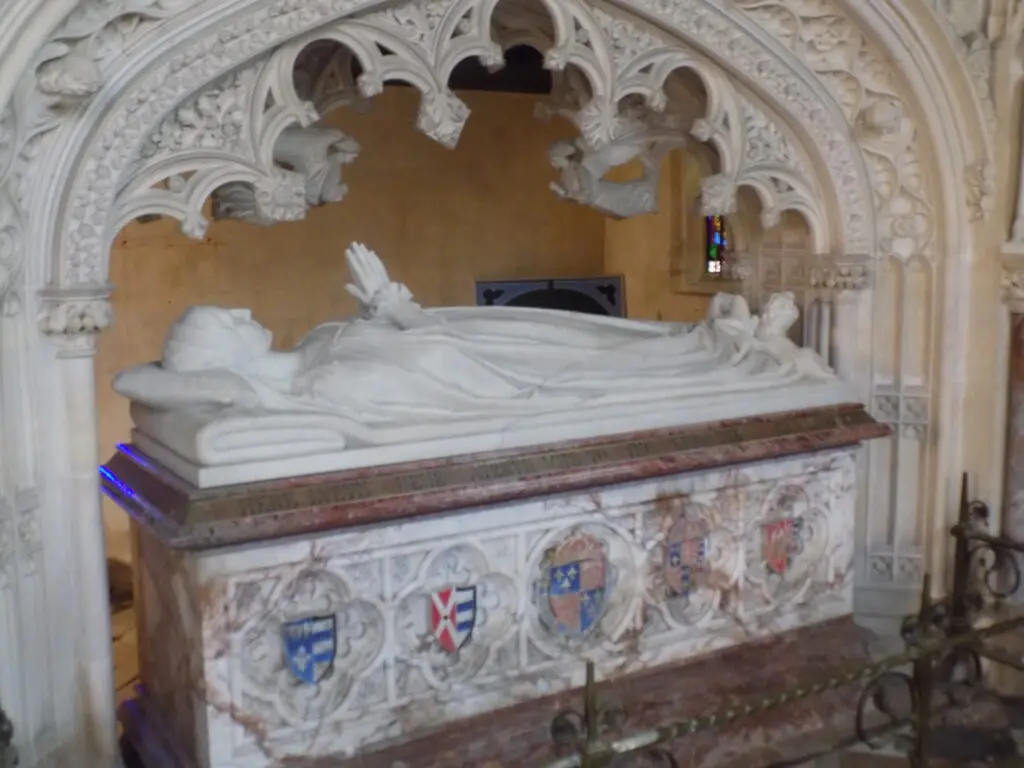
Katherine Parr, the indomitable last queen consort of Henry VIII, died in the predawn hours of September 5th, 1548, her passing a mere thirteen months after the formidable monarch’s own demise. Interred two days later within the hallowed grounds of Sudeley Castle in Gloucestershire, her final resting place was not to remain undisturbed. Her mortal remains, lost to the annals of time, were later rediscovered under circumstances as peculiar as the questions that continue to surround her abrupt end. A woman who had occupied one of the most pivotal positions in England, Parr’s vibrant and consequential life was swiftly overshadowed, leaving history to grapple with the true narrative of Henry VIII’s final queen.
A Queen Who Defied Expectations
History often bestows upon Katherine Parr the epithet of “survivor.” In a court rife with danger, and married to a king notorious for his marital turnover, Parr navigated the treacherous currents of Henry VIII’s final years, emerging with her marriage intact and her head firmly attached to her shoulders. This was no small feat, particularly for a woman who had already weathered two previous marriages, to John Nevill, 3rd Baron Latimer, and to John Seymour, a union that brought her into contact with the influential Seymour family, including Thomas Seymour, her eventual fourth husband. Yet, despite her proven resilience, her reign as Queen Consort concluded swiftly after Henry VIII’s death on January 28th, 1547. Kateryne The Quene, as she was known, was dead by September 1548. The question that lingers is how the story of a royal woman who so masterfully navigated the caprices and perils of the Tudor court concluded so soon after the storm had seemingly passed.
The prevailing narrative, at a glance, appears straightforward. Katherine Parr remarried within months of Henry VIII’s passing, wedding the ambitious Thomas Seymour in May 1547. Her death, occurring in September 1548, is attributed to complications following the birth of her daughter, Mary Seymour, born on August 30th of that year. She was laid to rest in the castle that had become her home, her memory often reduced to that of a dowdy, devoted consort who patiently tended to Henry VIII’s debilitating leg ulcers, while the Tudor court seethed with intrigue over the impending power vacuum. In this simplified version, Katherine becomes a mousey queen who found late-life love, only to meet a tragic, albeit natural, end.
However, this portrayal significantly diverges from the woman who lived. The conclusion that childbirth was the sole cause of her demise was not firmly established until the 18th century, long after decades of whispered speculation had pointed towards poisoning. Furthermore, Parr’s funeral itself was marked by unusual solemnity, and her grave lay undiscovered for centuries, its rediscovery transforming it into a macabre tourist attraction. These lingering enigmas compel a deeper examination: what truly precipitated the death of Katherine Parr, Queen of England?
The Final Days: Birth, Accusation, and Departure
There is little dispute that Katherine Parr died six days after giving birth. In August 1548, she was residing at Sudeley Castle, the estate of her new husband, Thomas Seymour. Seymour, the maternal uncle of the new king, the ten-year-old Edward VI, had been politically sidelined by his elder brother, Edward Seymour, the Lord Protector, and harbored considerable resentment. Parr’s daughter, Mary, was born on August 30th, and by all initial accounts, the queen appeared to be in good health.
The sole surviving contemporary account of her final days comes from Elizabeth Tyrwhit, one of her ladies-in-waiting. Tyrwhit’s testimony, recorded later, suggests that the queen, despite seeming strong, became convinced of her impending death on September 3rd, 1548, just two days before she passed. Crucially, Parr reportedly accused Thomas Seymour of hastening her end. She died in the early hours of September 5th, with Seymour departing Sudeley Castle almost immediately afterward.
Suspicion of Poison and the Rise of Childbed Fever
In the centuries following her death, historians did not shy away from the implication of foul play. Contemporary and later accounts often noted that her death was “not without suspicion of poison.” It was only in the 18th century, a period when antiquarian interests turned towards the Tudor era, that the theory of childbed fever gained traction. The burgeoning field of medical science was beginning to meticulously study puerperal fever, and Parr’s reported symptoms were retroactively interpreted as aligning with the emerging understanding of this deadly postpartum infection. Her apparent well-being followed by a rapid decline, accompanied by what was then interpreted as delirium, fit the pattern of infection setting in after childbirth.
However, this medical explanation relies on significant inference. Elizabeth Tyrwhit’s account offers no detailed physical description of Katherine Parr’s condition that would definitively confirm childbed fever. Moreover, the circumstances surrounding Tyrwhit’s testimony also raise questions of potential bias. Her statement was made as part of the proceedings against Thomas Seymour, who was later accused and executed for treason. By the time Tyrwhit recounted the queen’s final moments, Seymour was imprisoned in the Tower of London, facing charges of attempting to seize control of the young king. It is conceivable that Tyrwhit’s description of a queen accusing her husband of murder was crafted to bolster the prosecution’s case against a man already deemed a villainous schemer.
Despite this, the absence of definitive proof to the contrary leaves the possibility of suspicion intact. Thomas Seymour was undoubtedly a man of ambition and questionable ethics, known for his ruthless pursuit of power. His marriage to Katherine Parr had already been fraught with scandal, particularly his alleged attempts to seduce Princess Elizabeth, Henry VIII’s eldest daughter, who was under Katherine’s care. Seymour’s actions in the period following Parr’s death, a complex web of deceit and political maneuvering aimed at consolidating power around the young king, ultimately led to his own downfall and execution as an enemy of the state. While it was not uncommon for husbands to be absent from their wives’ funerals during this era, Seymour’s swift departure from Sudeley Castle immediately after Parr’s death is undeniably conspicuous.
An Unseemly and Hasty Burial
Further fueling speculation is the uncharacteristic haste of Katherine Parr’s burial. Within 48 hours of her death, she was interred. In Tudor England, royal funerals were often elaborate affairs, frequently taking weeks to arrange due to the complexities of embalming, transportation, and court mourning protocols. Given that Sudeley Castle was over 100 miles from London, it is even uncertain whether news of the queen’s death had reached the capital before her interment.
Katherine Parr was a devout Protestant, and it is plausible she would have eschewed a grand, ostentatious funeral in a major Catholic cathedral. However, even with her personal preferences in mind, her burial lacked the customary pomp and ceremony befitting a Queen of England. She was laid to rest in the chapel of Sudeley Castle, a relatively modest affair given her status.
Paradoxically, her funeral is widely regarded as the first public Protestant funeral of a major English figure, a fitting tribute to her ardent advocacy for religious reform. Her almoner, Miles Coverdale, a prominent reformer who had been in exile for his beliefs, was present to officiate. The written account of her funeral emphasizes its simplicity, yet it glosses over a most peculiar detail.
The Unexplained Preservation: A Lead Casket and Waxed Cloth
Katherine Parr was interred in an astonishing number of layers of cere cloth and sealed within a tightly fitted lead casket. This meticulous preservation was unusual. While royalty were often embalmed for long journeys or delayed funerals, Parr’s death occurred mere yards from her intended grave, and her interment followed within two days. The substantial effort invested in preparing her body, a process that consumed much of the 48 hours between her death and burial, raises a pointed question: why such extreme measures to prevent decomposition in a situation where rapid burial was already occurring?
This raises two primary possibilities. Did someone have a vested interest in preserving her body, perhaps to conceal the true cause of death or to prevent its examination? Or did Katherine Parr succumb to another affliction, equally notorious for its lethality during the period, such as the plague? The preservation would have been highly effective against decomposition from natural causes, but also served to conceal signs of poisoning or other unnatural influences.
A Lost Tomb and a Macabre Rediscovery
Katherine Parr’s final resting place remained undisturbed until the turmoil of the English Civil War in the 17th century led to the castle’s neglect and the loss of her tomb’s precise location. It was rediscovered in the late 18th century by a farmer, reportedly persuaded by a group of “lady sightseers” to investigate the area. The news of this discovery spread rapidly, and in the ensuing years, her grave became a site of morbid curiosity.
The exceptional preservation of her body, attributed to the cere cloth and lead casket, meant that upon its initial rediscovery, her remains were in near-perfect condition. However, repeated exhumations and the relentless curiosity of visitors inevitably led to the decomposition of her remains. Eventually, to protect what was left of the queen, her remains were reinterred within the more secure confines of the Sudeley Castle chapel. A more permanent and magnificent tomb, marking her resting place, was constructed in the 19th century, bringing a degree of finality to this chapter of her mysterious life and death.
The story of Katherine Parr’s death is the final, enigmatic act in the life of a woman of remarkable influence. She once served as Regent of England during Henry VIII’s campaign in France, a testament to her intelligence and capability. Yet, in her final years, she found herself excluded from the inner circle of power that coalesced around the young Edward VI, ultimately spending her last days far from the court she had once commanded. The question of how Katherine Parr, Queen of England, truly met her end continues to resonate, a lingering mystery at the close of a consequential Tudor life.
The enduring enigma of Katherine Parr’s death is further explored in the recently published book, The Mysterious Death of Katherine Parr, by Royal Central’s Editor in Chief, available now from Pen and Sword Books.




 Nila Kartika Wati

 Lina Irawan

 Yuyun Lusiyani

 Ana Megawati

 Joko Widodo
