
 Yuyun Lusiyani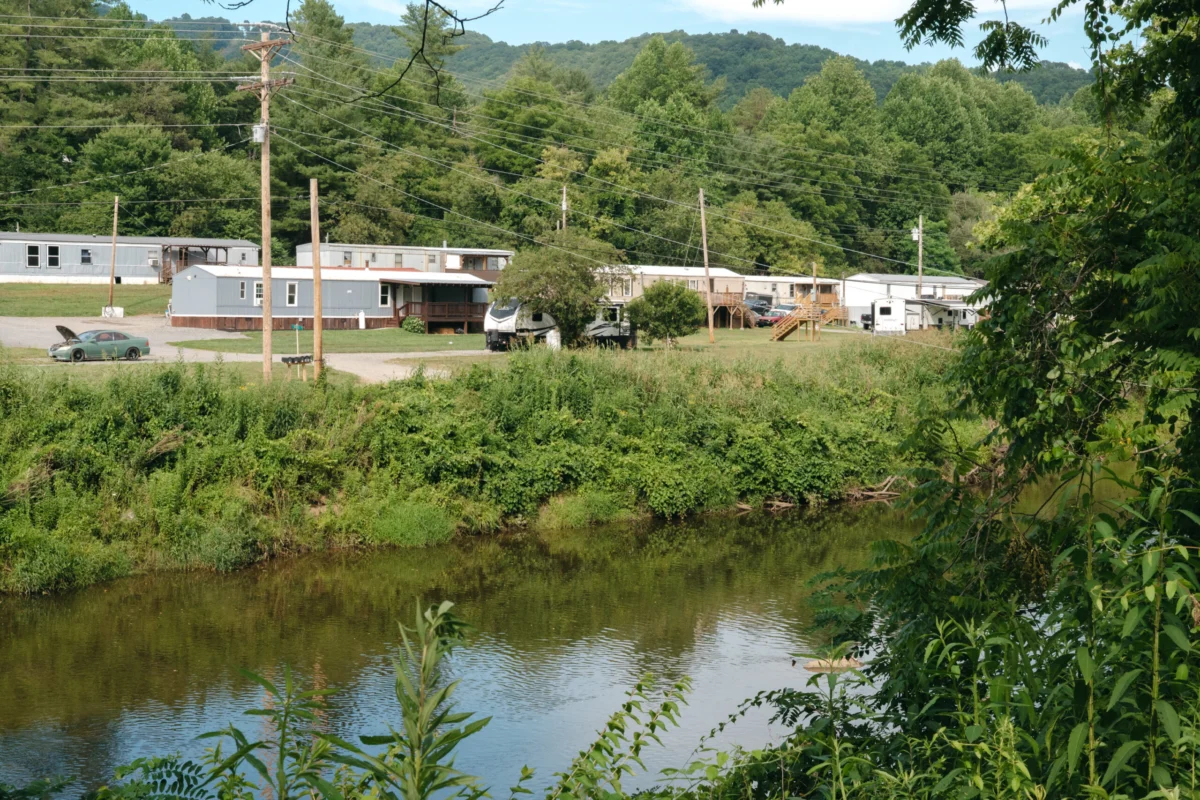
The devastating loss of Sandra Rogers and three of her beloved dogs in the raging waters of the Pigeon River during Hurricane Helene in September 2024 was not an isolated tragedy, but rather the grim culmination of a two-decade-long cycle of disaster and insufficient policy. Her death, alongside the destruction of her mobile home, which was swept into the same bridge that claimed Dave Masters’ father’s home 20 years prior, illuminates a systemic failure to protect vulnerable communities residing in flood-prone areas, particularly those in mobile home parks. Despite repeated warnings, documented flood risks, and prior evacuations, residents of the Hyder Mountain Road mobile home park in Clyde, Western North Carolina, have been consistently left exposed to an escalating threat, trapped by a complex interplay of outdated federal programs, local governmental inertia, and economic realities that prioritize property rights over human safety.

Western North Carolina: A Region on the Front Lines of Inland Flooding
Western North Carolina, with its dramatic mountainous terrain crisscrossed by numerous rivers and creeks, presents a unique and increasingly perilous landscape for inland flooding. While often overlooked in discussions of hurricane impact, these storms, even after making landfall and weakening, can unleash catastrophic rainfall when they collide with the Appalachian Mountains. The orographic lift forces moisture-laden air upwards, intensifying precipitation and leading to rapid river swelling, flash floods, and dangerous landslides. The Pigeon River, typically a serene waterway, transforms into a formidable torrent during such events, its narrow valley amplifying the destructive power of rising waters.
Climate change projections suggest an increase in the frequency and intensity of extreme rainfall events, making regions like Haywood County even more susceptible to such "rain bombs." What were once considered "once-in-a-century" floods are now occurring with alarming regularity, challenging historical assumptions about flood risk and mitigation strategies. This escalating environmental threat underscores the urgent need for robust, adaptive disaster preparedness and mitigation policies that acknowledge the changing climate reality.

A Chronology of Repeated Devastation at Hyder Mountain Road
The story of the Hyder Mountain Road mobile home park is a stark timeline of escalating risk and human cost:
September 2004: The Double Whammy of Frances and Ivan
The first major blow struck in early September 2004 when Hurricane Frances, followed just ten days later by Hurricane Ivan, unleashed unprecedented rainfall on Western North Carolina. The Pigeon River roared to life, its swollen waters inundating the Hyder Mountain Road area. Dave Masters, observing the unfolding disaster from his hillside trailer, bravely waded through waist-deep, frigid water to rescue his 63-year-old father, whose home, typically 100 feet from the riverbank, was engulfed. Within an hour, Masters’ father’s residence became a "bobber on a fishing line," floating down the road before colliding with a telephone pole and splitting apart, its remains lodging under a downstream bridge.

In the immediate aftermath, Haywood County recognized the severity of the threat. It condemned several mobile homes in the park and, crucially, bought out a traditional wood-frame house across the river under a federally funded program. Masters’ father and another family from the trailer park were also relocated out of the floodplain, a move explicitly aimed at "mitigat[ing] the possibility of future damage to life and property." This action, however, was incomplete. Despite federal floodplain maps clearly indicating the park’s vulnerability, the county did not pursue a buyout of the entire mobile home park. Instead, the park owners were allowed to rent out the now-vacant, flood-damaged lots, effectively resetting the stage for future disasters.
August 2021: Tropical Storm Fred Signals Lingering Vulnerability
Seventeen years later, the lessons of 2004 appeared largely forgotten or ignored. Tropical Storm Fred swept through the region in August 2021, once again causing the Pigeon River to surge. This time, five of the six trailers directly fronting the river at the Hyder Mountain Road park sustained damage, including the very plot where Masters’ father had lived. Joe Rogers, who had moved into a single-wide trailer next to Masters’ father’s former plot in 2006, experienced his first major flood. Muddy water rose three inches inside his home, damaging the floors and foundation. While FEMA assistance covered some repairs, allowing residents to return, the underlying risk remained unaddressed. The perception among many residents, who lacked memory of the 2004 devastation, was that Fred caused only "minor damage," fostering a false sense of security.

September 2024: Hurricane Helene’s Fatal Impact
The inevitable struck with brutal force in September 2024, when Hurricane Helene, a Category 4 storm that devastated Florida, spun inland, unleashing a "catastrophic, life-threatening event" on Western North Carolina. Haywood County officials issued dire warnings, explicitly stating the storm could surpass previous events. Yet, many residents of Hyder Mountain Road, recalling only Fred’s "minor" impact and driven by economic necessity, chose to stay, including Joe and his wife, Sandra Rogers, who felt compelled to protect their numerous rescued dogs and pet birds.
On the night of September 26, 2024, the Pigeon River crested at a record 30 feet, an unimaginable rise from its typical 5-foot depth. Within minutes, the Rogers’ home was deluged, water rising from ankle-deep to chest-high. Joe desperately tried to move vehicles and pack birds, but the situation rapidly deteriorated. The trailer was violently ripped from its foundation, and Sandra, trapped inside, drowned along with three of her dogs as the mobile home was swept downstream, eventually crashing into the same bridge that had claimed a home two decades earlier. Sandra Rogers’ death served as a horrifying validation of the repeated warnings and a stark indicator of the policy failures that had allowed such a predictable tragedy to occur.

The Policy Chasm: Mobile Homes and Disaster Mitigation
The repeated losses and, ultimately, the loss of life at Hyder Mountain Road expose a critical and persistent gap in federal disaster policy. The Federal Emergency Management Agency (FEMA) programs designed to buy out disaster-prone properties, hailed as the "cornerstone of the Nation’s system for emergency management," were primarily developed with traditional homeowners and real estate in mind. Mobile homes, despite serving as the country’s largest source of affordable housing, are often categorized as personal property, akin to vehicles or boats, rather than real estate. This distinction fundamentally alters their eligibility and the incentives for mitigation.
Lack of Incentive for Park Owners:
For a mobile home park to be bought out, the land owner, not the individual trailer owner, must initiate the process. However, FEMA’s current program offers minimal incentive for park owners to participate. They are not compensated for lost rental income or for the value of the mobile homes on their land. As John Richardson, a former mobile home park owner in neighboring Buncombe County, explained, "The cash flow is so good once you’re established in it that there isn’t an incentive to take a buyout." With a persistent housing shortage, even flood-prone lots can generate significant monthly income, making selling the land an economically disadvantageous proposition for owners. This financial reality, coupled with a lack of awareness about buyout programs (as some owners claim), means park owners frequently allow new trailers to occupy vacant, high-risk spots, perpetuating the cycle of vulnerability. Efforts to contact the current owners of the Hyder Mountain Road park, Art and Lynne Heinmiller, for comment on their decision to re-rent lots, were met with silence or reluctance.

Local and State Government Limitations:
Haywood County’s initial response to the Hyder Mountain Road situation highlights a common challenge for smaller jurisdictions. Cody Grasty, the county’s recovery officer, admitted that he "did not know it was even possible" to buy out an entire mobile home park until a neighboring county successfully did so after Helene. This lack of institutional knowledge and proactive guidance from state authorities leaves local governments ill-equipped to navigate complex federal programs. North Carolina Emergency Management, the state agency that reviews buyout applications, stated there is "no specific guidance for mobile home park buyouts" and that the process is "no different than it is for commercial or residential properties." They emphasized that participation is "entirely the property owners and the local jurisdiction’s decision." This hands-off approach, while adhering to current policy, effectively creates a vacuum where proactive mitigation could occur.
Furthermore, neither Haywood County nor the state of North Carolina maintains a comprehensive list of high-risk properties where mitigation is deemed necessary for public health and safety—a standard practice in many other states. This absence prevents targeted intervention and leaves communities vulnerable until a disaster forces a reactive, often insufficient, response.

Affordable Housing Crisis and the Cycle of Vulnerability
The predicament of Hyder Mountain Road is inextricably linked to the broader affordable housing crisis gripping many parts of the United States, including Appalachia. Mobile home parks often represent the last bastion of affordable living for low-income families, seniors, and others with limited financial resources. As housing costs continue to climb, these communities become even more vital, yet simultaneously more dangerous. Residents, facing few alternatives, are often forced to choose between unsafe living conditions and homelessness.
This economic reality creates a tragic feedback loop: disasters strike, homes are destroyed, but because residents have nowhere else to go and park owners have little incentive to sell, the cycle repeats. K.K. Bautista, a single mother living in a recreational camper on a previously flooded lot at Hyder Mountain Road after Helene destroyed her prior home, embodies this dilemma. "When it rains, I don’t sleep and I watch the river," she confessed, highlighting the constant anxiety and fear that pervades these vulnerable communities. Her choice was not one of preference, but of necessity, as the Hyder Mountain Road lot was the only place she could afford.

Failed Interventions and Pathways Forward
North Carolina has, in the past, attempted to address some of these issues. After Hurricane Floyd in 1999, the state legislature established the Crisis Housing Assistance Fund. This program aimed to assist families who didn’t qualify for federal aid, including mobile home residents, by repairing homes or relocating families. Yolanda Abram, retired director of the North Carolina Redevelopment Center, which oversaw the fund, noted that it "would not allow new homes to go back in the floodplain" in almost every circumstance. The program received additional state funding in 2005 to relocate homeowners in flood and landslide zones impacted by that year’s hurricanes, benefiting approximately 40 Haywood County families, including Masters’ father. While successful in individual relocations, the program, much like current efforts, failed to prevent new families from moving onto the vacated, flood-prone lots, thus not addressing the root cause of systemic vulnerability.
More recent initiatives, such as Gov. Josh Stein’s billion-dollar Hurricane Helene recovery program, Renew NC, also face similar limitations. While Renew NC can help relocate mobile home owners whose damaged trailers face future flood risks, its manual explicitly states it does not prevent new families from occupying lots with a history of flooding.

In stark contrast, other states and counties have implemented more comprehensive solutions. Central Pennsylvania’s Greene Township, for example, fully funded the buyout of a 54-home park after 2006 floods, paying the property owner and relocating residents. Harris County, Texas, offered a multimillion-dollar sum to a mobile home park owner and up to $210,000 to homeowners for relocation, alongside 42 months of rental assistance for renters. These examples demonstrate that robust, multi-faceted approaches, which include fair compensation for park owners and comprehensive support for residents, are not only possible but essential for breaking the cycle of repeated disaster.
The Unfolding Crisis and a Call to Action
The current situation at Hyder Mountain Road epitomizes the policy shortcomings. Following Helene, Haywood County mandated that new mobile homes in the floodplain be elevated at least 8 feet, incurring costs that can reach tens of thousands of dollars. However, this regulation does not apply to recreational campers, which are allowed to occupy the same flood-prone lots provided they can be driven or towed away during a storm. The reality, however, is that many of these campers have become year-round residences, with water, sewer, and electric hookups, and undercarriages wrapped in insulation. Without elevation and anchoring, these "temporary" homes are just as susceptible to being swept away by fast-moving waters, placing their occupants in grave danger. Clyde Volunteer Fire Department Chief Wentfard Henson succinctly captures the grim outlook: "Where they’re at, it’s not if, it’s just when. It’s going to flood again, there’s no doubt, because it flooded every time we’ve had a storm. It’s flooded four times."

Dave Masters, who moved out of the park before the 2021 floods, remains deeply disturbed by the ongoing risk. "Without a doubt in my mind, it’s going to happen again," Masters asserted. "They need to remove it." His sentiment echoes a growing chorus of voices calling for fundamental reform. The tragic death of Sandra Rogers must serve as a turning point, compelling federal, state, and local authorities to re-evaluate existing disaster mitigation policies. This necessitates a reclassification of mobile homes within federal programs, the creation of stronger financial incentives for mobile home park owners to participate in buyouts, and the development of comprehensive, proactive strategies to identify and mitigate risk in all vulnerable communities, not just those occupying traditional real estate. Only then can the cycle of repeated devastation be broken, ensuring that no more lives are needlessly lost to preventable floods in communities like Hyder Mountain Road.



 Joko Widodo
 admin
admin
 Lina Irawan
 Jia Lissa
 Pevita Pearce