
 Eva Lovia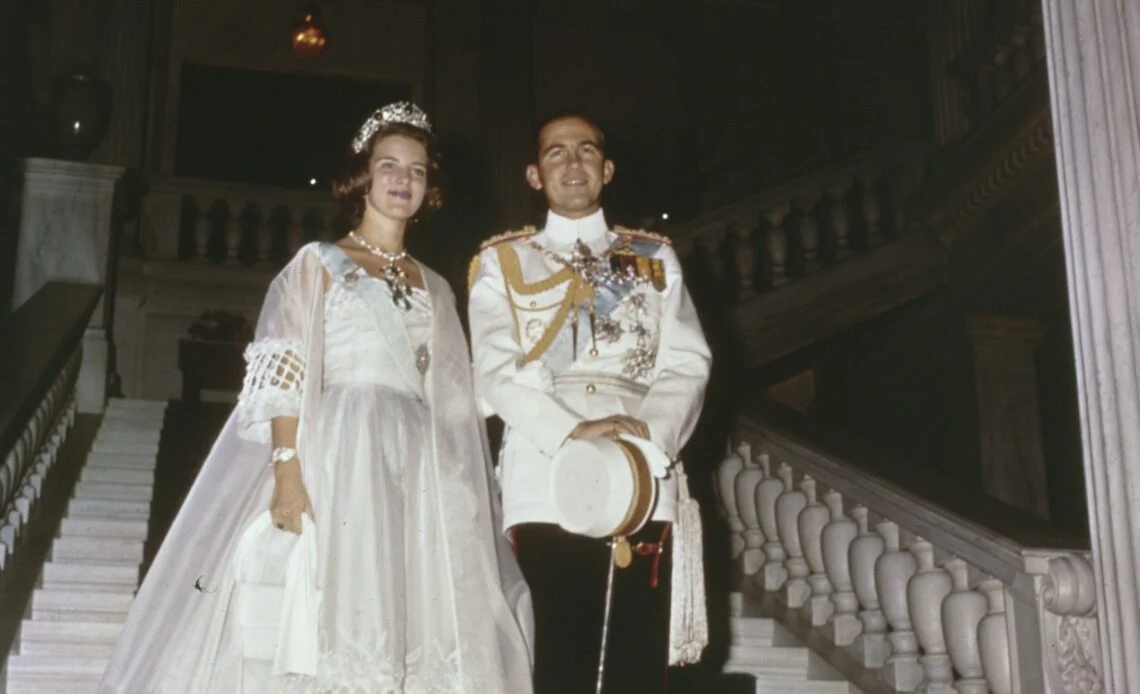
The union of Crown Prince Constantine of Greece and Princess Anne-Marie of Denmark, solemnised on September 18, 1964, was far more than a mere matrimonial event; it was a landmark occasion that captured the imagination of Europe and the world. This marriage, which transformed a young princess into a queen and cemented a celebrated love story, unfolded against a backdrop of evolving European monarchies and shifting political landscapes. The subsequent decades would test their bond through political upheaval and eventual exile, yet their enduring partnership, which tragically concluded with Constantine’s passing in early 2023, had its roots in a wedding ceremony that resonated with both historical significance and deeply personal affection.
The Genesis of a Royal Romance
The story of Constantine and Anne-Marie’s courtship began five years prior to their wedding, in the spring of 1959. The then Crown Prince Constantine, the sole male heir to the Greek throne, accompanied his parents, King Paul and Queen Frederica of Greece, on a state visit to Denmark. During this official delegation, they were hosted by the Danish royal family, including King Frederik IX and Queen Ingrid, and their three daughters. It was amidst this regal hospitality that the young Constantine first encountered the then thirteen-year-old Princess Anne-Marie.
While their initial meeting may have been brief, destiny intervened again. Two years later, in 1961, Constantine and Anne-Marie found themselves reunited in Denmark. The spark that had been ignited then, evidently, had not extinguished. By May 1962, their burgeoning affection was evident to those around them. Princess Anne-Marie served as a bridesmaid to Constantine’s sister, Princess Sofia, at her wedding in Athens. This occasion provided the couple with ample opportunity to deepen their connection, and by its conclusion, both were undeniably smitten.
A Royal Engagement and a Father’s Prudence
Following the palpable chemistry at Princess Sofia’s wedding, Crown Prince Constantine took the initiative. That summer, he formally proposed to his Danish princess. However, King Frederik IX, a man known for his pragmatism, harboured reservations about an immediate marriage for his youngest daughter, who was merely sixteen years old. He insisted that Anne-Marie’s education must be a priority, and that a wedding should not precede its completion. Furthermore, he stipulated that the engagement itself should remain private for a period, allowing the young couple time to mature and for the implications of such a significant union to be properly considered.
The official announcement of the impending royal union finally came on January 23, 1963. A twenty-two-year-old Crown Prince Constantine travelled to Copenhagen to stand alongside his fiancée and her family on the balcony of the magnificent Amalienborg Palace. The initial plan was for the wedding to take place in two years’ time, in 1965. This timeline would have allowed Anne-Marie to complete her education and the couple to further solidify their relationship.
A Shift in Destiny: From Crown Prince to King
However, the course of royal history is often dictated by unforeseen circumstances. In March 1964, a profound tragedy struck the Greek monarchy: the passing of King Paul. This event irrevocably altered Constantine’s trajectory. He ascended to the throne as Constantine II of Greece, a mere eighteen years old. The sudden elevation to monarchical responsibilities necessitated an immediate acceleration of his personal life. The wedding plans, once set for a more distant future, were rapidly brought forward. The ceremony was rescheduled for September of the same year, a mere six months after his accession. This swift transition from Crown Prince to King, coupled with the impending marriage, presented a period of immense personal and political transition for the young monarch.
Pre-Wedding Celebrations and a Bride’s Preparation
In the week preceding the wedding, Princess Anne-Marie arrived in Athens, her new home country, having participated in a series of celebratory events in Denmark. These included numerous functions and banquets designed to honour the soon-to-be royal couple. The atmosphere in Athens was electric, with anticipation building for the grand spectacle. A significant event in the lead-up was a gala dinner hosted for the assembled royal guests at the Royal Palace, a testament to the international importance of the impending nuptials.
Crucially, by the time Princess Anne-Marie walked down the aisle, she had formally embraced the Greek Orthodox faith. This conversion was a significant step, reflecting her commitment to her new country and her future role as Queen of Greece.
The Grand Ceremony: A Spectacle of European Royalty
The wedding ceremony itself took place at the Metropolitan Cathedral of the Annunciation in Athens, a magnificent edifice befitting the occasion. Approximately 1,200 distinguished guests, representing the cream of European royalty, were in attendance. Among the notable figures present was the Prince of Wales (later Queen Elizabeth II’s eldest son, Prince Charles), representing the British monarchy. Also in attendance were King Baudouin and Queen Fabiola of the Belgians, Queen Juliana of the Netherlands, King Olav V of Norway, and King Gustaf VI Adolf of Sweden. The presence of so many reigning monarchs and their consorts underscored the immense political and symbolic weight of this union. The solemn vows were exchanged, marking the official commencement of Constantine II and Anne-Marie’s journey as King and Queen. The religious ceremony was followed by a lavish reception held at the Royal Palace, allowing the newlyweds and their esteemed guests to celebrate the momentous occasion.
The Bridal Ensemble: A Symphony of Tradition and Elegance
Princess Anne-Marie’s wedding gown was a masterpiece of design, created by the Danish couturier Jorgen Bender. The dress featured a classic rounded neckline and elegant three-quarter length sleeves, evoking a sense of timeless grace. The empire line waist accentuated her youthful figure, flowing into a voluminous skirt that extended into a train measuring approximately twenty feet. The choice of a Danish designer was a poignant nod to her heritage, ensuring a piece of her homeland accompanied her on this significant transition. Her bridal bouquet was a delicate arrangement, predominantly featuring lily of the valley, a flower symbolically associated with a return to happiness and purity, a fitting sentiment for a young bride embarking on a new chapter.
A Tiara Steeped in Royal History
No royal bride is complete without a tiara, and Anne-Marie’s choice was one that carried with it generations of royal lineage. She opted for an all-diamond diadem that had belonged to her mother, Queen Ingrid of Denmark. This exquisite piece was no ordinary heirloom; it was the Khedive of Egypt tiara. Queen Ingrid had inherited it from her own mother, Princess Margaret of Connaught, who had received it as a wedding gift from the Khedive of Egypt in 1905. The tiara, adorned with intricate swirling scrolls of diamonds, had been a symbol of good fortune and regal continuity, worn by all of Queen Ingrid’s female descendants on their wedding days.
Furthermore, Anne-Marie’s ensemble incorporated another precious heirloom that provided a direct link to the grandmother she never knew: Princess Margaret. The tiara was used to secure an Irish lace veil, a delicate creation that Princess Margaret herself had worn at her own wedding. This veil had subsequently been worn by her only daughter, Queen Ingrid, on her wedding day, thus creating a tangible connection across three generations of royal women. This layered symbolism added profound depth to Anne-Marie’s bridal appearance, weaving together her personal history with the enduring legacy of her family.
The Honeymoon and the Dawn of a Tumultuous Reign
Following the grandeur of the wedding and reception, the newlyweds embarked on their honeymoon to the picturesque island of Corfu. This period of idyllic respite provided a brief interlude of personal bliss before the realities of their roles and the political climate of Greece would inevitably demand their full attention. Upon their return to the mainland, Constantine and Anne-Marie were immediately immersed in the complexities of governing. Greece at this time was a nation grappling with significant political instability. Constantine’s reign, though initially met with hope, proved to be a challenging and turbulent period. The pressures of maintaining monarchical authority in a politically charged environment ultimately led to a tumultuous reign and, eventually, to the royal family’s exile.
Despite the subsequent hardships and the eventual loss of their throne, the royal wedding of Constantine II and Anne-Marie remains a poignant and glittering chapter in their shared narrative. It stands as a testament to a genuine love story that blossomed amidst the strictures of royal duty and faced the formidable challenges of political upheaval. The images of the young couple, radiant on their wedding day, continue to captivate, offering a glimpse into a moment where destiny, love, and monarchy converged in a spectacular union. The enduring strength of their partnership through decades of adversity is a testament to the foundation laid on that unforgettable September day in Athens.




 Yuyun Lusiyani
 Joko Widodo
 Pevita Pearce
 admin
admin
 Lina Irawan