
 Amara Maple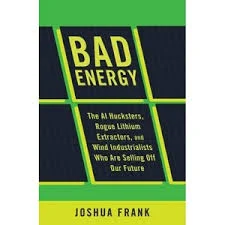
A critical debate is emerging at the heart of the global effort to combat climate change, pitting the optimistic narrative of rapid green energy expansion against a stark warning about its hidden environmental and social costs. This tension was recently highlighted by the appearance of environmentalist Bill McKibben on Ezra Klein’s podcast, where Klein summarized the prevailing climate outlook as a mix of "bad news and good news." While the accelerating pace of climate change remains a grave concern, the perceived good news is the unprecedented speed at which green energy is becoming more efficient and affordable. However, a powerful counter-narrative has been presented by Joshua Frank, co-editor at Counterpunch, in his new book, Bad Energy: The AI Hucksters, Rogue Lithium Extractors, and Wind Industrialists Who Are Selling Off Our Future (Haymarket Books, 2026), which argues that the current green transition risks replicating the extractive patterns of the fossil fuel industry rather than truly saving the planet.
The Optimistic Horizon: Green Energy’s Rapid Ascent
The "good news" heralded by figures like McKibben and echoed by Klein reflects a significant shift in the global energy landscape. For decades, the high cost and perceived inefficiency of renewable energy sources were major barriers to widespread adoption. However, a confluence of technological innovation, policy support, and economies of scale has dramatically altered this reality. Solar photovoltaic (PV) panel costs, for instance, have plummeted by over 80% in the last decade, while wind turbine technology has seen similar advancements, leading to substantial reductions in the levelized cost of electricity (LCOE) for these sources.
Klein’s observation that "Green energy is getting better and cheaper, faster than we had ever dared hope" is supported by empirical evidence. The International Renewable Energy Agency (IRENA) consistently reports that new renewable power projects are increasingly cheaper than the cheapest new fossil fuel-fired power generation, even without financial support. This economic advantage is translating into rapid deployment. In a landmark finding, the energy think tank Ember reported that in April 2025, all of the new electricity demand around the world was met by green power. This signifies a tipping point where renewables are not just supplementing, but actively satisfying, global energy growth.
This progress has fueled a vision of "clean energy abundance," a concept that posits a future of virtually limitless, affordable, and clean energy. Proponents argue that this abundance could unlock new forms of economic wealth and social progress, challenging the traditional left-wing perception that environmental sustainability requires sacrifice and reduction. As Klein articulated, "Clean energy abundance, a new form of energetic wealth, the possibility of the left actually offering a future of more and better — not less and worse — was a hard case to make even a few years ago. But now we cannot only imagine it, we can see it, touch it, live in it. It is here."
Joshua Frank’s Dissent: The Dark Side of Green Growth
Despite the palpable excitement surrounding this green energy revolution, Joshua Frank offers a sobering counterpoint, arguing that this rapid expansion, while necessary in principle, is being executed in a way that is profoundly problematic. His book, Bad Energy, asserts that the transition is driven less by genuine ecological imperative and more by entrenched capitalist profit motives, leading to a new wave of environmental destruction and social injustice.
Frank’s central thesis is that the "significant, haphazard expansion of green energy in recent years – from large solar projects to wind energy to mining for renewables – has destroyed communities and ecosystems." He contends that this approach fails to address the root cause of the climate crisis: an insatiable demand for endless growth and consumption. Worse, he argues, current renewable capacity simply cannot keep pace with our ever-expanding energy needs, a demand exacerbated by the rapid proliferation of energy-intensive data centers in wealthy nations. These data centers, powering artificial intelligence, cloud computing, and digital services, require immense amounts of electricity, creating a seemingly endless appetite for new energy sources, green or otherwise.
On-the-Ground Realities: From Deserts to Deep Seas
Frank’s investigation takes readers on a global journey, illustrating the tangible costs of the renewables rush. He points to the development of industrial-scale solar projects in California’s Mojave Desert, a region he knows intimately. For Frank, these sprawling solar farms, often covering "six square miles," represent a "desecration of the wilderness." He highlights that what many perceive as a wasteland is, in fact, a biologically pristine area home to endangered species and a vital carbon sink. Developing these deserts for solar, he argues, reduces their natural capacity to absorb atmospheric carbon, undermining a key environmental benefit.
His critique extends to wind farms in Wyoming, detailing the construction of massive turbine arrays and the extensive transmission lines required to carry power across vast distances to population centers like California. He questions whether this centralized, large-scale approach is truly the "best we can come up with," suggesting a more localized, decentralized energy production model as a superior alternative.
A significant portion of Bad Energy focuses on the burgeoning demand for critical minerals—lithium, copper, nickel, cobalt, and others—essential for electric vehicles (EVs), batteries, solar panels, and wind turbines. Frank traces the supply chain from copper mines in Montana and Bolivia to the geopolitical battlegrounds of deep-sea mining in the South Pacific. He warns that this scramble for minerals represents a continuation of "extractive industries that came before it," with little fundamental difference in their environmental and social impact. Rural and indigenous communities globally bear the brunt of these new mining projects, often facing displacement, pollution, and the destruction of sacred sites. Frank laments that "Big Green groups" and other proponents often overlook these "externalities" in their zeal for rapid deployment.
California’s Residential Solar Debacle and Corporate Control
Frank draws a direct line between profit motives and policy decisions, citing the case of California’s residential solar program. He alleges that Governor Gavin Newsom’s administration has effectively "gutted" the program, driven by the financial interests of large utilities like Pacific Gas & Electric (PG&E). Frank claims that PG&E and similar corporations, which have deep ties to Newsom’s political career, prioritize control and expansion of the centralized grid over the decentralization offered by rooftop solar. This move, he argues, is framed "under the guise of fighting climate change" but primarily serves to consolidate corporate power and profit.
The specific policy in question is often referred to as Net Energy Metering 3.0 (NEM 3.0), implemented in California in April 2023. This policy drastically reduced the compensation solar homeowners receive for excess electricity fed back into the grid, effectively making residential solar less financially attractive. While proponents argued it was necessary to address grid costs and ensure equity, critics like Frank contend it was a victory for utility companies seeking to stifle competition and maintain their market dominance. This illustrates a key aspect of Frank’s critique: that the "green" label can mask corporate interests that are ultimately detrimental to both the environment and ordinary citizens.
Beyond Consumption: A Call for Degrowth and Systemic Change
For Frank, the fundamental flaw in the prevailing green energy narrative is the belief that society can "consume our way out of climate chaos." He dismisses the idea that simply replacing fossil fuel-powered cars with electric vehicles, or large-scale fossil fuel plants with equally large-scale renewable projects, will solve the problem. Instead, he advocates for a radical shift away from the capitalist interests driving planetary collapse and towards a vision of "degrowth"—a conscious scaling back of consumption and economic activity in wealthier nations.
He argues for prioritizing public transit, bikeability, and walkability over an auto-centric culture, even an electric one. He points to European cities that restrict vehicles as positive examples and highlights cities like New York, Copenhagen, and Stockholm for their lower emission rates due to robust public transit and localized food systems. While acknowledging these aren’t perfect solutions, he sees them as steps towards a more sustainable model.
Frank’s critique extends to the international context, specifically addressing Bill McKibben’s optimism about countries like China and Australia. While China has indeed seen a massive boom in solar capacity, Frank notes that it has largely kept pace with—rather than replaced—its ever-growing energy demand, much of which is still met by fossil fuels. China remains the world’s largest emitter of greenhouse gases, and its continued construction of coal plants undermines the benefits of its renewable expansion. Similarly, Australia, despite its solar boom, remains the world’s second-largest exporter of fossil fuels. For Frank, true progress means "replacing fossil fuels on a real scale," not just adding renewables on top of existing, and expanding, fossil fuel infrastructure.
A Critique of "Big Green" and the Abundance Movement
Frank does not mince words when criticizing "Big Green groups" and many mainstream environmentalists. He argues that they have "blindly accepted policies because they are labeled Green," failing to scrutinize the underlying profit motives and the environmental externalities of large-scale renewable projects. He contrasts this with his support for residential solar and localized energy solutions, provided they are implemented in "already disturbed areas, on parking lots, brownfields," rather than pristine ecosystems. The goal, he stresses, is to "minimize that damage."
His book is an "indirect critique of the abundance movement," which he believes promises an unrealistic "exponential mining indefinitely." He highlights the lack of a "closed loop system" that can sustain universal abundance without continuous extraction. This perspective aligns him with thinkers like Kohei Saito (author of Slow Down: The Degrowth Manifesto) and Murray Bookchin (author of The Ecology of Freedom), who advocate for fundamental systemic change over technological fixes within a capitalist framework. Frank’s work is rooted in journalism, examining "how these technologies are playing out in the real world, on the ground," offering a practical, rather than purely theoretical, critique.
Beyond Capitalism: A Radical Vision for the Future
Ultimately, Frank argues that the climate crisis cannot be solved without "radically changing the economic system that underpins it." He sees the fight against climate change as inextricably linked to broader anti-capitalist struggles, from opposing war to working for affordable housing. He posits that replacing "fossil fuel capitalism with critical mineral capitalism isn’t going to solve the problem."
When asked about alternatives to lithium batteries, Frank points to emerging technologies like sodium batteries, which may have "potentially less impact than lithium mining." He emphasizes that the issue isn’t always the technology itself, but "the way it’s being sold to us." He advocates for "small-scaled mining operations with less impact" and a "democratized mining" approach, potentially through public authorities like the Tennessee Valley Authority, which could control energy production for public benefit rather than private profit. Such an approach, he suggests, would be "a lot better than selling off private lands to multinational corporations that want to come in, extract and leave biologically important lands desecrated."
Frank acknowledges that his views are not widely reflected in mainstream public policy or among most politicians. While he sees some resonance within contingents of the Democratic Socialists of America (DSA), he notes that "it’s not a conversation happening at that kind of policy level." He also preemptively addresses criticisms that his book might be seen as a "shill for Big Oil," asserting that anyone who reads it will understand his deep-seated critique of all forms of extractive industry, including hydropower and nuclear power, which he also examines critically.
Joshua Frank’s Bad Energy serves as a crucial intervention in the climate change discourse, urging a deeper, more systemic analysis of our energy transition. It challenges the prevailing techno-optimism and forces a confrontation with the uncomfortable truth that even "green" solutions, if pursued without critical thought and a commitment to systemic change, can perpetuate environmental harm and social injustice. As the world accelerates its shift away from fossil fuels, Frank’s work demands that we scrutinize not just what energy sources we choose, but how we choose to produce, consume, and govern them, ensuring that the path to a sustainable future does not leave a trail of desecrated landscapes and exploited communities in its wake.




 Yuyun Lusiyani
 Joko Widodo
 Eva Lovia
 Pevita Pearce
 admin
admin
 Lina Irawan