
 Jia Lissa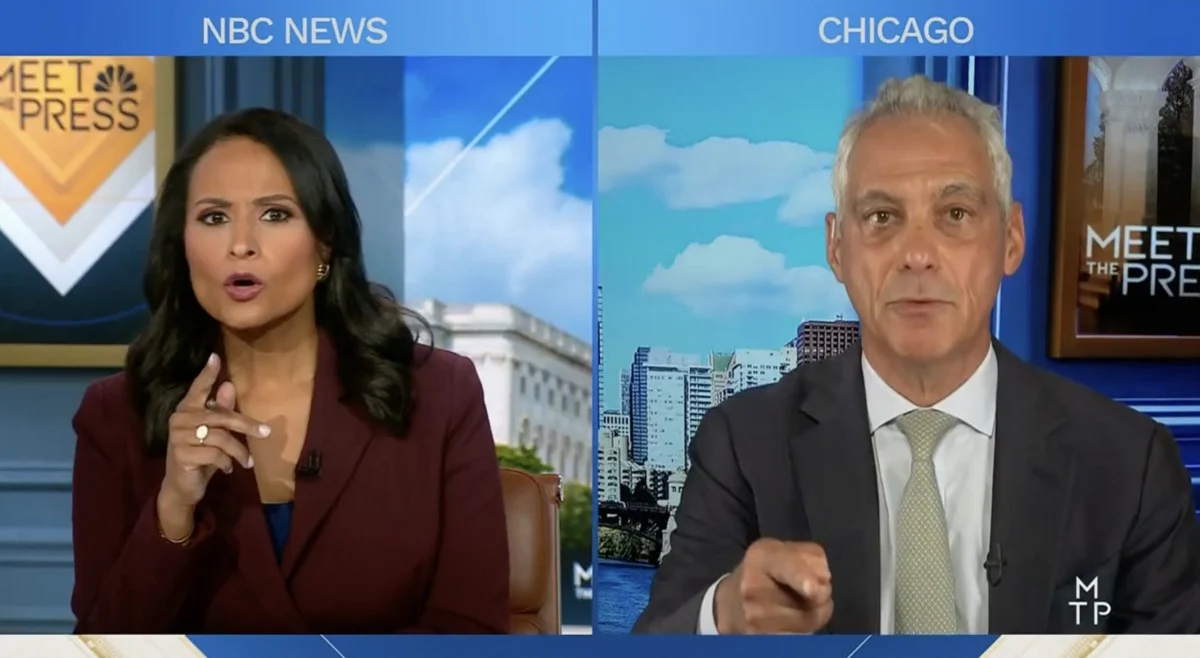
The interview, which took place against the backdrop of a pivotal election cycle, highlighted the delicate balancing act faced by party elders as they attempt to reconcile far-left rhetoric with mainstream electoral strategies. Welker’s persistent questioning focused on whether Emanuel, a figure long synonymous with the centrist "Clintonian" and "Obamian" wings of the party, would offer his personal endorsement to a candidate whose views on the conflict in Gaza and the use of the term "genocide" have sparked intense national debate.
The Meet the Press Confrontation
The dialogue began when Emanuel expressed significant discomfort with the rhetoric employed by El-Sayed regarding Israel’s military operations in Gaza. El-Sayed, a physician and former health commissioner who has gained a substantial following among young voters and the Democratic Socialists of America (DSA), has consistently characterized the humanitarian crisis in the region as a "genocide."
Emanuel, who served as the U.S. Ambassador to Japan and as the Mayor of Chicago, argued that the specific application of such a "historically heavy" term to one conflict while ignoring others constitutes a politicization of moral language. "If you’re going to use that term, then we’ve got to have a conversation about Sudan. We’ve got to have a conversation about Ukraine. We’ve got to have a conversation about the Armenians. We’ve got to have a conversation about what happened in Cambodia," Emanuel told Welker. He suggested that focusing exclusively on one nation suggests a selective moral outrage rather than a consistent application of international law.
Welker seized on this critique to pivot toward the electoral implications. She asked directly whether Emanuel would endorse El-Sayed, given these fundamental disagreements on foreign policy and human rights terminology. Emanuel initially attempted to deflect, characterizing the issue as "complex" and pivoting toward his general support for the Democratic ticket. However, Welker refused to move to the next topic, repeating the question multiple times: "Will you endorse Abdul El-Sayed? Do you support him given that position?"
The exchange culminated in a reluctant "yes" from Emanuel, though it was framed within a broader context of party loyalty rather than personal ideological alignment. "My support’s not important," Emanuel countered. "It’s the Michigan voters’ support that’s important. And he needs to work on that and earn their vote."
Background: The Rise of Abdul El-Sayed and the Michigan Senate Race
To understand the tension between Welker and Emanuel, one must look at the trajectory of Abdul El-Sayed’s political career and the unique demographics of Michigan. El-Sayed first rose to national prominence during his 2018 gubernatorial bid, where he ran as a progressive alternative to Gretchen Whitmer. While he did not win the primary, he secured a significant portion of the vote and established himself as a leader of the state’s left wing.
By 2026, El-Sayed’s candidacy for the Senate has become a litmus test for the Democratic Party’s "Big Tent" strategy. Michigan is home to one of the largest Arab American and Muslim populations in the United States, particularly in hubs like Dearborn and Hamtramck. For many voters in these communities, the federal government’s stance on Middle Eastern geopolitics is a primary voting issue. El-Sayed’s use of the term "genocide" in relation to Gaza resonates deeply with this constituency, even as it alienates pro-Israel moderates and donors within the party establishment.
Data from the 2024 presidential primary showed that over 100,000 Michigan Democrats voted "uncommitted" as a protest against the administration’s foreign policy. Analysts suggest that for a Democrat to win a statewide race in Michigan in 2026, they must bridge the gap between these disillusioned progressive voters and the suburban moderates who are wary of "socialist" labels.
Chronology of the Ideological Shift
The friction displayed on "Meet the Press" is the result of a decade-long shift within the Democratic Party.
- 2016–2018: The "Bernie Sanders Effect" introduces democratic socialism to the mainstream. Candidates like El-Sayed and Alexandria Ocasio-Cortez begin challenging established incumbents.
- 2020–2022: The party finds temporary unity in opposition to the Trump administration, but internal debates over "Defund the Police" and healthcare-for-all create friction during the midterms.
- 2023–2024: The escalation of the Israel-Hamas conflict becomes a breaking point. Younger voters and progressives demand a more critical stance toward Israel, while establishment figures like Emanuel maintain traditional alliances.
- 2025–2026: As the 2026 midterms approach, the "genocide" rhetoric becomes a central point of contention in Democratic primaries, leading to the current standoff between figures like Welker (representing the media’s push for clarity) and Emanuel (representing the party’s push for unity).
The Supreme Court and the "Get Out of Jail Free" Card
A significant portion of Emanuel’s defense during the interview rested on the existential threat he believes the Republican Party and the current Supreme Court pose to the country. He cited rumors of Justice Samuel Alito’s potential retirement as a primary reason why internal ideological disagreements must be sidelined in favor of party victory.
Emanuel’s reference to a "get out of jail card" for former President Donald Trump refers to the ongoing legal battles and Supreme Court rulings regarding presidential immunity and the scope of executive power. For Emanuel and many in the Democratic establishment, the risk of a further conservative shift on the Supreme Court outweighs any discomfort they may feel regarding a candidate’s specific rhetoric on foreign policy.
"I’m not playing around anymore with what they did under President Obama on the Supreme Court," Emanuel stated, referring to the blocked nomination of Merrick Garland in 2016. His argument suggests that for the Democratic establishment, the Senate race in Michigan is not about Abdul El-Sayed’s specific platform, but about the "D" next to his name and the vote he would provide for judicial confirmations.
Supporting Data: The Electoral Math
The urgency in Emanuel’s voice is backed by cold electoral math. In the 2020 and 2024 elections, Michigan was decided by margins of less than 3%. The Democratic Party’s path to a Senate majority runs directly through the Rust Belt.
- Voter Demographics: Michigan’s electorate is roughly 14% Black, 5% Hispanic, and has the highest concentration of Middle Eastern Americans in the country.
- The Progressive Base: In recent cycles, the youth vote (ages 18–29) in university towns like Ann Arbor and East Lansing has been essential for Democratic victories. This demographic overwhelmingly supports El-Sayed’s more radical stances on climate change and foreign policy.
- The Moderate Risk: Conversely, the "Oaktown" moderates (Oakland County) represent the affluent suburbanites who flipped from Republican to Democratic during the Trump era. This group is historically sensitive to the "socialist" label and supportive of traditional U.S. foreign policy alliances.
Emanuel’s struggle on "Meet the Press" reflects the difficulty of maintaining a coalition that includes both a 22-year-old activist in Dearborn and a 60-year-old moderate in West Bloomfield.
Official Responses and Reactions
The interview immediately drew reactions from across the political spectrum. Spokespersons for Abdul El-Sayed’s campaign released a brief statement following the broadcast, noting that the candidate is "focused on the needs of Michigan’s working families" and that he "welcomes the support of all Democrats who are committed to justice and equality at home and abroad."
On the other side of the aisle, the National Republican Senatorial Committee (NRSC) used the clip to argue that the Democratic Party has been "hijacked by radicals." A spokesperson for the NRSC stated, "Rahm Emanuel’s reluctant endorsement of a self-described socialist shows that there is no longer a place for moderates in the Democrat party. They are choosing extremism over our allies and common sense."
Progressive caucuses within the party, however, criticized Emanuel for his "deflection." Members of the "Squad" in the House of Representatives took to social media to argue that the term "genocide" is not a "political football" but a factual description of human rights violations that the party must confront head-on rather than ignore for the sake of electoral expediency.
Broader Implications for the Democratic Party
The "Welker-Emanuel" exchange is a microcosm of the identity crisis facing the Democratic Party as it moves toward the late 2020s. The tension is no longer just about policy—such as the difference between a public option and "Medicare for All"—but about the very language and moral framework the party uses to describe the world.
For the establishment, the goal is "institutional stability." This involves protecting the Supreme Court, maintaining traditional alliances, and winning elections through broad, sometimes vague, coalitions. For the rising progressive wing, the goal is "moral clarity." This involves calling out perceived injustices regardless of the diplomatic or electoral fallout.
As the Michigan Senate race progresses, the Democratic Party will have to decide if it can truly function as a "Big Tent" that includes both Rahm Emanuel and Abdul El-Sayed. Emanuel’s final answer to Welker—a "yes" followed by a pivot to the voters—suggests that while the party may be united by a common enemy in the Republican platform, its internal divisions remain as volatile as ever.
The outcome of the Michigan race will likely serve as a blueprint for future elections. If El-Sayed wins with the help of establishment figures like Emanuel, it may signal a new era where the party’s center of gravity has permanently shifted left. If the friction leads to a Republican pickup in the Senate, it will undoubtedly spark a period of intense internal recrimination that could reshape the party for a generation. For now, the "Meet the Press" interview stands as a stark reminder that in modern American politics, an endorsement is often less about agreement and more about the pragmatic necessity of holding onto power.


 Yuyun Lusiyani
 Ana Megawati
 Joko Widodo
 Eva Lovia
 Pevita Pearce