
 Jia Lissa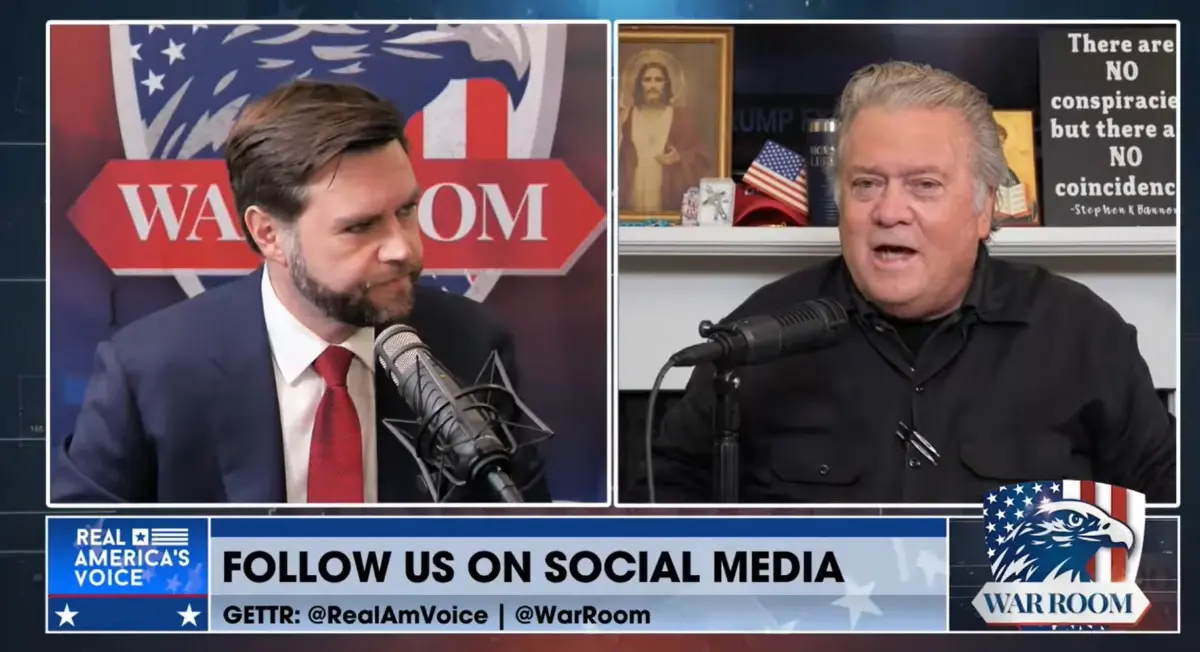
The internal ideological landscape of the incoming administration faced a public moment of friction this week as Steve Bannon, the former White House Chief Strategist and host of the "War Room" podcast, issued a direct challenge to Vice President-elect JD Vance. Bannon, a prominent figure in the "Make America Great Again" (MAGA) movement, demanded that Vance move beyond rhetoric and take substantive legislative or executive action against high-profile technology donors—whom Bannon labeled "Oligarch sponsors"—regarding the use of H-1B visas and foreign labor. The confrontation highlights a growing tension between the populist, protectionist wing of the Republican Party and the Silicon Valley billionaires who have recently aligned themselves with the Trump-Vance ticket.
The catalyst for Bannon’s remarks was a press conference where Vance addressed a federal crackdown on Microsoft. During the event, Vance criticized the tech giant for what he described as the systematic replacement of American workers with foreign nationals through the H-1B visa and the Permanent Employment Certification (PERM) program. While Bannon acknowledged Vance’s critical stance, he argued that "Happy Talk" would no longer be sufficient for the administration’s base. He specifically called for "definitive action" against the business interests of Elon Musk, Peter Thiel, and Palantir, all of whom have significant ties to Vance or the broader Republican infrastructure.
The Microsoft Allegations and the PERM Program Suspension
At the center of the current debate is a set of statistics released regarding Microsoft’s hiring practices. During his press conference, Vance presented data suggesting a sharp disparity between the company’s domestic layoffs and its acquisition of foreign labor. According to Vance, Microsoft laid off approximately 6,000 American workers over the past year while simultaneously benefiting from 6,300 H-1B visas and nearly 3,000 green cards.
Vance characterized the H-1B system as a mechanism that allows corporations to hire highly skilled foreign workers, often at lower costs than their American counterparts, which he claimed creates a "scandalous system" of "foreign indentured servants." He announced that, as a result of an ongoing investigation, the administration would support the suspension of the PERM program for Microsoft. The PERM program is the first step most employers must take to obtain a labor certification, which allows them to hire a foreign worker permanently. By suspending this, the government effectively blocks the company’s ability to transition H-1B holders into permanent residency status.
"Our message to Microsoft is: you’re a great American company, but you’ve got to hire great American workers," Vance stated. "You cannot lay off American workers and then replace them with foreign indentured servants."
The Complex Relationship Between JD Vance and Peter Thiel
Bannon’s demand for action against "Oligarch sponsors" specifically targets the men who were instrumental in Vance’s political ascent. Chief among them is Peter Thiel, the billionaire co-founder of PayPal and Palantir Technologies. Thiel’s relationship with Vance dates back to Vance’s time at Yale Law School and later in the venture capital world. Vance worked at Mithril Capital, a firm co-founded by Thiel, before launching his own firm, Narya Capital, which also received backing from Thiel.
In 2022, when Vance ran for the U.S. Senate in Ohio, Thiel provided a record-breaking $15 million in funding to a pro-Vance super PAC. This remains one of the largest individual donations to a single Senate candidate in American history. Bannon’s critique suggests that Vance’s political debts to Thiel may conflict with the "America First" labor agenda. Palantir, Thiel’s data analytics firm, relies heavily on government contracts and maintains a workforce that, like much of Silicon Valley, is integrated into the global talent market that Bannon seeks to restrict.
Elon Musk and the H-1B Debate
The inclusion of Elon Musk in Bannon’s list of targets underscores a long-standing animosity between the podcaster and the Tesla CEO. While Musk became a central figure in the 2024 campaign, donating tens of millions of dollars and appearing at rallies, Bannon has remained skeptical of Musk’s commitment to nationalist labor policies.
In previous broadcasts, Bannon has sparred with Musk over the issue of high-skilled immigration. Musk has frequently advocated for "merit-based" immigration, suggesting that the United States should make it easier for the world’s brightest engineers and scientists to move to the country. Bannon, conversely, views the H-1B program as a tool used by "globalist" elites to depress American wages and disincentivize the training of domestic talent. The friction reached a peak when Bannon previously told Musk to "sit in the back and study" or risk a political confrontation with the MAGA base.

Understanding the H-1B Visa Landscape
The H-1B visa program is designed to allow U.S. employers to temporarily employ foreign workers in specialty occupations that require a high degree of specialized knowledge. The program is currently capped at 65,000 visas per fiscal year, with an additional 20,000 visas available to foreign professionals with a master’s degree or higher from a U.S. institution.
For decades, the program has been a flashpoint in American politics. Proponents, including most major technology firms, argue that the program is essential for filling a "skills gap" in the STEM fields (science, technology, engineering, and mathematics). They contend that without the ability to recruit globally, American companies would lose their competitive edge to firms in China and Europe.
However, critics like Bannon and Vance point to data suggesting the program is abused. A 2023 report from the Economic Policy Institute (EPI) suggested that many H-1B workers are paid below the median wage for their occupations, and that the "lottery" system for visas is often dominated by outsourcing firms rather than innovative tech startups. The debate over whether H-1B workers complement or replace American labor remains one of the most contentious issues in labor economics.
A Chronology of the MAGA-Silicon Valley Alliance
The tension between Bannon and Vance reflects a broader shift in the Republican coalition.
- 2016-2020: The first Trump administration took several steps to restrict H-1B visas through executive orders such as "Buy American and Hire American." These moves were often met with legal challenges from tech industry groups.
- 2021-2022: JD Vance entered the political arena, bridging the gap between Rust Belt populism and Silicon Valley venture capital, largely through the mentorship of Peter Thiel.
- 2023: High-profile layoffs in the tech sector, totaling over 260,000 workers according to Layoffs.fyi, fueled resentment among domestic tech workers who saw companies continue to apply for thousands of foreign labor certifications.
- 2024: Elon Musk’s full-throated endorsement of the Trump-Vance ticket created a new power center within the movement, blending populist rhetoric with "techno-optimism."
- November 2024: Following the election victory, the focus shifted to policy implementation, leading to Bannon’s public demand that Vance prioritize labor protectionism over the interests of his former benefactors.
Broader Implications for the New Administration
The demand for "definitive action" against companies like Microsoft, Palantir, and Tesla sets the stage for a potential policy battle within the executive branch. If the administration pursues a broad crackdown on H-1B and PERM programs, it could face significant pushback from the very donors who helped fund the campaign.
From a policy perspective, the administration has several levers it could pull. It could increase the "prevailing wage" requirements for H-1B holders, making it more expensive for companies to hire foreign workers than domestic ones. It could also seek to move the visa process from a random lottery to a wage-ranked priority system, which would favor the highest-paid (and presumably most skilled) applicants.
However, such moves could stifle the growth of the American tech sector, particularly in the fields of Artificial Intelligence (AI) and semiconductor manufacturing, where the demand for specialized talent is at an all-time high. The challenge for the Vance-led efforts will be to balance the "America First" mandate with the practical realities of maintaining technological supremacy on the world stage.
Official Responses and Market Reaction
As of the time of reporting, representatives for Peter Thiel and Elon Musk have not issued formal responses to Bannon’s specific comments. Microsoft has consistently defended its hiring practices, stating that it complies with all federal immigration laws and that foreign talent is a necessary component of its global innovation strategy.
Market analysts suggest that a significant shift in visa policy could impact the stock valuations of major tech firms, which rely on a steady stream of specialized labor to maintain R&D pipelines. Conversely, labor advocates have praised the rhetoric coming from the Vice President-elect’s office, noting that it represents the most aggressive stance against corporate visa usage in recent memory.
Bannon’s ultimatum serves as a reminder that the populist base of the Republican Party is prepared to hold its leaders accountable to their campaign promises, even if it means targeting the wealthy individuals who facilitated their rise to power. Whether Vance will follow through with "definitive action" against his former mentors remains one of the most critical questions facing the incoming administration’s economic agenda.


 Yuyun Lusiyani
 Ana Megawati
 Joko Widodo
 Eva Lovia
 Pevita Pearce