
 Jia Lissa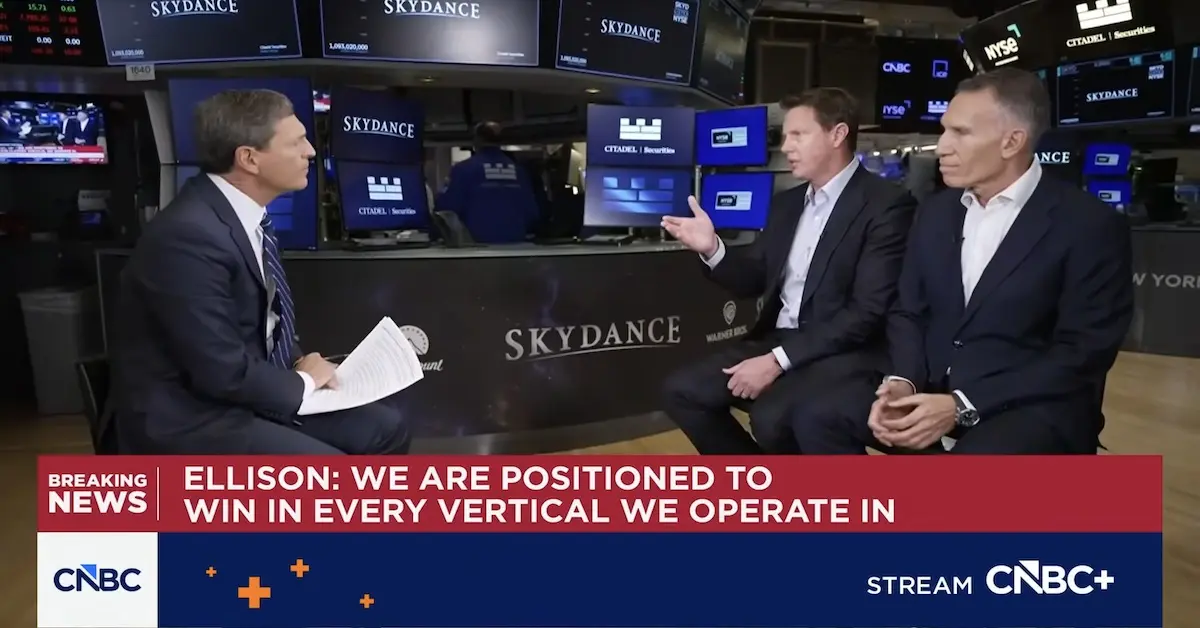
In a high-stakes television appearance that has reverberated throughout the media industry, Skydance Media CEO David Ellison addressed the future of CNN and the broader implications of the recently finalized $111 billion megamerger that has placed Warner Bros. Discovery and Paramount Global assets under a singular corporate umbrella. Speaking with CNBC’s David Faber on Thursday morning, Ellison sought to quell anxieties regarding potential editorial shifts at the news network, while simultaneously confirming that CNN CEO Mark Thompson will remain at the helm to provide much-needed stability during a period of unprecedented consolidation.
The interview, which also featured Skydance co-CEO and former Mattel chief Ynon Kreiz, served as a public introduction to the new leadership’s vision for some of the world’s most influential media brands, including HBO, CBS News, and CNN. Ellison’s remarks were particularly scrutinized following his previous move to install Bari Weiss as editor-in-chief of CBS News—a decision that sparked significant internal friction and raised questions about whether a similar ideological or structural overhaul was imminent for CNN.
The Mandate for Stability and Editorial Autonomy
When pressed by Faber on why he chose to retain Mark Thompson, who took over CNN following a period of leadership volatility, Ellison was unequivocal in his praise. He described Thompson’s performance as "phenomenal" and emphasized that the network requires a steady hand after years of corporate restructuring and shifting strategies. Thompson, the former Director-General of the BBC and former CEO of The New York Times Company, is widely viewed as a transformative figure capable of navigating the transition from traditional cable news to a digital-first future.
"He’s done a phenomenal job and we also, given everything everyone’s been through, we want stability," Ellison told CNBC. "We believe in editorial independence across the news organizations. We think CNN is a remarkable brand. We think CBS News is a remarkable brand."
Ellison’s insistence on "editorial independence" appears designed to buffer the network against claims of political interference. As the son of Oracle co-founder and billionaire Larry Ellison—a prominent donor and ally to former President Donald Trump—David Ellison has faced skepticism from critics who fear the network’s traditionally rigorous reporting on the Trump administration could be softened. These concerns were amplified by Donald Trump’s own public endorsement of the merger, which he characterized as a "great" development for the industry.
The CBS News Precedent and the Bari Weiss Factor
The skepticism surrounding Ellison’s takeover is rooted in recent history at CBS News. Following Skydance’s earlier merger with Paramount, Ellison took an active role in reshaping the news division by bringing in Bari Weiss, the founder of The Free Press and a vocal critic of modern mainstream media conventions. The appointment of Weiss led to what has been described as an "internal revolt" at CBS, with veteran producers and journalists expressing concern over the network’s shifting editorial direction.
Faber pointedly asked Ellison if CNN employees should expect a similar "change in approach." Ellison’s response was a calculated effort to distance corporate leadership from day-to-day newsroom decisions. He deflected specific questions about editorial strategy to the network heads themselves, asserting a "hands-off" policy for the parent company.
"I’d say you have to talk to Mark [Thompson]," Ellison remarked. "Corporate stays out of editorial. So again, I would say that’s a conversation for Mark. It’s a conversation for Bari. But we’re gonna support them."
This stance suggests a dual-track strategy: while Ellison may appoint leaders with specific philosophical bents, he intends to maintain a public posture of non-interference, leaving the responsibility for cultural and editorial shifts to the executives he installs.
Financial Scope and Market Context of the $111 Billion Merger
The scale of the Skydance-Warner Bros. Discovery-Paramount alignment represents one of the largest consolidations in the history of American media. The $111 billion valuation reflects the combined might of several iconic studios, streaming platforms, and news divisions. The merger aims to create a "content powerhouse" capable of competing with the likes of Netflix, Disney, and Amazon in the increasingly crowded and expensive streaming wars.
Key financial and operational data points of the merger include:
- Total Enterprise Value: Approximately $111 billion, accounting for debt and equity.
- Content Portfolio: Integration of the Warner Bros. film library, Paramount Pictures, HBO, CNN, CBS, and the Max and Paramount+ streaming services.
- Projected Synergies: Initial estimates suggest the merger could yield between $3 billion and $5 billion in annual cost savings through the consolidation of back-end operations and redundant marketing efforts.
- Market Reach: The combined entity now controls a significant plurality of the domestic television audience and a vast international distribution network.
For CNN, the merger comes at a time when the network is grappling with declining linear television ratings and the challenge of monetizing its digital presence through the "CNN Max" integration. Ellison’s commitment to "stability" may be a signal to advertisers and investors that the network will not undergo further disruptive pivots in the immediate future.
Chronology of the Skydance Media Ascent
The rise of Skydance Media from a boutique production house to a global media titan has been rapid. Understanding the timeline of David Ellison’s expansion provides context for his current role as a media mogul:
- 2010: David Ellison founds Skydance Media, initially focusing on co-financing major motion pictures with Paramount, including the Mission: Impossible and Star Trek franchises.
- 2016-2020: Skydance expands into television, animation, and gaming, diversifying its revenue streams beyond the box office.
- 2023: Negotiations begin for a transformative deal involving Paramount Global, as the Redstone family seeks an exit strategy amidst the shifting media landscape.
- Early 2024: Skydance successfully merges with Paramount, giving Ellison control over CBS and Paramount+; shortly thereafter, a secondary and larger deal with Warner Bros. Discovery is initiated.
- Present Day: The finalization of the $111 billion megamerger creates the current conglomerate, placing Ellison at the apex of a multi-platform media empire.
Internal Reactions and the Town Hall Address
In the wake of the merger’s finalization, Ellison held a town hall meeting with CNN employees to address morale and outline his philosophy. According to reports from those in attendance, Ellison was joined by Anderson Cooper, who moderated a portion of the discussion. During this session, Ellison reiterated his belief that CNN is a "vital part of our democracy" and pledged to protect the network’s integrity.
Furthermore, Ellison addressed the looming specter of layoffs—a common byproduct of large-scale mergers. He reportedly told staff that he intends to avoid the mass workforce reductions that characterized previous ownership changes at Warner Bros. Discovery, emphasizing that his goal is "growth through investment" rather than "contraction through austerity."
However, industry analysts remain cautious. "Billionaire owners often promise editorial independence in the honeymoon phase," noted one media consultant. "The true test comes during a heated election cycle or when the network’s reporting conflicts with the owner’s broader business interests or political ties."
Broader Implications for the Media Landscape
The consolidation of CNN, CBS News, and HBO under the Skydance umbrella marks a significant shift in the "Fourth Estate." With a single entity controlling two of the "Big Three" cable and broadcast news platforms, the diversity of corporate perspectives in mainstream journalism has arguably narrowed.
1. The "Billionaire Owner" Trend: Ellison joins the ranks of Jeff Bezos (The Washington Post), Patrick Soon-Shiong (Los Angeles Times), and Marc Benioff (Time) as a tech-adjacent billionaire taking the reins of a legacy media institution. This trend has historically led to a greater focus on digital transformation but has also raised concerns about the influence of personal wealth on public discourse.
2. Editorial Homogenization: There is a lingering concern that if Ellison applies the "Bari Weiss model" across his portfolio, the editorial distinction between CBS News and CNN could blur, leading to a more uniform ideological approach to news gathering.
3. The Future of Streaming News: By controlling both CNN and CBS News, Ellison has the opportunity to create a dominant "super-app" for news, combining the global reach of CNN with the localized and investigative strengths of CBS.
As the dust settles on this $111 billion deal, the media world will be watching David Ellison’s next moves closely. While his public statements emphasize stability and respect for the craft of journalism, his history of bold, disruptive leadership suggests that the status quo at CNN may be more fragile than his current rhetoric implies. For now, Mark Thompson remains the captain of the ship, but the course is being charted by a new and powerful navigator.



 Yuyun Lusiyani
 Ana Megawati
 Joko Widodo
 Eva Lovia
 Pevita Pearce