
 Jia Lissa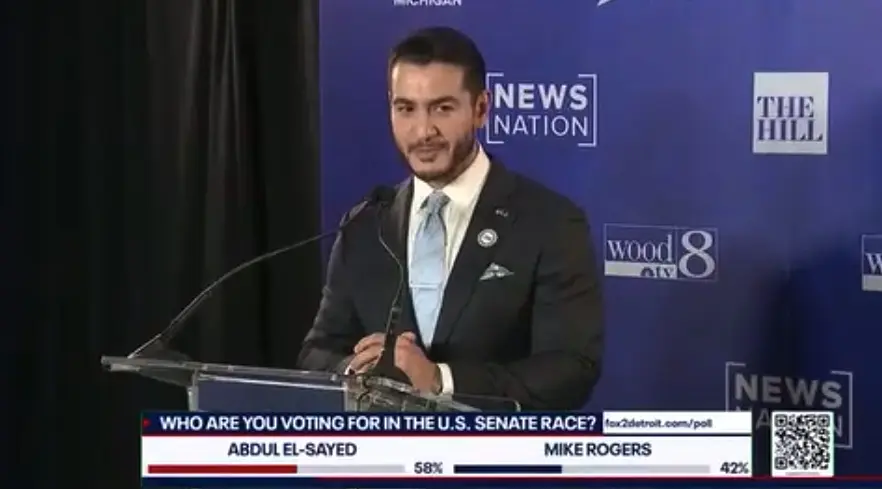
The Michigan race for the United States Senate reached a contentious milestone on Thursday night as Democratic nominee Dr. Abdul El-Sayed and Republican challenger Mike Rogers engaged in a high-stakes debate that highlighted the deep ideological and rhetorical rifts defining modern American politics. While the televised encounter touched on traditional pillars of campaign discourse—including foreign policy, energy costs, and personal wealth—the post-debate "spin room" provided the evening’s most viral moment. Dr. El-Sayed, an epidemiologist and former Detroit health commissioner, was forced to address his previous associations with controversial Twitch streamer Hasan Piker, leading to a sharp exchange regarding the relative political weight of social media influencers versus former presidents.
The confrontation occurred when Leland Vittert, a NewsNation host and former Fox News correspondent, questioned El-Sayed on what he characterized as a double standard in the campaign’s accountability. Vittert pointed to El-Sayed’s past campaign events with Piker, a prominent leftist commentator known for inflammatory statements regarding American history and international geopolitics. The query sought to equate El-Sayed’s ties to a polarizing digital figure with Mike Rogers’ alignment with former President Donald Trump. El-Sayed’s response, which centered on the distinction between institutional power and online influence, has since sparked a broader conversation about the nature of political endorsements in the 21st century.
The Spin Room Exchange: Influence Versus Authority
The tension in the spin room followed a debate where El-Sayed had repeatedly tied Rogers to the policies and persona of Donald Trump. Vittert challenged this strategy, asking El-Sayed why he felt Rogers must answer for Trump’s record while El-Sayed seemingly avoided scrutiny for his ties to Piker. "You’ve gotten angry and dismissive of reporters asking about your friendship and campaigning with Hasan Piker, the guy who said America deserved 9/11, praises Stalin," Vittert began. "Why does Mike Rogers have to answer for Donald Trump if you don’t have to answer for Hasan Piker?"
El-Sayed’s rebuttal was swift, dismissing the premise of the comparison as a false equivalency. He argued that the scrutiny applied to a former Commander-in-Chief—who remains the leader of the Republican Party—cannot be compared to that of a private citizen operating on a streaming platform. "That’s a serious question?" El-Sayed replied. "Well, Donald Trump is the president of the United States, which means he has significant power, including holding the nuclear football. And when he makes war, which he has the power to do, it’s a very different thing than a streamer in California."
El-Sayed continued by emphasizing the global implications of a presidency, suggesting that equating a digital content creator with the "most powerful person in the world" was "silly." The candidate’s defense rested on the argument that Rogers, if elected to the Senate, would be a direct legislative vessel for the Trump agenda, whereas a streamer holds no formal role in governance or policy-making.
Background on the Piker Controversy
The scrutiny surrounding Hasan Piker stems from his massive reach on Twitch, where he broadcasts to millions of viewers, primarily from the Gen Z and Millennial demographics. While Piker has been a vocal supporter of progressive causes and was an early surrogate for El-Sayed, his rhetorical history has provided significant fodder for Republican opposition research.
Specifically, Piker drew widespread condemnation for a 2019 clip in which he stated that "America deserved 9/11," a comment he later clarified was a critique of U.S. foreign policy rather than a justification for terrorism. Additionally, Piker has faced criticism for his commentary on historical communist figures and his perspectives on contemporary Chinese domestic policy.
In the lead-up to the general election, El-Sayed’s campaign appears to have distanced itself from Piker. Reports indicate that the Democratic nominee has ceased joint appearances with the streamer, opting instead to focus on labor unions and healthcare professionals. However, the "Piker connection" remains a central theme for the Rogers campaign, which seeks to paint El-Sayed as an extremist out of step with Michigan’s more moderate and conservative voting blocs.
Debate Highlights: Energy, Iran, and the "Two Yachts" Jab
Before the spin room confrontation, the debate itself saw El-Sayed and Rogers clash over the economic state of Michigan and the nation’s role in the Middle East. El-Sayed utilized his platform to frame Rogers as a "career politician" and a "carpetbagger," citing Rogers’ time living in Florida after leaving Congress in 2015.
One of the most heated moments of the night occurred when El-Sayed accused Rogers of being disconnected from the struggles of working-class Michiganders. Holding up two fingers, El-Sayed asked, "How many yachts do you have?" referencing reports of Rogers’ personal wealth and property holdings. Rogers dodged the specific jab, instead pivoting to a critique of the Biden-Harris administration’s economic policies, which he claimed have stifled Michigan’s manufacturing sector.
The candidates also sparred over foreign policy, particularly regarding Iran. El-Sayed hammered Rogers for his historical support of hawkish interventions, arguing that such policies have directly led to the volatility in global energy markets. "Mike Rogers backed the war path with Iran, and every time we beat the drums of war, the people at the pump in Grand Rapids and Detroit pay the price," El-Sayed stated. Rogers countered by arguing that a "peace through strength" approach is the only way to ensure long-term stability and that El-Sayed’s platform would embolden adversaries of the United States.
Chronology of the Michigan Senate Race
The path to this debate has been marked by a shifting political landscape in Michigan, a critical swing state.
- Early 2024: Mike Rogers, a former Chairman of the House Intelligence Committee, enters the race with the backing of the national Republican establishment, eventually securing a pivotal endorsement from Donald Trump.
- Spring 2024: Dr. Abdul El-Sayed emerges as the Democratic frontrunner, leveraging his background in public health and his previous 2018 gubernatorial run to build a coalition of progressive activists and urban voters.
- Summer 2024: The "Piker Controversy" begins to surface in local media as Rogers’ campaign releases digital ads featuring Piker’s most controversial clips, questioning El-Sayed’s judgment.
- Late Summer 2024: Polling shows El-Sayed with a consistent but narrowing lead. The Democratic campaign shifts focus toward "kitchen table" issues, attempting to pivot away from cultural-war rhetoric.
- October 2024: The first televised debate takes place in Detroit, setting the stage for the final sprint to Election Day.
Data and Polling Analysis
Recent polling data reflects the volatility of the Michigan electorate. According to a composite of surveys compiled by the New York Times and local Michigan outlets, El-Sayed holds a lead of approximately 3 to 4 percentage points. However, this lead remains within the margin of error in several key surveys, particularly those focusing on "likely voters" in rural counties.
A significant factor in the race is the Arab American vote in regions like Dearborn and Hamtramck. Michigan is home to one of the largest Middle Eastern populations in the United States. El-Sayed, who would be the first Muslim U.S. Senator if elected, has a natural rapport with this demographic. However, Rogers has attempted to make inroads by focusing on traditional values and economic deregulation, hoping to peel away socially conservative voters within the community.
Energy prices also remain a top-tier issue for Michigan voters. With the state’s heavy reliance on the automotive industry and logistics, fluctuations in gasoline prices have a disproportionate impact on the local economy. Rogers has capitalized on this by blaming Democratic environmental regulations for high costs, while El-Sayed has pointed toward corporate profiteering and unstable foreign interventions as the primary drivers of inflation.
Official Responses and Tactical Shifts
Following the debate, the Rogers campaign issued a statement doubling down on the Piker connection. "Dr. El-Sayed’s refusal to disavow an individual who praised our nation’s enemies and mocked the victims of 9/11 is a disqualifying lack of judgment," the statement read. "Michigan deserves a Senator who stands for American values, not someone who cavorts with radical streamers."
Conversely, the El-Sayed campaign characterized the focus on Piker as a "desperate distraction." A campaign spokesperson stated, "Mike Rogers wants to talk about Twitch because he doesn’t want to talk about his record of voting to ship Michigan jobs overseas or his years spent living in a Florida mansion. Dr. El-Sayed is focused on the people of Michigan, not the internet’s latest controversy."
Broader Implications for Modern Campaigning
The exchange between El-Sayed and Vittert underscores a growing challenge for modern political candidates: the "endorsement baggage" of the digital age. In previous decades, candidates were primarily judged by the company they kept in the halls of power—fellow politicians, union leaders, or business executives. Today, the rise of "alternative media" means that a candidate’s association with a YouTuber or a streamer can become a central campaign theme.
The debate also highlights the asymmetrical nature of political accountability in a polarized environment. For Democrats, the "Trump factor" is a potent tool to mobilize the base and court moderate independents who are wary of the former president’s temperament. For Republicans, the "Radical Left" trope—personified by figures like Piker—is used to suggest that even mainstream-appearing Democrats are beholden to an extremist fringe.
As the Michigan Senate race enters its final weeks, the focus is likely to remain on these contrasting associations. Whether voters view a streamer’s rhetoric as a valid reflection of a candidate’s character, or whether they agree with El-Sayed that such comparisons are "silly" in the face of executive power, may well determine which party controls this vital Senate seat in the coming term. With Michigan serving as a microcosm of the national political divide, the outcome will provide a clear signal of which narrative—institutional accountability or cultural-war association—resonates more deeply with the American electorate.



 Yuyun Lusiyani
 Ana Megawati
 Joko Widodo
 Eva Lovia
 Pevita Pearce