Pevita Pearce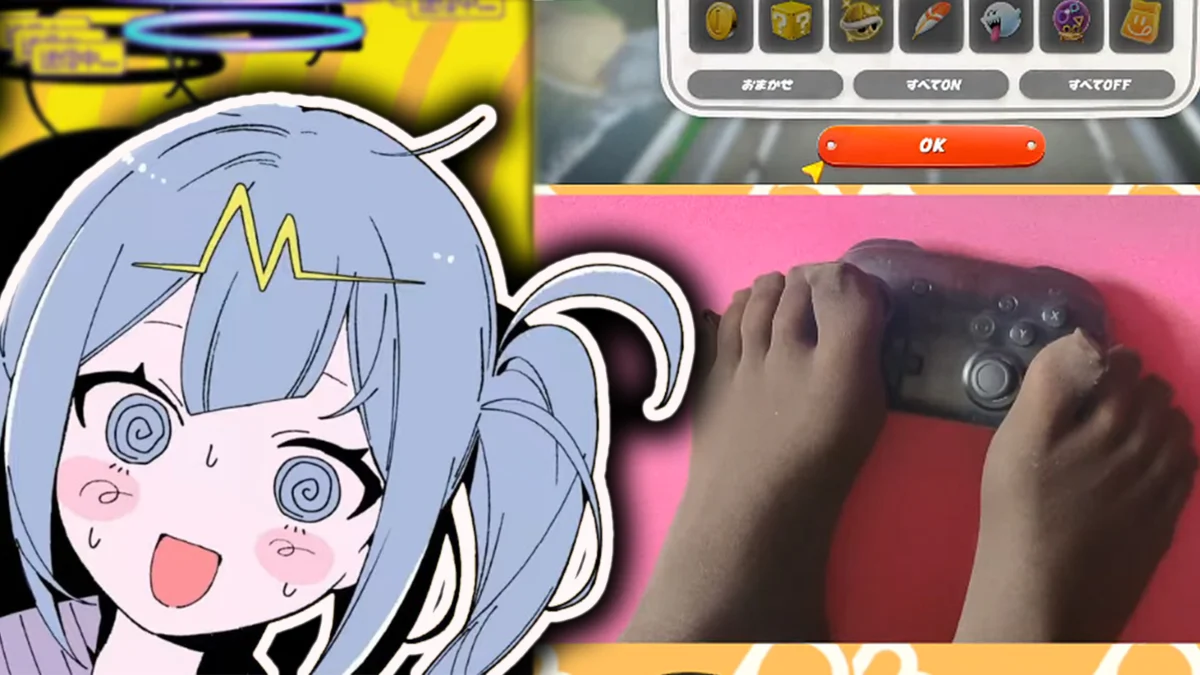
Amakusa Miro, a Japanese Virtual YouTuber (VTuber) recognized for her unconventional control schemes, has garnered significant attention from the international gaming community and medical observers alike after revealing a physical transformation resulting from her unique playstyle. Over a half-decade of utilizing her feet to operate standard video game controllers, Miro has reported the development of a prominent, localized muscle mass near her left ankle. This physiological adaptation highlights the extreme physical demands of high-level competitive gaming and the human body’s capacity for functional hypertrophy when subjected to repetitive, specialized motor tasks. Miro, who primarily broadcasts her gameplay on platforms like YouTube, has built a dedicated following by demonstrating that complex titles typically reserved for manual dexterity—such as Splatoon, Monster Hunter Wilds, and Mario Kart—can be mastered using the lower extremities.
The Evolution of a Specialized Gaming Anatomy
The revelation occurred on March 19, 2026, when Amakusa Miro shared a photograph of her left foot alongside her digital avatar, pointing out a distinct protrusion near the lateral malleolus (the outer ankle bone). In her social media post, she humorously noted that after five years of "foot-operating" games, her ankle appeared to have sprouted a "second bump," which she colloquially dubbed the "Amakusa Muscle." While the VTuber playfully suggested she had grown an entirely new anatomical structure, medical analysis of the imagery suggests a more scientific explanation: significant hypertrophy of the Extensor Digitorum Brevis.
The Extensor Digitorum Brevis is a muscle located on the dorsal (top) surface of the foot. Its primary function is to extend the second, third, and fourth toes. In the general population, this muscle is rarely prominent. However, in Miro’s case, the constant and precise tension required to manipulate a Nintendo Switch Pro Controller or Joy-Con has likely led to muscle fiber enlargement. This type of localized hypertrophy is often seen in professional athletes or musicians who rely on specific, repetitive motions. For Miro, the left foot is her primary "input device" for directional movement, requiring her to maintain her foot in a dorsiflexed position while using her toes to navigate joysticks and D-pads—a configuration that places immense strain on the extensor muscles.
A Five-Year Journey of Lower-Extremity Mastery
Amakusa Miro’s rise in the VTuber space is not merely a product of her physical novelty but a testament to her persistence in competitive gaming. Her primary objective has been to challenge the perceived limitations of foot-based gaming. To prove her proficiency, Miro initiated a high-stakes challenge in Splatoon, Nintendo’s flagship team-based shooter. Starting from a "C Rank"—the entry-level tier for competitive play—she has systematically climbed the ladder with the goal of reaching "X Rank," a tier reserved for the top one percent of the global player base.
The technical requirements for Splatoon are notoriously high, involving rapid 360-degree camera movements, precise aiming, and constant "sub-weapon" management. Miro’s ability to compete at this level using only her toes has debunked initial skepticism regarding the viability of her methods. Beyond Splatoon, she has expanded her repertoire to include Monster Hunter Wilds, a title known for its complex button combinations and timing-heavy combat. Observers note that her right foot is typically positioned flat to handle the "face buttons" (A, B, X, Y), while her left foot remains elevated and active, controlling the movement axes. This asymmetrical physical exertion explains why the "gains" are more pronounced on her left foot, as it bears the brunt of the constant micro-adjustments required for character positioning.
The Biomechanics of Foot-Based Gaming
To understand the physical toll and subsequent adaptation of Miro’s anatomy, it is necessary to examine the ergonomics of modern gaming controllers. Standard controllers are designed for the opposable thumbs and the grip strength of the human hand. When these devices are placed on the floor or a low platform, the user must adapt their lower limb biomechanics to compensate for the lack of a palm-grip.
- Toe Dexterity: The hallucis (big toe) and smaller digits must perform the roles of the thumb and index fingers. This requires a high degree of "prehensile" control, which is not a natural state for most modern humans.
- Ankle Stability: To move a joystick with precision, the ankle must act as a stabilized pivot point. This leads to isometric tension in the surrounding tendons and muscles.
- Repetition and Hypertrophy: Five years of daily streaming sessions, often lasting several hours, provide the "progressive overload" necessary for muscle growth. Just as a weightlifter develops their biceps, Miro has conditioned her foot to handle the mechanical load of gaming.
Medical professionals note that while this hypertrophy is a fascinating example of neuroplasticity and physical adaptation, it also carries risks. Repetitive strain injuries (RSIs), such as tendonitis or "Gamer’s Foot," could pose long-term health challenges if ergonomic adjustments are not made.

Community Reception and the "Amakusa Muscle" Phenomenon
The response from the VTuber community and the broader gaming public has been a mix of awe and humor. Following her viral post, Miro jokingly offered to "sell ad space" on her newly developed muscle, suggesting that companies could place miniature logos on the "Amakusa Muscle" during her "foot-cam" streams. This self-aware approach to her unique physical trait has only served to increase her popularity.
Fans have praised Miro for her transparency and for showcasing the "behind-the-scenes" physical reality of being a full-time content creator. In an industry where the focus is often on the digital 2D or 3D avatar, Miro’s "foot-tuber" reveal brings a grounding, human element to her virtual persona. It serves as a reminder that behind every high-performing virtual character is a human operator pushing their physical limits.
The Broader Context: Accessibility and Innovation in VTubing
Amakusa Miro’s story fits into a larger trend within the Japanese tech and entertainment sectors, where the boundaries between the physical and virtual worlds are increasingly blurred. The VTuber industry, in particular, has become a hotbed for experimental human-computer interfaces.
Recently, the industry saw the introduction of immersive "haptic" technologies, such as vibrating spheres designed to synchronize with a VTuber’s movements during live virtual concerts. These innovations aim to provide fans with a more tactile connection to their favorite digital performers. Miro’s development of a "gaming muscle" represents the opposite side of this coin: the physical world adapting to the demands of the virtual environment.
Furthermore, Miro’s success has significant implications for gaming accessibility. While she uses her feet as a personal challenge and a unique selling point for her brand, her techniques provide a blueprint for gamers with upper-limb disabilities. By demonstrating that X-Rank performance is possible through foot controls, she provides representation and inspiration for a demographic that is often overlooked by mainstream hardware manufacturers.
Timeline of Key Events
- 2021: Amakusa Miro begins her journey as a "foot-operating" VTuber, establishing her niche in the competitive Splatoon community.
- 2022–2024: Miro expands her gameplay to include high-difficulty titles like Ark: Survival Evolved and Monster Hunter, refining her toe-button-mashing techniques.
- Late 2025: Miro announces her "C to X Rank" challenge in Splatoon, gaining international traction for her high-level play.
- March 19, 2026: The viral "Amakusa Muscle" post is published, documenting the physical hypertrophy of her left foot after five years of consistent gaming.
- Present: Miro continues to stream, utilizing her unique anatomy to maintain her status as one of the most technically skilled "challenge" VTubers in the industry.
Future Implications for Human-Computer Interaction
As video games become more complex and competitive, the physical demands on players continue to evolve. Amakusa Miro’s "Amakusa Muscle" may be an extreme case, but it raises important questions about the future of ergonomics. If the human body can adapt to use its lower extremities for tasks as precise as competitive shooting, it suggests that the current "hand-centric" design of technology may be limiting our potential.
For now, Amakusa Miro remains a singular figure in the digital landscape—a VTuber who has literally reshaped her body in the pursuit of virtual excellence. Whether her "Amakusa Muscle" becomes a badge of honor for a new generation of foot-gamers or remains a unique anatomical curiosity, it stands as a definitive marker of the dedication required to excel in the modern era of digital entertainment. As she continues her climb toward X Rank, the gaming world will undoubtedly be watching—not just her avatar’s movements on the screen, but the remarkable physical effort happening beneath the desk.




 Jia Lissa
 Yuyun Lusiyani
 Joko Widodo
 Eva Lovia