
 Jia Lissa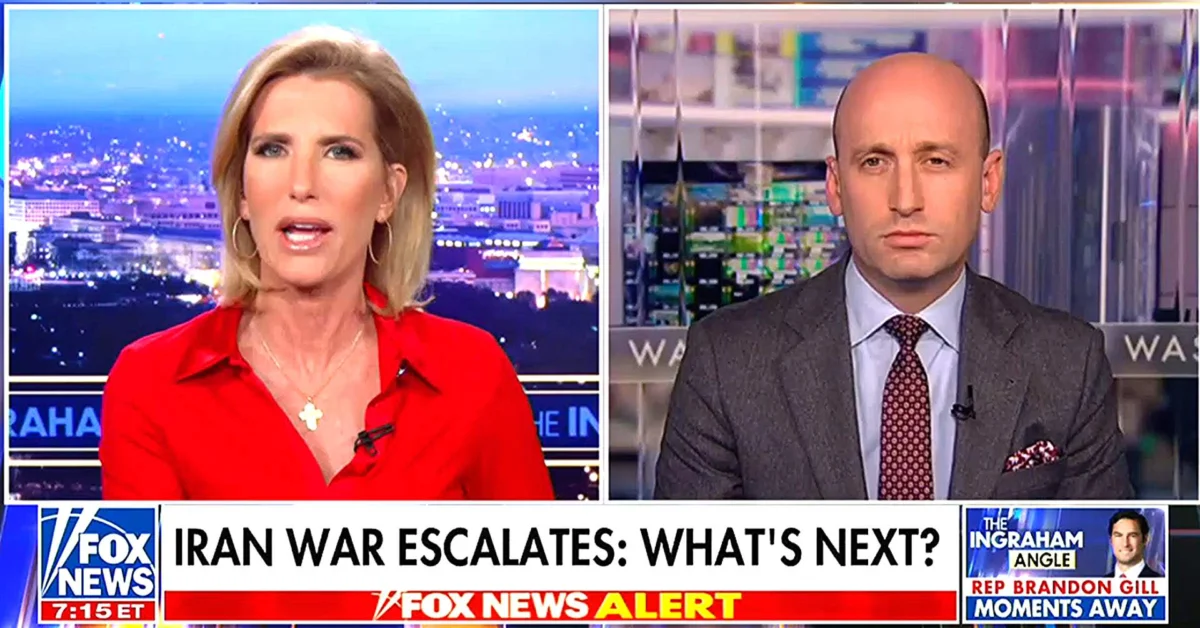
The political and diplomatic landscape surrounding United States-Iran relations faced renewed scrutiny this week following a series of public statements and high-profile media appearances that highlighted potential gaps between executive-level perceptions and military intelligence. During a recent broadcast of Fox News Channel’s The Ingraham Angle, host Laura Ingraham engaged in a pointed exchange with Trump Deputy Chief of Staff for Policy Stephen Miller regarding the administration’s level of preparedness for Iranian military actions in the Middle East. The discussion centered on President Donald Trump’s recent admission to reporters that he and his administration were “shocked” by the scope and targets of Iranian retaliatory strikes, which impacted several regional partners, including Qatar, Saudi Arabia, the United Arab Emirates (UAE), Bahrain, and Kuwait.
The friction between the President’s public expression of surprise and the expected foresight of a multi-billion-dollar military and intelligence apparatus has sparked a debate over the efficacy of U.S. strategic planning. While the administration has consistently maintained a "maximum pressure" campaign against the Islamic Republic of Iran, the President’s suggestion that the targeting of non-combatant regional neighbors was unexpected has raised questions about whether military planners failed to communicate potential contingencies or if the executive branch misinterpreted the available data.
The Context of the Conflict and the President’s Remarks
The current escalation follows a period of heightened tensions in the Persian Gulf, a region vital to global energy security. On Monday, while addressing questions regarding rising energy costs and regional stability, President Trump indicated that the Iranian military’s choice of targets was unanticipated. According to the President, the missiles utilized in the strikes were "supposed" to be directed elsewhere, yet they ultimately impacted various sovereign nations across the Middle East. "Nobody expected that. We were shocked," the President stated, referring to the strikes on Qatar, Saudi Arabia, the UAE, Bahrain, and Kuwait.
This admission of surprise stands in contrast to the traditional posture of U.S. intelligence, which typically monitors Iranian missile movements and launch preparations with a high degree of granularity. Critics and observers have noted that Iran’s history of utilizing proxy forces and direct missile capabilities to pressure regional adversaries is well-documented. Consequently, the President’s use of the word “shocked” became a focal point for media inquiry, leading to the exchange between Ingraham and Miller.
Chronology of Escalation and Military Readiness
The timeline of recent events suggests a rapid transition from diplomatic maneuvering to kinetic engagement. Over the last several months, the U.S. has increased its naval presence in the Strait of Hormuz and deployed additional Patriot missile batteries to the region.
- Initial Intelligence Briefings: Reports suggest that senior officials, including former National Security Advisor John Bolton, had previously briefed the President on various scenarios involving the Strait of Hormuz and potential Iranian provocations.
- Iranian Missile Deployment: Satellite imagery and signals intelligence reportedly tracked the movement of Iranian short- and medium-range ballistic missiles in the weeks leading up to the strikes.
- The Retaliatory Strikes: Iran launched a series of strikes that, contrary to some internal U.S. expectations, hit infrastructure and locations in nations not directly involved in the immediate U.S.-Iran military friction.
- The Presidential Admission: On Monday, President Trump publicly stated the administration’s surprise at these specific targets.
- The Ingraham-Miller Dialogue: On Wednesday night, Stephen Miller appeared on Fox News to clarify the administration’s position and rebut claims of a lack of foresight.
The Ingraham-Miller Exchange: Analyzing the Policy Defense
During the interview, Laura Ingraham questioned the fundamental efficacy of U.S. military planning if such strikes could truly be classified as a surprise. She noted that the U.S. invests heavily in "gaming out" war plans, specifically regarding the clearance of the Strait of Hormuz and the defense of regional allies. Ingraham pointedly asked, "Why didn’t they anticipate this and inform the president of those facts?"
Stephen Miller responded by attempting to reframe the President’s "shock" not as a failure of intelligence, but as a moral and political revelation regarding the nature of the Iranian regime. Miller argued that the surprise stemmed from Iran’s willingness to "reveal itself" by targeting nations that were either neutral or, in some instances, diplomatic interlocutors. Miller contended that this "bloodthirst" and recklessness underscored the dangers of Iran pursuing nuclear capabilities.
Furthermore, Miller pivoted to a defense of U.S. military execution, describing the tactical response as "exquisite." He cited several named operations—Midnight Hammer, Absolute Resolve, and Epic Fury—as evidence of American dominance in the theater. According to Miller, U.S. imaging and weaponry successfully neutralized Iranian drones and launchers, asserting that the Islamic Revolutionary Guard Corps (IRGC) is currently being "crushed" and its command structure "ripped apart."
Supporting Data: Intelligence Capabilities and Regional Alliances
To understand the weight of Ingraham’s question, one must look at the scale of U.S. investment in Middle Eastern stability. The United States maintains a network of bases across the countries mentioned by the President. Qatar hosts the Al Udeid Air Base, the largest U.S. military installation in the Middle East, while Bahrain is home to the U.S. Navy’s 5th Fleet.
The U.S. intelligence budget, which exceeds $80 billion annually across various agencies, is designed specifically to prevent strategic surprises. Military analysts often utilize Integrated Air and Missile Defense (IAMD) systems to protect the very countries that were hit. The fact that the executive branch felt "shocked" implies either a breakdown in the dissemination of intelligence or a deliberate choice by Iran to employ tactics that bypassed conventional predictive models.
Moreover, the mention of Russian assistance to Iran adds a layer of complexity. Ingraham noted reports that Moscow has been providing technical or intelligence support to Tehran. This geopolitical partnership has historically allowed Iran to enhance its electronic warfare capabilities and missile guidance systems, potentially complicating U.S. efforts to predict precise strike coordinates.
Official Responses and Strategic Implications
While Stephen Miller focused on the "recklessness" of Iran, other voices within the national security community have offered differing perspectives. Former officials have suggested that Iranian strategy often relies on "calculated ambiguity"—performing actions that are just below the threshold of triggering a full-scale U.S. war while still inflicting economic and political costs on U.S. allies.
The implications of these events are manifold:
- Deterrence Credibility: If the U.S. administration is seen as being caught off guard, it may embolden regional adversaries to test the "red lines" established by Washington.
- Energy Markets: The "shock" referred to by the President is inextricably linked to the volatility of oil prices. Attacks on Saudi or Emirati infrastructure directly impact global supply chains, requiring a predictable and steady military response to reassure markets.
- Alliance Trust: Nations like Kuwait, Bahrain, and the UAE rely on U.S. security guarantees. Public admissions of surprise regarding their safety could lead these nations to seek alternative security arrangements or pursue more independent diplomatic paths with Iran and Russia.
Analysis of the Administration’s Rhetorical Strategy
The divergence between the President’s candid admission and Miller’s structured defense highlights a common tension in modern political communication. The President’s use of "shocked" may have been intended to emphasize the "lawlessness" of Iran to a domestic audience, painting the regime as an unpredictable actor that justifies harsh sanctions and military readiness.
However, from a purely strategic standpoint, Miller’s task was to ensure that "shock" was not interpreted as "incapacity." By highlighting the success of operations like "Midnight Hammer" and asserting that the IRGC is in a state of collapse, Miller sought to project an image of total control. He cautioned against being "gaslit by Iranian propaganda," suggesting that any perception of Iranian success is a fabrication and that the U.S. remains the preeminent power capable of anticipating and neutralizing threats.
Future Outlook
As the situation in the Middle East continues to evolve, the focus will likely shift toward the resilience of regional air defenses and the ability of the U.S. to maintain its "exquisite intelligence" edge. The interaction on Fox News serves as a reminder of the high stakes involved in executive communication during times of conflict. Whether the administration was truly surprised or was simply utilizing a specific rhetorical frame, the reality on the ground remains one of high tension and significant military investment.
The ongoing assessment of Iranian capabilities, particularly with the alleged support of Russia, will remain a priority for the Department of Defense. As military planners continue to "game out" future scenarios, the clarity of communication between the intelligence community and the Oval Office will be essential in ensuring that "shocks" are minimized and that the United States can effectively protect its interests and allies in an increasingly volatile region.

 Yuyun Lusiyani
 Joko Widodo
 Eva Lovia
 Pevita Pearce