
 Jia Lissa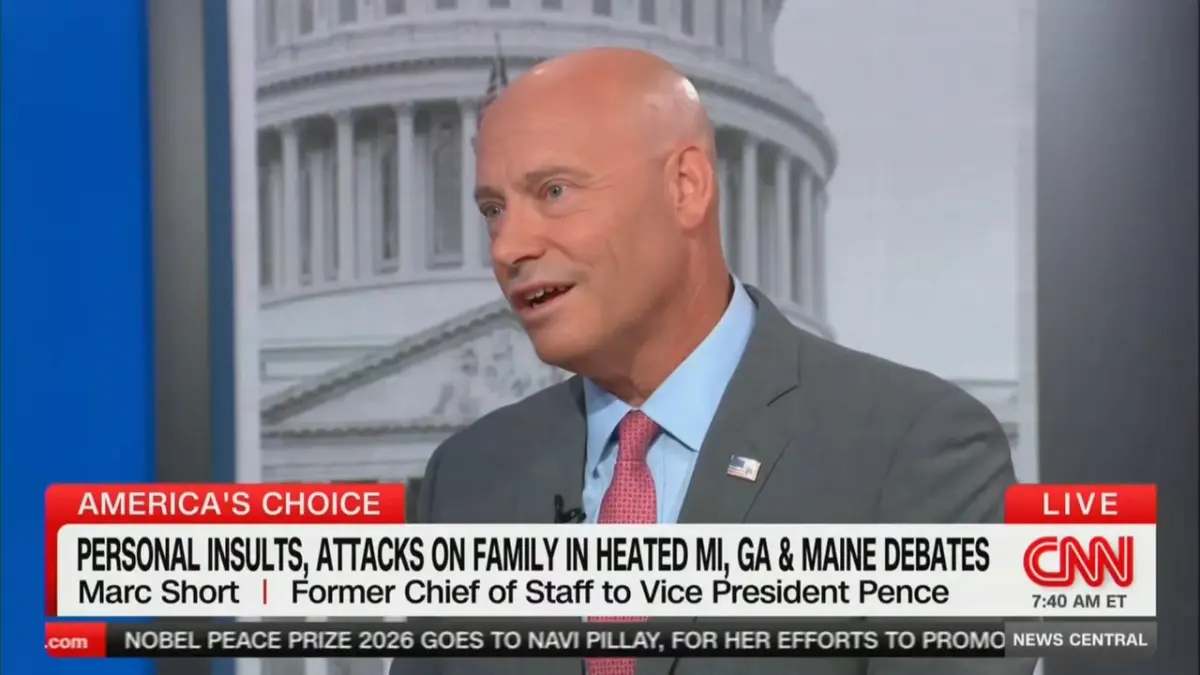
Marc Short, who served as the chief of staff to former Vice President Mike Pence and remains a prominent figure within traditional conservative circles, has issued a stark warning regarding what he describes as “corruption and grift” permeating the political environment surrounding former President Donald Trump. Appearing on CNN News Central on Friday, Short suggested to anchor John Berman that the current trajectory of the Trump campaign and its associated figures risks alienating the very voters who were originally drawn to Trump’s 2016 promise to "drain the swamp" in Washington, D.C. Short’s comments come at a critical juncture in the 2024 election cycle, as Republicans attempt to balance a message of economic stability against a backdrop of mounting ethical questions and high-profile controversies involving the former president’s inner circle.
During the broadcast, Short was joined by Democratic strategist Yemisi Egbewole to analyze the current state of the race, specifically focusing on a recent debate in Michigan between U.S. Senate candidates Abdul El-Sayed, a Democrat, and Mike Rogers, a Republican. While the conversation initially centered on the Michigan political landscape and the candidates’ contrasting visions for the state, it quickly pivoted to the broader national narrative. Berman questioned Short on whether the GOP should focus exclusively on the economy and the cost of living—areas where polling generally shows a Republican advantage—rather than engaging in personal attacks or defending the personal conduct of party leaders. Short agreed that the economy remains the primary concern for voters, but he emphasized that the recurring reports of financial impropriety within the Trump orbit are becoming an unavoidable and damaging distraction.
The Shift from Policy to Personal Ethics
The core of Short’s argument is that the "outsider" brand that propelled Donald Trump to the presidency in 2016 is being systematically undermined by contemporary reports of self-dealing and transactional politics. In 2016, Trump’s platform was built heavily on the idea that Washington was a "swamp" of corruption and that he, as a billionaire businessman with no prior political ties, was the only individual capable of dismantling established power structures. Short noted that this message was the "overarching message that got everybody shouting" at rallies in both 2016 and 2020. However, he argued that the current atmosphere is different, characterized by a steady stream of stories involving personal financial gain that conflict with the image of a selfless reformer.
Short’s critique is particularly notable given his history with the administration. As Mike Pence’s chief of staff, Short was a key architect of the administration’s legislative strategies and witnessed the internal dynamics of the White House firsthand. His willingness to speak out suggests a growing rift between the "Pence wing" of the party—which often emphasizes institutional stability and traditional conservative values—and the more populist, personality-driven movement currently led by Trump. Short indicated that the "indictment" of corruption is not just a Democratic talking point but a "big challenge for Republicans" that could erode support among independent and moderate voters who are weary of political scandals.
The Michigan Senate Debate and Local Implications
The discussion on CNN was framed by the recent clash in Michigan between Abdul El-Sayed and Mike Rogers. Michigan is a pivotal battleground state, and the Senate race there is seen as a bellwether for the national mood. Rogers, a former Congressman and Chairman of the House Intelligence Committee, represents the Republican effort to reclaim a seat in a state that has trended toward Democrats in recent statewide elections. During the debate, El-Sayed challenged Rogers on his record and his alignment with the national Republican platform, leading to a heated exchange that Berman characterized as deeply personal.
Short defended Rogers’ performance, stating that Rogers was "right to make the indictment that he did" against a candidate he views as outside the mainstream. However, Short’s broader point was that even a strong candidate like Rogers can be hampered by national headlines that focus on "grift." In Michigan, where the economy—specifically the manufacturing sector and the transition to electric vehicles—is a top-tier issue, Republicans want the focus to remain on the Biden-Harris administration’s fiscal policies. Short’s warning implies that as long as the Trump campaign is dogged by ethics stories, down-ballot candidates like Rogers will find it harder to keep the conversation on the "number one issue" of the cost of living.
High-Profile Allegations: The Kimberly Guilfoyle Controversy
A significant catalyst for Short’s remarks was a recent investigative report published by The Wall Street Journal. The report detailed an exchange involving Kimberly Guilfoyle, a senior official in the Trump campaign and the fiancée of Donald Trump Jr. According to the report, Guilfoyle allegedly solicited a $100,000 payment from a Trump donor, Eric Deters, specifically requesting that the funds be used to pay off her personal American Express credit card bill. In exchange for the payment, Guilfoyle reportedly promised to be the donor’s "Trump ride or die, forever and ever," implying that the money would secure long-term access and influence within the Trump inner circle.
Eric Deters, the donor at the center of the story, eventually spoke to The Wall Street Journal, expressing frustration that the promised access never materialized. "She never came through on anything," Deters told the publication. This specific incident has been cited by critics as a quintessential example of the "grift" that Short described. It portrays a campaign environment where access to the candidate is potentially for sale and where campaign-related fundraising is allegedly blurred with personal financial obligations. The fallout from the Guilfoyle story has been significant, with even some conservative commentators admitting the optics are "extremely unseemly."
Chronology of Recent Ethics Concerns
The allegations involving Guilfoyle are not isolated incidents but part of a broader timeline of events that have raised ethical red flags during the 2024 campaign cycle.
- Early 2024: Concerns were raised regarding the use of political action committee (PAC) funds to cover Donald Trump’s mounting legal fees. Reports indicated that tens of millions of dollars donated by grassroots supporters were being diverted from campaign advertising to pay for defense attorneys in various criminal and civil cases.
- Spring 2024: The launch of various Trump-branded merchandise, including high-priced sneakers and Bibles, drew criticism from those who argued that the former president was commercializing his candidacy in an unprecedented manner.
- Summer 2024: The announcement of "World Liberty Financial," a cryptocurrency venture involving Donald Trump and his sons, sparked warnings from ethics experts. The concern is that a sitting president or a major candidate owning a private financial platform could create massive conflicts of interest, particularly regarding the regulation of the crypto industry.
- Late Summer 2024: The Wall Street Journal report on Kimberly Guilfoyle’s $100,000 request surfaced, providing a specific, documented instance of alleged transactional politics within the campaign’s leadership.
- Friday, September 2024: Marc Short’s CNN appearance, where he codified these various incidents into a single narrative of "corruption and grift" that threatens the GOP’s electoral prospects.
Broader Impact and Electoral Implications
The implications of Short’s warnings extend beyond simple media optics. For the Republican Party, the risk is twofold. First, there is the risk of "enthusiasm fatigue" among the base. If voters who supported Trump because he promised to "clean up Washington" perceive that his own operation has become a microcosm of the very system he criticized, they may be less motivated to turn out. Second, and perhaps more importantly, these stories provide significant ammunition for the Democratic Party to target suburban and independent voters.
Democratic strategists have already begun to pivot their messaging to highlight these ethical concerns. By framing the choice not just as a policy debate but as a choice between "stability and chaos" or "public service and self-interest," the Harris-Walz campaign seeks to capitalize on the "grift" narrative. For voters who are undecided, the perception of a corrupt administration can be a powerful deterrent, even if they are dissatisfied with the current administration’s handling of the economy.
Furthermore, the focus on corruption complicates the GOP’s ability to prosecute its own case against the current administration. Republicans have spent years investigating the business dealings of Hunter Biden, seeking to link President Joe Biden to his son’s international ventures. However, when prominent Republicans like Marc Short acknowledge that corruption exists within their own party’s leadership, it weakens the moral authority of those investigations in the eyes of the general public.
Analysis of the "Swamp" Narrative
The irony of the current situation, as noted by Short, is that the "Drain the Swamp" slogan was perhaps the most effective political tool of the last decade. It allowed Donald Trump to bridge the gap between traditional conservatives, who want smaller government, and populist voters, who feel the system is rigged against them. By suggesting that the swamp is merely being "refilled" by different actors, Short is pointing to a fundamental breakdown in the populist contract.
The data regarding voter priorities continues to show that while "corruption" is often a secondary or tertiary concern compared to inflation or immigration, it acts as a "character filter" through which all other policies are viewed. If a candidate is perceived as corrupt, their economic plans are viewed with skepticism—as potential vehicles for further self-dealing rather than genuine public policy. As the 2024 election enters its final stages, the ability of the Trump campaign to distance itself from these allegations of grift may determine whether they can successfully reclaim the "outsider" mantle or whether they will be seen as the new establishment they once sought to overthrow.
Short’s public critique serves as a reminder that the internal debate within the Republican Party is far from settled. While the party has largely unified behind Trump’s candidacy, voices like Short’s indicate that a significant portion of the conservative infrastructure remains deeply concerned about the long-term health of the movement and its adherence to the principles of ethical governance. Whether these warnings will lead to a course correction within the campaign or a further distancing of the old guard remains to be seen.


 Yuyun Lusiyani
 Ana Megawati
 Joko Widodo
 Eva Lovia
 Pevita Pearce