
 Jia Lissa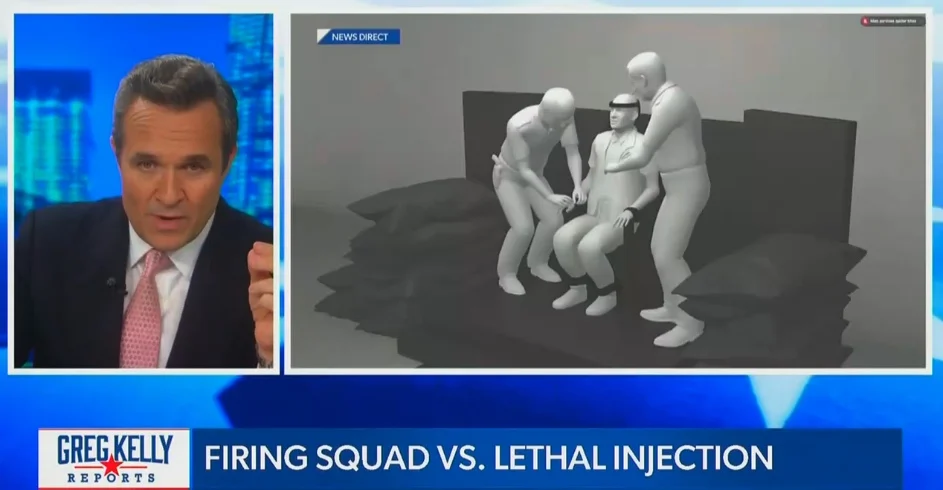
The debate surrounding the efficacy and morality of capital punishment in the United States has been reignited following a failed execution attempt in Tennessee. On Wednesday evening, state officials attempted to carry out the death sentence of Christa Pike, 50, via lethal injection. The procedure, which took place at the Riverbend Maximum Security Institution, resulted in a medical emergency rather than a completed execution. In the wake of the incident, Newsmax host Greg Kelly utilized his platform to argue that the failure of lethal injection protocols necessitates a return to the firing squad, which he characterized as a more reliable and humane method of state-sanctioned killing.
The Botched Execution of Christa Pike
Christa Pike was scheduled to be executed for the 1995 murder of Colleen Slemmer. According to eyewitness accounts and official reports from the Tennessee Department of Correction, the execution team administered an initial dose of pentobarbital, a potent sedative intended to induce rapid unconsciousness followed by respiratory and cardiac arrest. However, the drug failed to achieve the intended result.
Observers reported that Pike remained conscious and responsive long after the initial administration. In an attempt to proceed, officials administered a second dose of the barbiturate. Despite the additional medication, Pike did not succumb. Instead, her physical condition deteriorated rapidly, leading to what her legal team described as a "torturous" physical reaction. The execution was eventually halted, and Pike was rushed to a nearby medical facility. As of Thursday, she remains in a hospital under heavy guard, reportedly in critical condition.
Pike’s attorney issued a stern statement following the incident, asserting that the state’s failure constituted a violation of the Eighth Amendment, which prohibits cruel and unusual punishment. "What occurred in that chamber was a preventable tragedy that crossed the line into torture," the statement read. "The state has a constitutional obligation to ensure that executions are not unnecessarily painful or lingering. In this instance, they failed fundamentally."
Background: The 1995 Murder of Colleen Slemmer
To understand the context of the execution, it is necessary to examine the crime that led to Christa Pike’s death sentence. In January 1995, Pike was an 18-year-old student at the Job Corps center in Knoxville, Tennessee. Along with two accomplices, Pike lured 19-year-old Colleen Slemmer to an isolated area of the University of Tennessee campus.
The motive for the attack was reportedly rooted in a romantic rivalry and personal animosity. The ensuing assault was characterized by extreme brutality. Pike and her accomplices tortured Slemmer for approximately 30 minutes, during which Slemmer was beaten and slashed with a miniature meat cleaver. The assault culminated in Pike crushing Slemmer’s skull with a large stone. Following the murder, Pike famously kept a piece of Slemmer’s skull as a trophy, showing it to fellow students at the Job Corps center.
Pike was convicted of first-degree murder and conspiracy to commit murder in 1996. At the time, she was one of the youngest women in modern U.S. history to be sentenced to death. For nearly three decades, her case has moved through various stages of the appeals process, with her defense citing her age at the time of the crime and her history of mental illness as mitigating factors.
Greg Kelly’s Commentary: A Call for the Firing Squad
During Thursday’s broadcast of Greg Kelly Reports, the Newsmax host addressed the Tennessee incident with a critical view of modern execution methods. Kelly argued that the recurring issues with lethal injection—ranging from difficulty locating veins to the failure of sedative cocktails—suggest that the method is inherently flawed and prone to human error.
"You can’t really screw that up," Kelly said, referring to the firing squad. He detailed the mechanics of the method, noting that it involves trained law enforcement officers who are proficient in the use of firearms. "They come in, they strap the dude to the chair, they blindfold him. They have trained marksmen… Law enforcement officers don’t use injections very often, so it could be screwed up. But they know how to shoot, and they aim at the heart, which is very critical here."
Kelly’s central argument rested on the premise that the firing squad provides a definitive and instantaneous result. He posited that the medicalization of the death penalty via lethal injection has created a "clinical" facade that is more susceptible to failure than traditional mechanical methods. By aiming for the heart, Kelly argued, the firing squad ensures a rapid drop in blood pressure and a near-instantaneous loss of consciousness, which he termed the "most humane way to do this."
Expert Analysis: The Science of the Firing Squad
Kelly supported his position by citing Dr. James Williams, a prominent medical expert and researcher who has studied execution methods extensively. Although Williams is a self-identified opponent of the death penalty, his research suggests that if the state is to perform executions, the firing squad is physiologically superior to lethal injection or the electric chair.
In a 2025 interview, Williams explained the biological mechanics of a gunshot to the heart. "There is a lot of evidence that the near-instant loss of blood pressure means no blood gets to the brainstem and there is a rapid loss of consciousness, i.e., not that much pain," Williams stated. He supported this claim by referencing interviews with military field medics who had witnessed similar injuries in combat. According to Williams, victims of high-velocity shots to the heart typically cease purposeful movement within seconds and do not exhibit vocalizations of pain.
The expert’s perspective highlights a growing movement among both proponents and critics of capital punishment to reconsider the firing squad. Proponents see it as a "fail-proof" method, while some critics view it as a more honest, albeit graphic, representation of state power compared to the "surgical" appearance of lethal injection.
A History of Botched Lethal Injections
The failure in the Christa Pike case is not an isolated event. Over the last two decades, the United States has seen a significant number of "botched" executions involving lethal injection. According to data from the Death Penalty Information Center (DPIC), lethal injection has the highest rate of failure among all execution methods used in the U.S., with an estimated 7% of attempts resulting in complications.
Notable cases include the 2014 execution of Clayton Lockett in Oklahoma, where a failed intravenous line caused the inmate to struggle and speak for 43 minutes before dying of a heart attack. Similarly, the 2014 execution of Joseph Wood in Arizona took nearly two hours and required 15 doses of the execution drugs. More recently, in 2024, Alabama drew international criticism for the first-ever use of nitrogen hypoxia after multiple failed attempts to execute Kenneth Smith via lethal injection.
The primary causes of these failures include:
- Drug Shortages: Major pharmaceutical companies have prohibited the use of their drugs in executions, forcing states to source drugs from unregulated compounding pharmacies or experiment with new, untested chemical combinations.
- Medical Inexperience: Because professional medical associations (such as the AMA) prohibit members from participating in executions, the procedures are often carried out by technicians with limited training in anesthesiology or IV placement.
- Physical Condition of Inmates: Many death row inmates have histories of intravenous drug use or age-related health issues that make vein access extremely difficult.
The Legal and National Landscape
The debate over execution methods is inextricably linked to the Eighth Amendment’s prohibition of "cruel and unusual punishment." The U.S. Supreme Court has generally upheld the constitutionality of the death penalty, provided the method does not involve the "unnecessary and wanton infliction of pain." In cases such as Baze v. Rees (2008) and Glossip v. Gross (2015), the Court ruled that a method is not unconstitutional simply because it carries a risk of pain; rather, the prisoner must prove that a "feasible, readily implemented" alternative exists that significantly reduces that risk.
As lethal injection drugs become harder to obtain and procedures more prone to failure, several states have moved to reintroduce older methods as backups. As of 2026, states including South Carolina, Utah, Oklahoma, Mississippi, and Idaho have authorized the firing squad as an alternative or primary method of execution.
In South Carolina, a 2021 law made the electric chair the default method but allowed inmates to choose the firing squad. The state recently completed renovations on its execution chamber to accommodate a three-person firing squad, arguing that it provides a more certain outcome than the drug-dependent lethal injection protocol.
Broader Implications and Public Reaction
The incident involving Christa Pike has sparked a flurry of reactions across the political and social spectrum. For death penalty advocates, the failure is a bureaucratic and technical hurdle that must be overcome to ensure justice for victims like Colleen Slemmer. For abolitionists, the botched attempt serves as further evidence that the death penalty is an archaic practice that cannot be carried out humanely in a civilized society.
Greg Kelly’s advocacy for the firing squad reflects a segment of public opinion that favors transparency and efficiency over the clinical "medicalization" of executions. By highlighting the expert testimony of Dr. Williams, Kelly attempted to shift the conversation from the aesthetics of the execution to the physiological reality of the inmate’s experience.
However, the firing squad remains controversial due to its visceral nature. Critics argue that the method is "barbaric" and traumatizing for the executioners and witnesses. Furthermore, the logistical challenges of ensuring a "clean" execution via firearm—including the risk of ricochets and the psychological impact on the marksmen—remain points of contention.
Conclusion
The failed execution of Christa Pike in Tennessee has forced a re-evaluation of the state’s capital punishment protocols. As Pike remains in critical condition under medical care, the legal ramifications of the botched procedure are expected to tie up the state’s judicial system for years to come.
The commentary provided by Greg Kelly highlights a significant pivot in the national discourse. As lethal injection continues to face logistical and constitutional challenges, the "traditional" methods of the past are being reconsidered not as relics of history, but as potential solutions to the complications of modern pharmacology. Whether Tennessee or other states will heed the call to return to the firing squad remains a question of legislative will and judicial interpretation. For now, the case of Christa Pike stands as a stark reminder of the complexities and potential for error inherent in the state’s most severe form of punishment.




 Yuyun Lusiyani
 Ana Megawati
 Joko Widodo
 Eva Lovia
 Pevita Pearce