
 Jia Lissa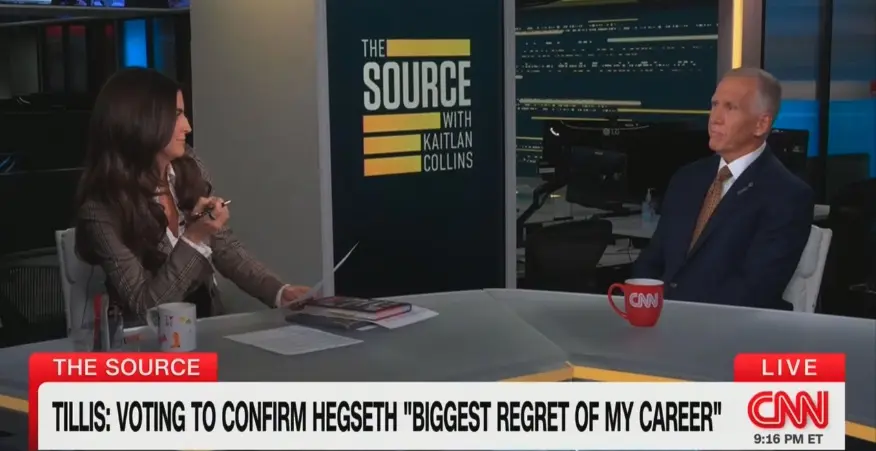
Senator Thom Tillis (R-NC) has utilized the final months of his congressional tenure to launch a high-profile media campaign surrounding the release of his new book, offering a series of blunt assessments regarding the direction of the Republican Party and the personnel choices of President Donald Trump. As Tillis prepares to exit the Senate in January, his recent public appearances have been characterized by an unprecedented level of candor, particularly concerning high-ranking administration officials and the populist shift that has reshaped the GOP landscape. This media blitz culminated in a notable interview on CNN’s "The Source," where Tillis doubled down on sharp critiques of cabinet members, describing some in terms rarely heard from a sitting member of the same political party.
The transition from a disciplined legislator to a vocal internal critic highlights a growing rift between the traditional institutionalist wing of the Republican Party and the populist movement led by President Trump. Tillis’s decision not to seek reelection has effectively unburdened him from the political constraints of primary challenges or base-driven electoral pressures, allowing him to position himself as a defender of "traditional conservatism" while expressing deep reservations about the individuals selected to lead the federal government.
A Detailed Critique of Cabinet Personnel
During his appearance on "The Source" with host Kaitlan Collins, Senator Tillis was confronted with several excerpts from his book that targeted prominent figures within the Trump administration. The interview served as a platform for Tillis to confirm his stance on various appointees, many of whom have faced public scrutiny for their qualifications or past controversies.
Among the most significant criticisms was Tillis’s assessment of Pete Hegseth, the nominee for Secretary of Defense. Tillis characterized his support for Hegseth as the "biggest regret" of his career. This statement is particularly impactful given Tillis’s long-standing involvement in military and veterans’ affairs during his time in the Senate. Hegseth, a former Fox News host and military veteran, faced a tumultuous confirmation process marked by questions regarding his administrative experience and personal background. Tillis’s admission of regret suggests a deeper dissatisfaction with the vetting process and the prioritization of media presence over bureaucratic expertise.
The Senator also addressed the appointment of Robert F. Kennedy Jr. to lead the Department of Health and Human Services (HHS). Tillis expressed remorse for not doing more to prevent Kennedy’s ascension to the role, citing concerns over Kennedy’s well-documented skepticism toward established medical science and vaccines. This critique aligns with a broader concern among establishment Republicans that placing a former independent with heterodox views at the head of the nation’s health apparatus could undermine public trust in scientific institutions.
Tillis’s commentary extended to Tulsi Gabbard, the Director of National Intelligence, and Kristi Noem, the Secretary of Homeland Security. Regarding Gabbard, Tillis employed a sharp rhetorical jab, suggesting she lacked the intellectual rigor required for the post. His criticism of Noem referenced a widely publicized controversy from her own memoir involving the killing of a family dog, a story that Tillis used to question her judgment. Perhaps his most colorful language was reserved for Howard Lutnick, the Secretary of Commerce, whom Tillis described as "nuttier than squirrel sh*t." When asked by Collins if he stood by these characterizations, Tillis remained firm, replying, "I stand by all that. What else you got?"
The Context of the 2026 Midterm Elections
Despite his personal distaste for several key administration figures, Tillis maintained a pragmatic outlook on the Republican Party’s electoral prospects. He acknowledged that President Trump remains the primary catalyst for voter turnout within the party’s base. As the 2026 midterm elections approach, Tillis argued that the GOP must navigate the complexities of "populist" energy while maintaining the support of "traditional conservatives."
Tillis’s analysis suggests that the Republican Party is currently operating as a coalition of two distinct groups: a populist base uniquely motivated by Trump’s persona and rhetoric, and a traditionalist wing that prioritizes institutional stability and conservative policy orthodoxy. "The president is a populist president," Tillis noted during the interview. "He is gonna do a good job of bringing out that base that’s uniquely motivated by him. Traditional conservatives, traditional Republicans have to do their part to get the other folks out."
This perspective underscores a strategic anxiety within the party. While Trump’s influence is essential for high-turnout elections, there is a persistent fear among moderates and institutionalists that the populist fringe could alienate suburban voters and independent-leaning Republicans. Tillis urged his colleagues not to "abandon the party," even as they "deal with populism" in a manner similar to how the Democratic Party managed internal shifts during the Obama and Biden administrations.
Timeline of Tillis’s Political Evolution
To understand Tillis’s current stance, it is necessary to examine his trajectory within the North Carolina and national political spheres.
- 2014 Election: Thom Tillis, then the Speaker of the North Carolina House of Representatives, defeated incumbent Democrat Kay Hagan in one of the most expensive Senate races in history at that time. He entered Washington as a pro-business, mainstream Republican.
- 2017-2019: During Trump’s first term, Tillis was often viewed as a reliable vote for the administration’s judicial nominees and tax reforms, though he occasionally broke ranks on issues like trade and the protection of Special Counsel Robert Mueller.
- 2020 Reelection: Tillis faced a difficult reelection campaign against Cal Cunningham. He leaned heavily into his alliance with Trump to secure the Republican base, ultimately winning a narrow victory.
- 2023-2024: Following his reelection, Tillis began to take more independent stances, notably on bipartisan legislation regarding gun safety (the Bipartisan Safer Communities Act) and same-sex marriage (the Respect for Marriage Act).
- Retirement Announcement: Tillis announced he would not seek a third term, citing a desire to move into the private sector and focus on writing. This announcement set the stage for his current "unfiltered" media tour.
- Late 2026: The release of his book and the subsequent media blitz on networks like CNN, NBC, and MSNBC mark his final act as a public official, aimed at shaping his legacy and the future of the GOP.
Data on Voting and Cabinet Confirmations
Tillis’s critiques are often contrasted with his voting record, a point of contention raised by media figures and political opponents alike. According to Senate records, Tillis has voted in favor of the vast majority of President Trump’s nominees throughout both terms. However, his recent "regrets" highlight the internal pressure senators often face to maintain party unity during confirmation hearings.
Data from the Lugar Center’s Bipartisan Index consistently ranked Tillis as one of the more bipartisan members of the Senate, reflecting his willingness to work across the aisle on specific policy initiatives. This background provides the foundation for his current critiques; he views himself as a legislator who prioritizes the functional aspects of government over the ideological purity or "celebrity" status of cabinet appointees.
The specific cabinet members he criticized represent a departure from traditional Republican appointments. For instance, Pete Hegseth and Tulsi Gabbard were viewed by many institutionalists as "disruptors" rather than experienced administrators. Tillis’s public opposition to these figures, even after their appointments, serves as a warning to the party about the potential long-term consequences of prioritizing loyalty and media savvy over institutional knowledge.
Broader Implications for the Republican Party
The "Tillis Tour" is more than a promotional effort for a book; it is a symptom of the ongoing identity crisis within the Republican Party. By speaking out so forcefully, Tillis is attempting to carve out a space for "traditional Republicans" to remain in the party without fully endorsing the populist elements they find objectionable.
The implications of his rhetoric are twofold:
- Internal Party Friction: Tillis’s comments have likely further alienated him from the Trump-aligned wing of the party, which views such public dissent as a betrayal. This could influence how other retiring or "safe" Republicans choose to voice their own concerns.
- Voter Sentiment: For the 2026 midterms, Tillis’s message serves as a call to action for the "silent majority" of the GOP who may feel displaced by populism. His argument that "you don’t abandon your party" is a plea for patience and persistence from the establishment wing.
As Tillis prepares to vacate his seat, the Republican Party faces the challenge of reconciling these two factions. The Senator’s willingness to use "color insults" and blunt language may be seen by some as a necessary wake-up call and by others as the bitter parting shots of a politician out of step with his party’s new reality. Regardless of the interpretation, Tillis has ensured that his departure from the Senate is as loud and impactful as his entrance, leaving behind a provocative roadmap for those who wish to challenge the populist tide from within.


 Yuyun Lusiyani
 Ana Megawati
 Joko Widodo
 Eva Lovia
 Pevita Pearce