
 Jia Lissa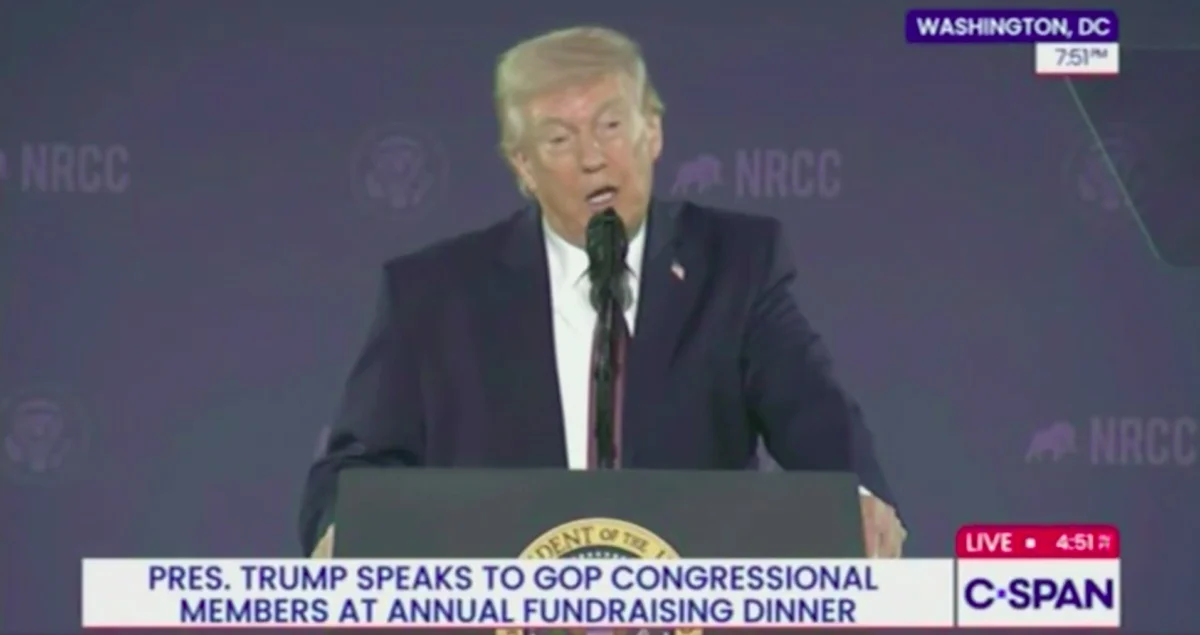
President Donald Trump addressed a high-profile gathering of Republican congressional members and donors on Wednesday evening, delivering a speech that underscored the complex and often contradictory relationship between the current administration and the American mail-in voting system. Speaking at an annual fundraising dinner in Washington, D.C., the President pivoted between boasting of his own electoral victories achieved through absentee and mail-in ballots and calling for the total abolition of the practice. The remarks come at a critical juncture as the Republican Party prepares for the 2026 midterm elections and as the Supreme Court of the United States deliberates on landmark cases that could redefine how ballots are collected and counted across the country.
During his address, President Trump highlighted his significant victory in Florida, a state that has long utilized a robust mail-in voting infrastructure. Despite his reliance on these systems to secure high-turnout wins, he maintained a stance of deep skepticism regarding the integrity of the process. "Now I happen to be a fan of no mail-in ballots, even though I won Florida, which is mail-in ballots by a massive number—the highest number in history," the President stated. His comments reflect a broader tension within the GOP, which has simultaneously launched "Bank Your Vote" initiatives to encourage early and mail-in voting while maintaining a legislative platform focused on restricting these very methods.
The Legislative Context: The SAVE Act and Voter Identification
The President’s remarks were framed by his support for the Safeguard American Voter Eligibility (SAVE) Act, a piece of legislation that has become a cornerstone of the Republican legislative agenda. The SAVE Act seeks to mandate that individuals provide proof of citizenship when registering to vote in federal elections. While federal law already prohibits non-citizens from voting, proponents of the act argue that current enforcement mechanisms are insufficient.
President Trump used the fundraising platform to decry Democratic opposition to the SAVE Act, characterizing the resistance as an attempt to undermine election security. "They cheat so badly with that," Trump claimed, referring to mail-in systems in states like California. He alleged that the distribution of ballots in high-population Democratic strongholds leads to irregularities, suggesting that some households receive multiple ballots while Republican voters are left waiting. Although election officials in California and other universal mail-in states have repeatedly pointed to rigorous signature verification and tracking systems as safeguards against such occurrences, the President’s rhetoric remains focused on the potential for "massive cheating."
The SAVE Act has faced a difficult path in Congress. Democrats have largely opposed the measure, arguing that it places an undue burden on eligible voters—particularly low-income individuals, the elderly, and students—who may not have immediate access to passports or birth certificates. Civil rights organizations have warned that the act could disenfranchise millions of legitimate voters under the guise of preventing a problem that statistical data suggests is exceedingly rare.
Historical Precedents and the Carter-Baker Commission
To bolster his argument against mail-in voting, President Trump referenced a 2005 commission co-chaired by former President Jimmy Carter and former Secretary of State James A. Baker III. The Commission on Federal Election Reform, often referred to as the Carter-Baker Commission, was formed in the wake of the 2000 and 2004 elections to evaluate the American electoral process.
Trump specifically cited the commission’s findings as a warning against mail-in ballots. "Jimmy Carter… had a commission with Scoop Jackson and some other very respected people, and the conclusion was never allow mail-in ballots because if you do, there will be massive cheating," Trump told the audience.
While the Carter-Baker report did indeed note that absentee ballots remain the largest source of potential voter fraud, the context of their recommendations was more nuanced than the President’s summary suggested. The 2005 report recommended that states increase efforts to reduce the risks of fraud associated with mail-in voting but did not call for an outright ban. Instead, it proposed measures such as improved signature verification and the prohibition of "ballot harvesting" by third parties. In the years since the report, many states, including Republican-led Florida, have implemented the very security measures the commission suggested, leading to what many experts consider a secure and efficient system.
The Paradox of the Florida Model
The President’s praise for his win in Florida highlights a significant data point in the mail-in voting debate. Florida has allowed "no-excuse" absentee voting for over two decades, a policy originally championed by the state’s Republican leadership. In the 2024 election cycle, data showed that Florida Republicans utilized mail-in and early voting at record rates, narrowing the traditional Democratic advantage in those categories.
According to state election data, Florida’s system relies on a combination of pre-election day processing, real-time signature matching, and a "cure" process that allows voters to fix minor errors on their ballot envelopes. This infrastructure has allowed Florida to report results quickly on election night, a feat that President Trump has frequently praised. However, he continues to contrast Florida’s success with California’s system, where ballots are mailed to every registered voter. The President’s assertion that 38 million ballots are "sent out" in California refers to the state’s total population, though the number of registered voters is closer to 22 million.
The divergence in state-level administration has created a patchwork of voting experiences across the U.S., fueling the President’s calls for federal intervention and standardized restrictions on mail-in processes.
Legal Challenges and the Supreme Court
The timing of the President’s remarks is particularly significant given the current docket of the Supreme Court. The justices are currently considering cases that could have a profound impact on the 2026 midterms and the 2028 presidential election. One of the primary issues before the Court involves the legality of counting ballots that are postmarked by Election Day but arrive at election offices several days later.
During recent oral arguments, some members of the Court’s conservative majority signaled skepticism toward state laws that extend the deadline for ballot receipt. Republican National Committee (RNC) lawyers have argued that allowing ballots to arrive after Election Day undermines public confidence and creates an "election month" rather than an Election Day. Conversely, Justice Sonia Sotomayor and other members of the liberal wing have questioned whether blocking these ballots would disenfranchise military members and overseas voters who rely on the postal service.
If the Supreme Court rules to block late-arriving ballots, it could invalidate thousands of votes in states with close margins. This legal battle is central to the President’s broader narrative that the current system is "unfair" and prone to manipulation.
Personal Practice vs. Political Rhetoric
A point of contention often raised by critics of the President is his own personal use of the mail-in system. Just one day prior to his speech at the fundraising dinner, President Trump reportedly cast a mail-in ballot in a special election. This follows a pattern established during his previous terms, where he has utilized absentee voting in Florida while simultaneously campaigning against its widespread adoption.
White House spokespeople have defended the President’s use of mail-in voting, distinguishing between "absentee" ballots—which require a voter to request them—and "universal mail-in" ballots, which are sent automatically. However, in many states, the two terms are functionally identical, utilizing the same security protocols and processing methods. The President’s personal reliance on the mail serves as a reminder of the utility the system provides to individuals who are unable to visit a polling place in person due to travel or scheduling conflicts.
Broader Implications for the 2026 Midterms
As the 2026 midterm elections approach, the Republican Party faces a strategic dilemma. Party strategists have acknowledged that discouraging mail-in voting can put GOP candidates at a disadvantage, particularly in states where Democrats have mastered the "ground game" of ballot collection and early turnout.
The RNC’s current "Bank Your Vote" campaign is an effort to reconcile this by telling voters that while the system needs reform, they must work within the existing rules to win. President Trump’s comments, however, threaten to complicate this message. By labeling the process as a "way of cheating," there is a risk that Republican voters may lose confidence in the system and stay home, a phenomenon that some analysts believe contributed to losses in previous cycles.
The President’s speech on Wednesday suggests that he intends to keep election integrity at the forefront of his political platform. By framing the issue as a choice between "traditional" voting and a "corrupt" mail-in system, he continues to mobilize his base around the idea of significant electoral reform.
Conclusion and Future Outlook
The debate over mail-in voting remains one of the most polarizing issues in American politics. While President Trump brags of his "massive" success in states like Florida, his persistent rhetoric against the system at large indicates that the legislative and legal battles over how Americans vote are far from over.
As the SAVE Act moves through a divided Congress and the Supreme Court prepares to issue rulings on ballot deadlines, the landscape of American elections stands on the precipice of significant change. Whether the President’s calls for an end to mail-in voting will result in policy shifts or simply serve as a potent campaign theme remains to be seen. For now, the administration continues to navigate the paradox of winning through a system it publicly distrusts, setting the stage for a high-stakes electoral season in 2026.



 Yuyun Lusiyani
 Joko Widodo
 Eva Lovia
 Pevita Pearce
 admin
admin
 Lina Irawan