
 Lina Irawan
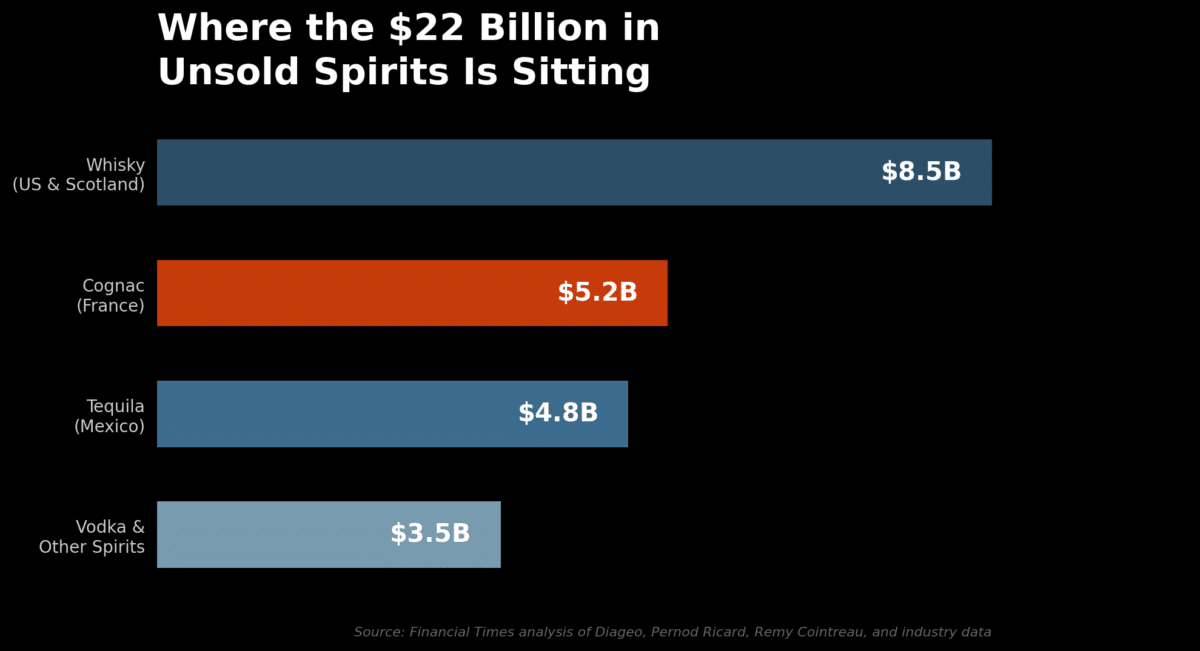
The global spirits industry is currently confronting a structural crisis valued at approximately $22 billion, as the world’s leading alcohol producers face a massive surplus of aging inventory. Barrels of high-end whisky, cognac, and tequila are accumulating in warehouses at rates far exceeding consumer demand, marking the highest inventory levels seen in more than a decade. Major industry players, including Diageo, Pernod Ricard, and Rémy Cointreau, are now navigating the fallout of a post-pandemic miscalculation where production was aggressively scaled to meet a "premiumization" trend that has since evaporated under the pressure of global economic shifts and changing consumer habits.
The current glut is the result of a multi-year strategy that prioritized high-value, aged spirits over volume. During the COVID-19 lockdowns of 2020 and 2021, homebound consumers redirected their discretionary spending toward luxury goods, including $100 bottles of extra-añejo tequila and rare single-malt scotches. This "drink better, not more" philosophy encouraged spirits conglomerates to ramp up production and increase prices, operating under the assumption that the appetite for premium spirits had reached a new, permanent plateau. However, as the global economy shifted toward a high-interest-rate environment and a cost-of-living crisis took hold, that demand proved ephemeral, leaving the industry with a massive, slow-moving backlog of liquid assets.
The Pandemic Boom and the Forecasting Failure
To understand the current $22 billion stockpile, it is necessary to examine the unique market conditions of the early 2020s. The closure of bars and restaurants during the pandemic did not result in a decline in alcohol consumption; rather, it shifted the venue to the home. With travel and external entertainment off the table, consumers engaged in "revenge spending," opting for high-end labels they previously only ordered on special occasions.
Spirits producers reacted by accelerating production cycles and increasing their aging stocks. However, spirits production—specifically for brown spirits like whisky and cognac—is a long-game endeavor. Decisions made in 2021 regarding how much liquid to put into barrels were based on forecasts for 2026, 2031, and beyond. Bernstein analyst Trevor Stirling recently noted that the industry "lost the run of themselves," assuming that the double-digit growth seen during the pandemic was the new baseline rather than a temporary anomaly.
By 2023 and early 2024, the reality of the "post-pandemic hangover" became clear. As inflation rose and disposable income shrank, the $100 bottle of tequila became a luxury many consumers were no longer willing to justify. The industry is now facing the consequences of those long-term bets, with inventory levels reaching nearly 2,000 Olympic-sized swimming pools worth of liquor sitting in storage.
Quantifying the Surplus: A Breakdown by Category
The $22 billion figure represents a diverse range of spirits, each facing its own set of challenges. The following table illustrates the scale of the inventory build-up across key sectors:
| Category | Estimated Unsold Inventory | Market Implication |
|---|---|---|
| Total Industry | ~$22 Billion | Highest level in 10+ years; significant capital tied up in aging stock. |
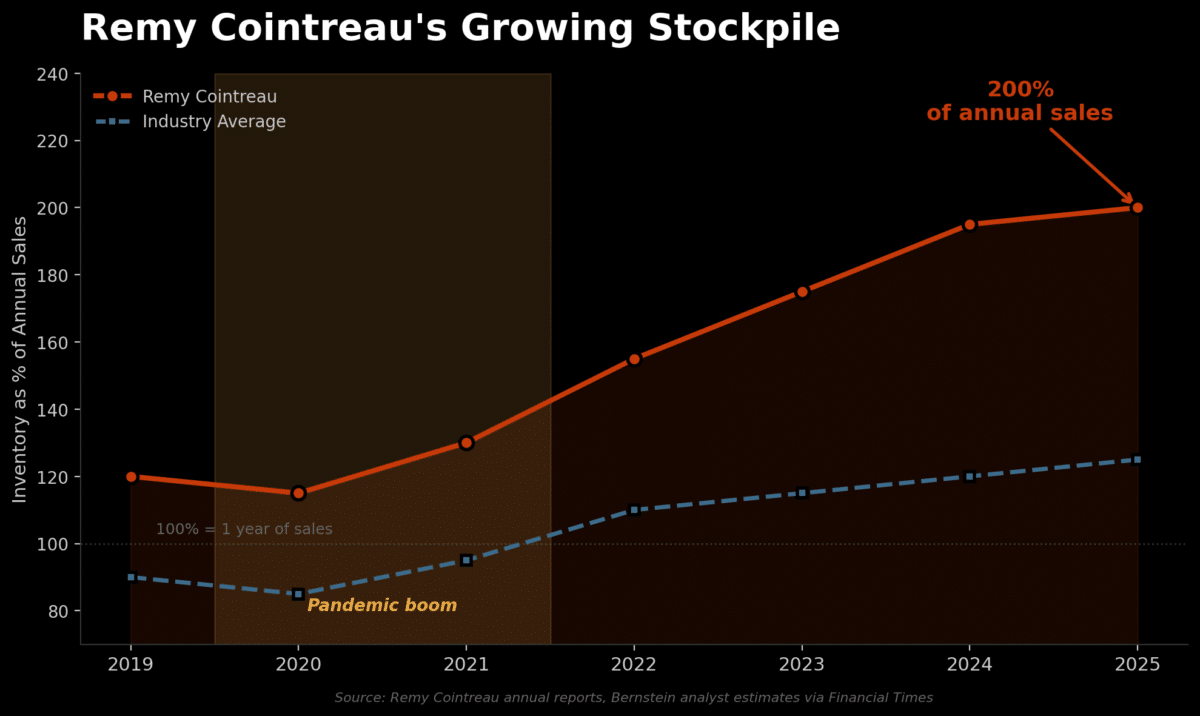
| Rémy Cointreau (Cognac) | ~200% of annual sales | Producer could halt production for two years and still meet current demand. |
| Tequila (Mexico) | ~500+ Million Liters | Roughly one full year of global production waiting to be absorbed. |
| Whisky (US & Scotland) | Multi-year aging stock | Distilleries are pausing operations to prevent further oversupply. |
| Cognac (Exports) | Disrupted by tariffs | Trade tensions with China have closed off a primary high-end market. |
Rémy Cointreau, which specializes in premium cognac, is perhaps the most visible example of this imbalance. Its inventory-to-sales ratio suggests that even if every still were turned off today, the company would have enough stock to satisfy global demand for two years. In Mexico, the tequila industry is grappling with a similar surplus. After years of frantic planting to keep up with the celebrity-fueled tequila boom, producers are sitting on half a billion liters of spirit, leading to a collapse in the price of raw agave.

Regional Impacts and Production Halts
The inventory crisis has forced the world’s largest distillers to take drastic operational measures. In the United States, the bourbon and American whiskey sector is seeing a significant cooldown. Suntory Global Spirits recently made the decision to close its primary Jim Beam distillery in Kentucky for a period to rebalance supply. Similarly, Diageo, the parent company of brands like Johnnie Walker and Bulleit, has paused whiskey production at facilities in Texas and Tennessee.
Brown-Forman, the producer of Jack Daniel’s, has gone further, implementing job cuts and scaling back operations as the category slows. These moves reflect a broader strategy of "destocking"—a process where manufacturers and distributors work to clear out existing warehouse inventory before committing to new production runs. For the companies, this is a necessary but painful correction that weighs heavily on quarterly earnings and stock prices.
Shifting Consumer Behavior: The "Sober-Curious" and GLP-1 Factors
Beyond the economic pressures of inflation and rent increases, the spirits industry is facing a cultural shift. The "sober-curious" movement, which encourages temporary or permanent abstinence from alcohol, has moved from a niche trend to a mainstream lifestyle choice. This is particularly prevalent among Gen Z and Millennial cohorts, who are consuming significantly less alcohol than previous generations at the same age.
Furthermore, the rise of GLP-1 medications, such as Ozempic and Wegovy, is emerging as an unexpected headwind for the alcohol industry. Clinical observations and early studies suggest that these medications, primarily used for weight loss and diabetes, may also suppress the neurological pathways associated with alcohol cravings. As the adoption of these drugs increases, industry analysts are closely monitoring their potential to permanently dampen per-capita alcohol consumption.
At the same time, the "occasion" for drinking is being cannibalized by the rise of Ready-To-Drink (RTD) canned cocktails and non-alcoholic alternatives. These products typically have shorter production cycles and lower price points, making them more attractive to price-sensitive consumers but less profitable for companies that have invested billions in long-term aged spirits.
Geopolitical Headwinds: The China-EU Trade Conflict
The inventory crisis is being exacerbated by external political pressures, particularly in the cognac sector. Cognac is one of the industry’s most profitable categories, with China serving as a vital market for high-end "XO" and "VSOP" expressions. However, trade tensions between the European Union and China have led to the imposition of provisional anti-dumping duties on European brandy.
These tariffs have effectively throttled shipments to China, leaving French producers with a surplus of premium liquid that has no alternative market capable of absorbing such high volumes at premium prices. This geopolitical friction has turned what was already a demand problem into a logistical and financial nightmare for companies like Pernod Ricard and Hennessy (LVMH).
The Consumer Perspective: A Shift in Pricing Power
For the average consumer, the $22 billion inventory glut offers a rare silver lining. After years of aggressive price hikes, the power dynamic is shifting back toward the buyer. In the United States, the price of a standard bottle of Hennessy, which peaked near $45 during the height of the pandemic, has been seen as low as $35 in some markets as producers and retailers attempt to move stock.
While a "fire sale" on luxury spirits is unlikely due to the brands’ desire to maintain their "premium" image, discounts, promotions, and value-added bundles are becoming more frequent. In markets like Australia, where high alcohol excise taxes and import costs create a price floor, the drops may be less dramatic, but the era of rapid price escalations appears to have ended.
Future Outlook: Rebalancing the Barrels
The spirits industry now faces a delicate balancing act. To clear the $22 billion backlog, companies must find ways to stimulate demand without devaluing their brands through excessive discounting. The current strategy of slowing or pausing production is a short-term fix intended to prevent the surplus from growing further, but it carries long-term risks. If demand were to suddenly rebound, the industry could face a "supply cliff" in several years because the liquid that should have been barreled today will not be available for sale in the future.
In the immediate term, investors and analysts expect a period of "right-sizing." This will likely involve further consolidation within the industry, continued operational efficiencies, and a pivot toward emerging categories like non-alcoholic spirits and functional beverages.
The $22 billion sitting in global warehouses serves as a stark reminder of the volatility inherent in luxury commodities. While the industry bet on a future of endless premiumization, the reality of 2024 has forced a return to economic fundamentals. For the giants of the spirits world, the challenge is no longer just about making a better bottle of whisky—it is about finding someone willing to buy it.




 Yuyun Lusiyani
 Joko Widodo
 Eva Lovia
 Pevita Pearce
 admin
admin