
 admin
admin
Culinary personality Eric Adjepong, known for his appearances on "Top Chef" and Food Network, is embroiled in significant legal challenges, facing allegations of violating a protective order obtained by his ex-wife, Janell Mack, in early 2025, prior to his seven-year-old daughter successfully obtaining a separate, year-long protective order against him in July 2026. These developments have brought the private life of the public figure into sharp focus, highlighting the complexities of family law and the sensitive nature of domestic disputes, particularly when children are involved.
The Rise to Prominence: Eric Adjepong’s Public Persona
Before these legal issues surfaced, Eric Adjepong cultivated a strong reputation within the culinary world. A Ghanaian-American chef, Adjepong first gained widespread recognition as a finalist on season 16 of Bravo’s "Top Chef." His distinctive approach to West African cuisine, coupled with his engaging personality, quickly made him a fan favorite. Following his successful run on "Top Chef," Adjepong further cemented his status as a prominent figure in food media, making numerous appearances on various Food Network programs and contributing to various culinary publications. His career trajectory pointed towards continued growth, with a public image built around innovation, cultural heritage, and professional excellence. This background context underscores the significant contrast between his public persona and the recent allegations that have emerged from his personal life. The gravity of the accusations, particularly those involving a minor, presents a formidable challenge to his carefully constructed public image and professional standing.
A Chronology of Legal Proceedings: Two Protective Orders

The legal entanglements involving Adjepong span more than a year, beginning with a temporary protective order filed by his ex-wife, Janell Mack, in January 2025, and culminating in a final protective order secured by their daughter in July 2026. Understanding the precise timeline and the distinct nature of each legal action is crucial to grasping the full scope of the situation.
The First Protective Order: Janell Mack’s Filing in 2025
In January 2025, Janell Mack initiated legal proceedings against Eric Adjepong, successfully obtaining a temporary protective order. This order, issued by the court, legally prohibited Adjepong from contacting Mack "by any means." Protective orders are civil injunctions designed to prevent domestic violence, harassment, or other forms of abuse, establishing legal boundaries for interaction between parties. They are often issued on an emergency or temporary basis, pending a more comprehensive hearing, to ensure immediate safety. The specific incidents or circumstances that led to Mack seeking this initial protective order were not detailed in the public records available, leaving a gap in the understanding of the initial marital discord.
However, a day after the temporary order was put into effect, on January 23, 2025, Adjepong allegedly contacted Mack. The contact, according to court documents, occurred via the "OurFamilyWizard" parenting application, a platform specifically designed for co-parents to communicate and manage shared responsibilities, especially in high-conflict divorce or custody cases. Adjepong reportedly used the app to request a FaceTime call with his former wife. This alleged communication, despite being facilitated through a court-mandated co-parenting tool, was seen as a potential violation of the recently issued protective order, which explicitly barred contact by "any means."
Following this alleged contact, a court summons was issued to Eric Adjepong, serving as a formal notification of the potential violation and a stern reminder of the terms of the protective order. The temporary protective order remained active through February 4, 2025, at which point its terms would have expired or been reviewed for extension or conversion into a permanent order.

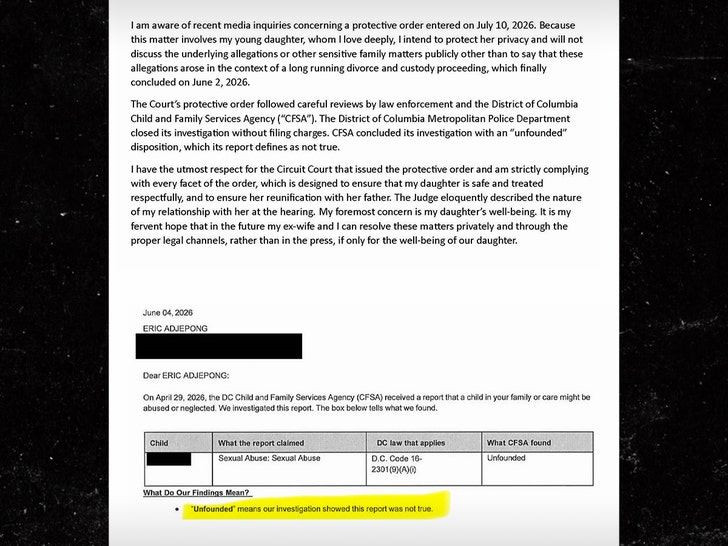
Adjepong’s attorney addressed this specific incident, providing a critical clarification. According to the attorney, "The alleged violation entailed Mr. Adjepong contacting his ex-wife regarding their daughter through the OurFamilyWizard app, a court-mandated communications app used during the parties’ divorce and custody proceedings. The alleged violation was dismissed because the court recognized that the required method of communication was the OurFamilyWizard app, creating a conflict with the protective order." This statement suggests that the court acknowledged a procedural conflict arising from the simultaneous existence of a general no-contact order and a separate mandate to use a specific communication platform for co-parenting matters. This legal nuance indicates that while an alleged violation occurred, it was subsequently resolved without further legal penalty, presumably due to the conflicting court directives.
The Second Protective Order: Daughter Lennox in 2026
More than a year after the initial protective order incident involving his ex-wife, Eric Adjepong faced a more severe legal challenge. On July 10, 2026, his seven-year-old daughter, Lennox, successfully obtained a year-long final protective order against him in Howard County, Maryland. This development followed serious allegations of sexual abuse against the child.
The process leading to this protective order began on May 1, 2026, when the allegations were first brought to the attention of Child and Family Services. Such agencies are mandated to investigate reports of child abuse or neglect and, if necessary, involve law enforcement. In this case, Child and Family Services subsequently notified the Washington, D.C. police department, triggering a criminal investigation. However, after their inquiry, the Washington, D.C. police concluded that they found "no probable cause that a crime occurred."
It is crucial to understand the distinction between a criminal investigation and a civil protective order proceeding. A criminal investigation, conducted by law enforcement, seeks to determine if a crime has been committed and requires a higher standard of proof ("beyond a reasonable doubt" for conviction, "probable cause" for arrest or charges). The police finding of "no probable cause" meant that they did not have sufficient evidence to bring criminal charges against Adjepong at that time.

Conversely, civil protective orders, such as the one obtained by Lennox, operate under a different legal standard, typically a "preponderance of the evidence," meaning it is more likely than not that abuse or harassment occurred. This lower standard of proof allows civil courts to issue orders aimed at protection and safety, even if criminal charges are not pursued or are unsuccessful. Thus, despite the police finding no probable cause for a criminal offense, a Howard County, Maryland judge determined that there was sufficient evidence under the civil standard to issue a final protective order against Eric Adjepong, effective for one year.
Statements from Involved Parties
The legal proceedings have elicited public statements from both Eric Adjepong and Janell Mack, reflecting their respective positions and emotional tolls.
Eric Adjepong, through his attorney, has maintained compliance with the most recent protective order concerning his daughter. His legal representative stated, "It is my fervent hope that in the future my ex-wife and I can resolve these matters privately and through the proper legal channels, rather than in the press, if only for the well-being of our daughter." This statement emphasizes a desire for privacy in family matters and prioritizes the child’s welfare, while also subtly critiquing the public nature of the ongoing dispute.
Adjepong also posted a personal statement on Instagram, addressing the broader situation without delving into specifics. He wrote, "The past several weeks have been among the most difficult of my life. I have remained silent not because I lacked a response, but because I believe integrity is measured by how you conduct yourself when your character is being questioned. Others can choose rhetoric. I will choose truth." This message projects a stance of resilience and integrity amidst adversity, suggesting that his silence was a conscious choice rather than an absence of defense.
Janell Mack, Adjepong’s ex-wife and Lennox’s mother, also used Instagram to share her perspective, focusing on her daughter’s courage. Her statement read, "My daughter was just granted a protective order against her father because she was brave enough to speak up against who should have been one of the most trusted adults in her life." Mack’s statement highlights the severe nature of the allegations and frames the court’s decision as a validation of her daughter’s bravery and a necessary protective measure. This publicly underscores the mother’s belief in the veracity and gravity of the child’s claims.
Broader Implications and Impact
The legal battles surrounding Eric Adjepong carry significant implications, both personally and professionally. For a public figure like Adjepong, who has built a career in an industry often associated with hospitality, family, and public trust, allegations of this nature can have a profound impact on his brand and future opportunities.
Professional Impact:
His association with "Top Chef" and Food Network positions him within a family-friendly and aspirational sphere. Allegations, especially those involving a child, can lead to severe reputational damage. Networks and sponsors often distance themselves from talent embroiled in such controversies to protect their own public image. While the legal process is ongoing and the civil protective order does not equate to a criminal conviction, the mere existence of such an order and the public nature of the allegations can result in professional setbacks, including potential loss of endorsement deals, television appearances, and other career opportunities. The culinary world, like many entertainment industries, is sensitive to public perception, and these developments place Adjepong in a precarious position.
Legal Complexities of Co-Parenting:
The case also illustrates the intricate challenges inherent in co-parenting after divorce, particularly when protective orders are involved. The conflict between the "OurFamilyWizard" app’s mandate for communication and the "no contact" clause of a protective order highlights a common legal conundrum. Courts often strive to balance the need for parental communication regarding a child with the safety concerns addressed by protective orders. This requires careful judicial crafting of orders to prevent unintended violations while ensuring child welfare.

Child Protection and Judicial Role:
The successful attainment of a protective order by a minor, represented by a parent or guardian, underscores the legal system’s commitment to child protection. The distinction between the police finding "no probable cause" for criminal charges and the civil court issuing a protective order based on a lower standard of proof is a critical aspect of child welfare law. It demonstrates that even without a criminal conviction, the civil courts can intervene to ensure a child’s safety and well-being based on credible allegations and evidence presented. This serves as a vital safeguard for vulnerable individuals.
Public Scrutiny:
High-profile individuals involved in domestic disputes often face intense public and media scrutiny, which can complicate private legal matters. The desire expressed by Adjepong’s attorney to resolve matters privately is a common sentiment in such situations, reflecting the added pressure and emotional toll that public exposure can bring to an already difficult family situation.
As these legal proceedings unfold, the focus will remain on the welfare of the child and the ongoing adherence to the court’s orders. The case serves as a stark reminder that even individuals in the public eye are subject to the complexities and challenges of personal and family legal matters, with potentially far-reaching consequences.


 Yuyun Lusiyani
 Joko Widodo
 Eva Lovia
 Pevita Pearce

 Lina Irawan