
 Jia Lissa
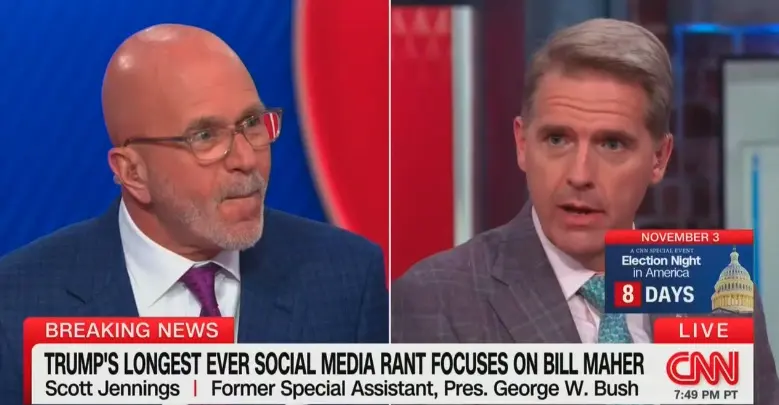
Scott Jennings, a veteran Republican strategist and prominent CNN political commentator, sparked a wave of media analysis and social media discourse following his recent defense of President Donald Trump’s unprecedentedly long digital tirade against HBO host Bill Maher. During an appearance on CNN NewsNight, Jennings described the President’s 1,300-word critique of the comedian as "miraculous," a comment that comes at a pivotal moment as the Trump administration seeks to fill the high-profile vacancy of White House Press Secretary. The exchange highlighted the deepening divide in how political observers interpret the President’s unconventional communication style and the strategic underpinnings of his ongoing engagement with mainstream media figures.
The controversy began in the wake of a series of private interactions between the President and the host of Real Time with Bill Maher. For the second consecutive year, Maher accepted an invitation to dine with President Trump at the White House. Following their first meeting, Maher had surprised his audience by praising the President’s personal conduct, describing him as "gracious" and "measured." This pattern continued after their most recent dinner, with Maher using his Friday night broadcast to push back against critics who claimed he was being "duped" by the administration. Maher asserted that his willingness to engage face-to-face with the President was a necessary component of political discourse, even as he maintained his identity as a liberal critic.
However, the cordiality of the White House dinner was short-lived. Within 48 hours of Maher’s defense of the meeting, President Trump utilized his Truth Social platform to issue a sprawling, multi-part "screed" that targeted Maher’s career, intelligence, and the quality of his HBO program. The post, which spanned more than 1,300 words, is believed to be the longest single communication Trump has ever posted to the platform. In the message, the President referred to Maher as a "COMPLETE AND TOTAL LOSER" and lamented the decline of HBO, claiming the network was no longer "HOT" or a "Network of Quality and Excitement."
The Chronology of the Trump-Maher Interaction
The timeline of the recent friction between the President and the comedian illustrates the volatile nature of their relationship. The sequence of events began last week when Maher arrived at the White House for a scheduled dinner. While the specifics of their conversation remained private, Maher provided a summary during his Friday night monologue on Real Time. He told his audience that when Trump is in the White House, "he looks you in the eye, he never interrupts, he never gets mad, he listens."
Maher’s defense of the dinner was notably defiant. Addressing his detractors directly, he stated, "Yeah, I did it again, btches. I know! I’m the bad guy because I go and say face-to-face to the man the things you write in articles he’ll never read." He concluded his remarks by telling critics, "Fck you. I like these dinners."
The response from the President, issued on Sunday, took a drastically different tone. Despite Maher’s complimentary remarks regarding the President’s temperament, Trump’s Truth Social post focused on Maher’s perceived failures as a broadcaster. The President characterized Maher as a "coward" and a "major pothead," focusing heavily on the ratings of his show and the perceived irrelevance of his commentary. This sudden pivot from a private, polite dinner to a public, vitriolic attack is a hallmark of the President’s "counter-punching" media strategy, though it appeared particularly jarring given Maher’s recent attempts to humanize the President to a liberal audience.
Analyzing the CNN NewsNight Exchange
The Monday night broadcast of CNN NewsNight, hosted by guest anchor Michael Smerconish, sought to unpack the motivations behind the President’s lengthy post. Smerconish questioned Scott Jennings on the necessity of the post’s extreme length, asking why the President felt compelled to write a 1,300-word essay when a single paragraph would have garnered the same level of media attention.
Jennings’ response was both defensive and laudatory. "I mean, our president has a lot to say about this," Jennings began. When pressed by Smerconish on why the length was necessary, Jennings replied, "I don’t know, but I think it’s sort of miraculous that the president of the United States issues such detailed missives about all sorts of things going on in our culture." He went on to argue that the President’s verbosity is a sign of transparency, noting that "one thing you can never say about him is we don’t know what’s on his mind."
This interpretation was immediately challenged by fellow panelist Van Jones, who quipped, "What’s left of his mind." The exchange highlighted the fundamental disagreement between Trump’s supporters, who view his unfiltered communications as a form of authentic engagement, and his critics, who view them as evidence of erratic behavior or cognitive decline. Jennings, however, maintained his stance, further complicating the discussion by expressing his own personal affinity for Maher. He described Maher as a "rational actor" who has attempted to pull the political left "back from the brink of insanity." Jennings admitted he was confused as to why the President was "so upset" with Maher, given Maher’s recent trajectory toward more moderate or "common sense" critiques of progressive culture.
The Strategic Context of Jennings’ Remarks
The timing of Scott Jennings’ robust defense of the President has not escaped the attention of political analysts. Jennings has been frequently mentioned as a top contender for the role of White House Press Secretary. The position has seen significant turnover and instability in recent weeks. Following the departure of Karoline Leavitt, the role was briefly filled by Katie Zacharia. However, Zacharia’s tenure lasted only five days, ending abruptly after a single press briefing that was widely panned by both the administration and the media.
With the Press Secretary role once again vacant, Jennings’ performance on CNN is being viewed by some as a public audition. By framing the President’s 1,300-word social media rant as "miraculous" and "detailed," Jennings demonstrated a willingness to provide a sophisticated intellectual defense for the President’s most controversial impulses. This ability to translate the President’s unfiltered rhetoric into a coherent political narrative is considered a primary requirement for the Press Secretary position in the current administration.
Reports have surfaced that Jennings has previously sent transcripts of his media appearances to the White House as part of his bid for the job. His recent comments suggest a strategic alignment with the President’s preference for loyalists who can effectively navigate the hostile environment of cable news panels.
Data and Implications of Trump’s Communication Strategy
The length of the Truth Social post in question—over 1,300 words—represents a significant shift in the President’s digital footprint. During his time on Twitter (now X), Trump was constrained by character limits, which necessitated a punchy, staccato style of communication. On Truth Social, where character limits are significantly higher, the President has increasingly turned to "long-form" grievances.
Data from media monitoring groups suggests that these long-form posts serve several functions:
- Direct Communication: They allow the President to bypass media filters entirely, providing a raw transcript of his thoughts directly to his base.
- Media Saturation: The sheer volume of the text ensures that news outlets have a wealth of material to analyze, effectively dominating the news cycle for multiple days.
- Psychological Warfare: By attacking critics in such granular detail, the President signals to other media figures that any engagement, even if partially positive like Maher’s, can result in a scorched-earth public response.
The broader implications of this communication style are profound. For the White House press office, defending 1,300-word posts creates a unique set of challenges. It requires a spokesperson who can explain the nuance—or lack thereof—in the President’s personal feuds while maintaining the dignity of the office. Jennings’ characterization of these posts as "miraculous" suggests that the next phase of the administration’s media strategy may involve leaning even further into the President’s persona as a cultural critic-in-chief.
Public and Official Reactions
The reaction to Jennings’ "miraculous" comment has been polarized. Supporters of the President on social media praised Jennings for standing his ground against Smerconish and Jones, viewing his comments as a refreshing defense of the President’s right to speak his mind. Conversely, media critics have argued that describing a rambling social media attack as "miraculous" is an example of the "normalization" of behavior that would be considered disqualifying for any other political figure.
The White House has not officially commented on the Maher post or Jennings’ defense of it, nor has there been an official announcement regarding the Press Secretary vacancy. However, the internal pressure to find a stable and effective communicator remains high. The Zacharia episode was seen as a significant embarrassment for the administration, and there is a perceived need for a "professional" who also possesses the "MAGA" credentials necessary to satisfy the President’s core supporters.
As the search for a new Press Secretary continues, the Maher incident serves as a case study in the complexities of the Trump era’s media relations. It involves a mix of private diplomacy (the dinners), public betrayal (the Truth Social post), and media surrogacy (the CNN defense). Whether Scott Jennings’ "miraculous" defense will earn him the podium in the Brady Press Briefing Room remains to be seen, but it has undoubtedly cemented his status as one of the President’s most dedicated and articulate defenders in the current media landscape.
Conclusion and Future Outlook
The saga of the 1,300-word post and the subsequent "miraculous" defense highlights the unconventional nature of modern political communication. Bill Maher, once a pariah to the right, found himself in the crosshairs of a President he had recently attempted to humanize. Scott Jennings, a strategist looking toward a potential government role, found a way to frame a digital tirade as a feat of transparency.
As the administration moves forward, the frequency and length of these "detailed missives" are likely to increase, especially as the President continues to use Truth Social as his primary platform for cultural and political commentary. The role of the Press Secretary will not just be to relay policy, but to interpret and defend the President’s extensive digital manifestos. In this environment, the definition of "miraculous" may continue to be a point of contention between those who see it as a sign of a vibrant, unfiltered leader and those who see it as a symptom of a fractured political discourse.


 Nila Kartika Wati

 Eva Lovia

 Lina Irawan

 Yuyun Lusiyani

 Ana Megawati

 Joko Widodo
