
 Jia Lissa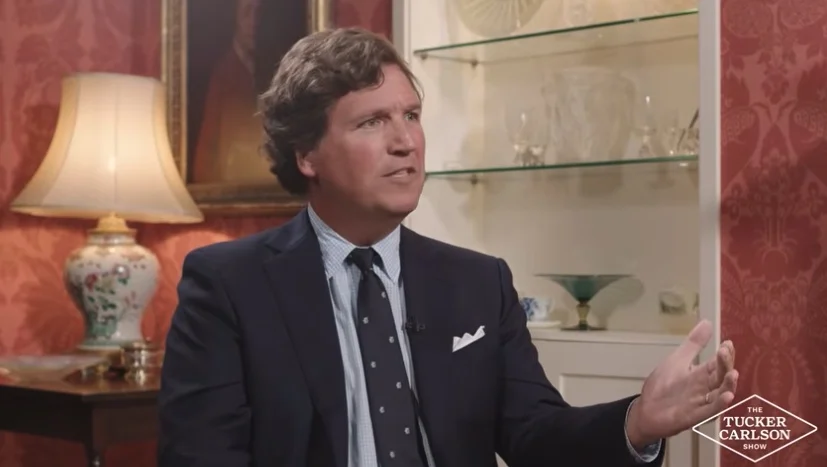
In a recent and widely circulated interview, former Fox News host Tucker Carlson engaged in a contentious dialogue with Jacob Rees-Mogg, a prominent former member of the British Parliament and Conservative Party figure. The discussion, which initially centered on the modern conflict in Ukraine and British military aid to Kyiv, veered into a deep interrogation of the United Kingdom’s participation in World War II. Carlson’s line of questioning, which challenged the fundamental moral and strategic justifications for the Allied effort against Nazi Germany, has sparked significant debate regarding historical revisionism and the current state of transatlantic relations.
The exchange occurred on Carlson’s independent media platform, where he has increasingly focused on isolationist foreign policy and critiques of Western interventionism. During the interview, Carlson questioned whether the United Kingdom truly benefited from its victory over the Axis powers, suggesting that the cost of the war—including the eventual dissolution of the British Empire and the loss of life—outweighed the necessity of defeating Adolf Hitler’s regime.
Analysis of the Interview Exchange
The most striking moment of the interview began when Carlson asked why the United Kingdom chose to fight the Second World War in the first place. Rees-Mogg, visibly taken aback, initially described it as a "fundamental question," eventually asserting that the war was a "classic good-versus-evil" struggle. He argued that if the UK had not intervened, Hitler would have continued his expansionist agenda across the European continent.
Carlson countered by addressing the historical motivations behind the German invasion of Poland in 1939. He noted that Hitler’s justification involved reclaiming territories, such as parts of Prussia and the "Polish Corridor," which had been ceded by Germany following the Treaty of Versailles in 1919. Carlson stated that the idea of Hitler "randomly" rolling into Poland was a "lie" and that Germany had "big pieces of it carved off" to create the Polish state. While Carlson explicitly stated he was not "defending Hitler," he argued that the U.K. had no vital interest in the border disputes of Eastern Europe and that by entering the war, the British "destroyed their empire and their country."
The dialogue reached a climax when Rees-Mogg argued that without the victory, the British people would "all be speaking German." Carlson responded with the phrase "Who cares?" and suggested that modern Britain is already struggling with linguistic and cultural cohesion, stating, "There are a lot of people in Britain who can’t speak English. So, it would be nice to have like, at least a European language spoken in your country."
Historical Context and the Treaty of Versailles
To understand the weight of Carlson’s assertions, it is necessary to examine the historical framework of the late 1930s. The Treaty of Versailles, signed at the end of World War I, indeed forced Germany to cede roughly 13% of its European territory and all of its overseas colonies. The creation of the Polish Corridor, which gave the newly reconstituted Poland access to the Baltic Sea, physically separated East Prussia from the rest of Germany.
Historians generally agree that the perceived humiliations of the Versailles Treaty provided fertile ground for the rise of the Nazi Party. However, mainstream historical consensus rejects the notion that the invasion of Poland was a mere border dispute. The "Lebensraum" (living space) policy outlined in Hitler’s Mein Kampf indicated a much broader intent to colonize Eastern Europe and enslave or exterminate its populations.
The United Kingdom’s entry into the war was precipitated by the Anglo-Polish alliance. Following the German occupation of the remainder of Czechoslovakia in March 1939—an act that violated the Munich Agreement—the British government issued a formal guarantee of Polish independence. When Germany invaded Poland on September 1, 1939, Britain and France issued an ultimatum for withdrawal. Upon its expiration on September 3, the two nations declared war on Germany.
Chronology of Related Events and Controversies
The interview with Rees-Mogg is not an isolated incident in Carlson’s recent media output. It follows a pattern of content that re-evaluates the history of the 20th century:
- September 2024: Carlson hosted Darryl Cooper, an independent historian and podcaster, on his program. During the episode, Cooper described Winston Churchill as the "chief villain" of World War II, arguing that the British Prime Minister was more responsible for the scale of the conflict than Hitler. Cooper suggested that the Holocaust was an "accident" resulting from Germany being unprepared to care for the millions of people it had captured.
- February 2024: Carlson conducted a high-profile interview with Russian President Vladimir Putin in Moscow. During that session, Putin also invoked the Treaty of Versailles and the history of Polish-German relations to justify contemporary Russian foreign policy, a narrative that bears similarities to the arguments Carlson presented to Rees-Mogg.
- Late 2023 – Present: Carlson has consistently used his platform to oppose U.S. and U.K. funding for Ukraine, often drawing parallels between what he views as the "mistakes" of past world wars and current Western involvement in Eastern Europe.
Supporting Data: The Cost and Consequences of World War II for the UK
Carlson’s assertion that the UK "destroyed" itself during the war touches on a complex economic reality. While the UK emerged as a victor and a founding member of the United Nations, the financial toll was staggering.
- National Debt: At the start of the war in 1939, the UK’s national debt was approximately £7 billion. By 1945, it had soared to over £21 billion. The country was essentially bankrupt and required the Anglo-American loan of $3.75 billion (roughly $60 billion in today’s currency) in 1946 to survive the post-war transition.
- Human Cost: The United Kingdom suffered approximately 450,000 deaths (including both military personnel and civilians).
- The End of Empire: The economic exhaustion following the war accelerated the decolonization process. Within two decades of the war’s end, the British Empire—once the largest in history—had largely dissolved, with major territories like India gaining independence in 1947.
- Economic Growth: Despite the initial post-war austerity, the UK experienced a period of significant social reform and economic growth in the 1950s and 60s, often referred to as the "post-war consensus," which saw the creation of the National Health Service (NHS).
Reactions and Implications
The interview has drawn sharp criticism from historians, politicians, and media commentators on both sides of the Atlantic. Critics argue that Carlson’s rhetoric downplays the existential threat posed by the Third Reich and ignores the moral imperative of stopping the Holocaust.
In the United Kingdom, Rees-Mogg’s defense of the war effort reflects the standard national narrative: that Britain’s "finest hour" was its stand against fascism when much of Europe had fallen. The suggestion that "it wouldn’t matter" if the country spoke German is viewed by many in Britain as an affront to the generation that fought the war.
Conversely, some of Carlson’s supporters view his comments as a necessary challenge to "state-sanctioned" history. They argue that he is merely applying a consistent isolationist logic: that nations should not involve themselves in foreign conflicts unless their direct territorial integrity is at stake.
Broader Impact on Political Discourse
This discourse highlights a growing rift within the modern conservative movement, particularly in the United States. A significant faction, represented by Carlson and various "America First" advocates, is increasingly skeptical of the international alliances and moral frameworks that have defined Western policy since 1945. By questioning the necessity of World War II—the conflict that serves as the moral bedrock for the current international order—Carlson is signaling a desire for a fundamental shift in how the West views its role in the world.
The implications for current events are direct. If the intervention against Hitler is viewed as a mistake or a net negative for the British people, then the argument for intervening against modern aggressors becomes significantly harder to sustain in the eyes of the public. This revisionist approach to history serves as a tool for shaping contemporary debates on isolationism, immigration, and national identity.
As the video continues to circulate, it remains a focal point for discussions on the limits of historical inquiry and the influence of alternative media in reshaping public perception of the most defining events of the 20th century. The clash between Carlson’s skepticism and Rees-Mogg’s traditionalism underscores a deeper cultural struggle over the meaning of national sacrifice and the value of global leadership.

 Yuyun Lusiyani
 Ana Megawati
 Joko Widodo
 Eva Lovia
 Pevita Pearce