
 Jia Lissa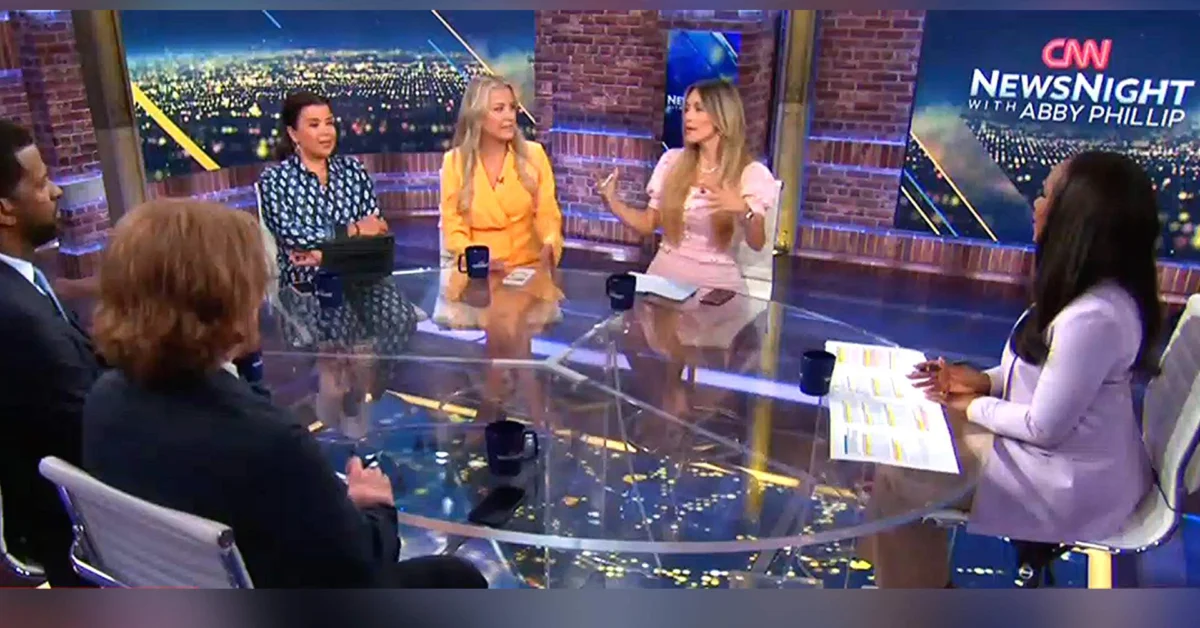
The intersection of religious iconography, political branding, and social media conduct became a flashpoint on CNN’s Newsnight this week as a panel of commentators engaged in a heated debate over former President Donald Trump’s recent online activities. The discussion, moderated by anchor Abby Phillip, centered on a controversial social media post shared by the former president which depicted him in a manner many observers described as a Christ-like figure. The ensuing dialogue highlighted the deep divisions within the political commentary sphere regarding Trump’s intent, his relationship with religious voters, and the standards to which political figures are held by their supporters.
The controversy began when Donald Trump shared an image on his social media platform, Truth Social, which appeared to be an AI-generated or heavily edited depiction of himself. In the image, Trump is shown with an ethereal aura, his hands positioned in a way that mirrors traditional Christian artistic depictions of Jesus Christ. When later questioned about the post, Trump offered a clarification that many critics found difficult to reconcile with the visual evidence. He claimed that he believed the image portrayed him as a medical professional or a worker for the Red Cross, stating, “I did post it, and I thought it was me as a doctor—and had to do with Red Cross, as a Red Cross worker there, which we support.”
The Newsnight Debate: A Microcosm of Political Friction
On Tuesday night’s edition of CNN NewsNight, Abby Phillip convened a diverse panel to dissect the implications of this post and Trump’s subsequent explanation. The panel included pro-Trump podcast host Emily Austin, Democratic strategist Bakari Sellers, former Republican Representative Peter Meijer, former Trump administration press aide Sarah Matthews, and veteran political commentator Ana Navarro.
The segment quickly intensified when Emily Austin suggested that Trump’s explanation was not a lie. "I don’t think Trump lied about the post, and I’m not here to defend every action that he makes," Austin stated, sparking an immediate wave of incredulity from her fellow panelists. Austin argued that the original creator of the image, conservative influencer Nick Adams, had posted the photo months prior with the caption "the healer of the nation." She posited that Trump might have interpreted the "healer" motif as a medical reference rather than a theological one.
Ana Navarro, speaking from her perspective as a resident of Miami—a community with a significant Republican base—rejected this defense. Navarro characterized the post as "blasphemy" and a "lack of respect," suggesting that such actions are starting to alienate even some of Trump’s staunch supporters. "I think part of the reason that he’s picked this fight with the pope… and he’s depicting himself as Jesus Christ and then lying about it, so that’s like two or three commandments that he violated in one fell swoop," Navarro remarked.
Chronology of the Controversy and Social Media Impact
The timeline of the event suggests a calculated, or perhaps impulsive, engagement with provocative imagery that is characteristic of Trump’s digital strategy. The image in question was originally circulated by Nick Adams, an Australian-born conservative commentator known for his "Alpha Male" branding and staunch support of the former president. Adams’ original intent was to frame Trump as a "healer" during a period of national political tension.
When Trump reshared the image to his millions of followers, it immediately went viral, drawing both praise from his most devoted followers and sharp condemnation from religious leaders and political opponents. The image was eventually removed from his profile, a move that Emily Austin pointed to as evidence of a corrective action once the religious implications were realized. However, Sarah Matthews questioned whether the removal was sufficient to mitigate the initial "sacrilegious" nature of the post.
The debate on CNN reflected a broader national conversation about the "Messiah complex" frequently attributed to the Trump campaign by critics. Throughout his political career, Trump has frequently leaned into religious themes, despite his occasional struggles with theological specifics—most famously evidenced by his "Two Corinthians" reference during the 2016 campaign.
Supporting Data: The Religious Vote and Public Perception
The significance of this controversy is rooted in Trump’s reliance on the evangelical and Catholic vote. According to data from the Pew Research Center, white evangelical Protestants have consistently supported Trump at high rates, with approximately 80% voting for him in both 2016 and 2020. However, the use of explicit Christ-like imagery tests the boundaries of this support.
While many in the MAGA movement view such imagery as metaphorical—representing Trump as a figure persecuted for his beliefs—mainstream religious organizations often view it as a violation of the prohibition against graven images or as a form of narcissism that borders on the heretical. A 2023 AP-NORC poll indicated that while religious Republicans generally approve of Trump’s policies, a significant minority expresses discomfort with his personal conduct and rhetoric.
Bakari Sellers emphasized this point during the Newsnight segment, challenging the idea that a party claiming to be the "party of faith" could overlook such a blatant appropriation of religious symbols. "This is not a Donald Trump problem. This is more of a… my good friends on the panel problem," Sellers said, addressing Austin. "Because we know who Donald Trump is. And the problem is that his supporters cannot sit on TV or wherever it is and simply say, look, that’s blasphemous."
Official Responses and Political Implications
The Trump campaign has generally dismissed the controversy as an attempt by the "fake news media" to distract from more pressing issues like inflation and border security. However, the internal logic of the defense—that the former president mistook Jesus Christ for a Red Cross worker—has provided significant fodder for late-night comedians and political opponents alike.
The timing of the controversy coincided with other significant political developments. Ana Navarro pointed out that the focus on the "Jesus" post served as a distraction from the recent electoral defeat of Viktor Orban’s allies in Hungary and the domestic struggles of the Republican party. J.D. Vance, Trump’s vice-presidential pick, had recently visited Hungary to strengthen ties with the Orban administration, making the subsequent electoral results a point of concern for GOP strategists looking at international populist trends.
Furthermore, the panel discussed the broader context of Trump’s current legal and political challenges. With approval numbers fluctuating and various legal battles ongoing, critics argue that the resort to "messianic" imagery is a tactic designed to fortify his base by framing his legal struggles as a form of religious or national martyrdom.
Analysis of the "Healer" Narrative
The defense of the image as portraying a "healer" or "doctor" was a central point of contention on the CNN panel. Abby Phillip noted that the specific iconography used in the image—including the robes and the halo-like aura—is universally recognized as religious. "The whole thing that the picture depicts is Jesus healing," Phillip noted. "The idea that Trump thought of himself as a healer but sees himself depicted as somebody dressed like Jesus… that does not absolve him at all."
This narrative of "Trump as Healer" is part of a larger effort by some supporters to rebrand the former president’s persona. By moving away from the "combatant" image and toward a "restorative" one, the campaign hopes to appeal to moderate voters who are weary of political strife. However, as the Newsnight debate illustrated, when that rebranding utilizes sacred imagery, it often results in further polarization rather than reconciliation.
The exchange concluded with Bakari Sellers demanding a clear condemnation from Austin, asking her to simply state that Trump was "wrong" for the post. Austin’s refusal to use that specific word, opting instead to call the post "not smart," highlighted the cautious line many pro-Trump commentators walk. They seek to maintain credibility with a general audience while avoiding a break with the former president’s fiercely loyal base.
Broader Impact on the 2024 Election Cycle
As the 2024 election cycle moves into high gear, the "Newsnight" clash serves as a preview of the cultural and religious debates that will likely define the campaign. The ability of the Trump campaign to navigate these "sacrilegious" controversies will be crucial in maintaining the support of the religious right, while critics will continue to use such incidents to paint the former president as fundamentally unsuited for the moral dimensions of the presidency.
The "cracks in the dam" mentioned by Navarro—referring to shifting sentiments in communities like Miami—suggest that the constant stream of controversy may be leading to a sense of exhaustion among some voters. Whether this exhaustion translates into a loss of support or is simply a temporary reaction to social media "noise" remains to be seen. What is clear, however, is that as long as Donald Trump continues to use provocative imagery to define his political identity, the intersection of faith and politics will remain a volatile battleground in American media.


 Yuyun Lusiyani
 Joko Widodo
 Eva Lovia
 Pevita Pearce
 admin
admin
 Lina Irawan