
 Jia Lissa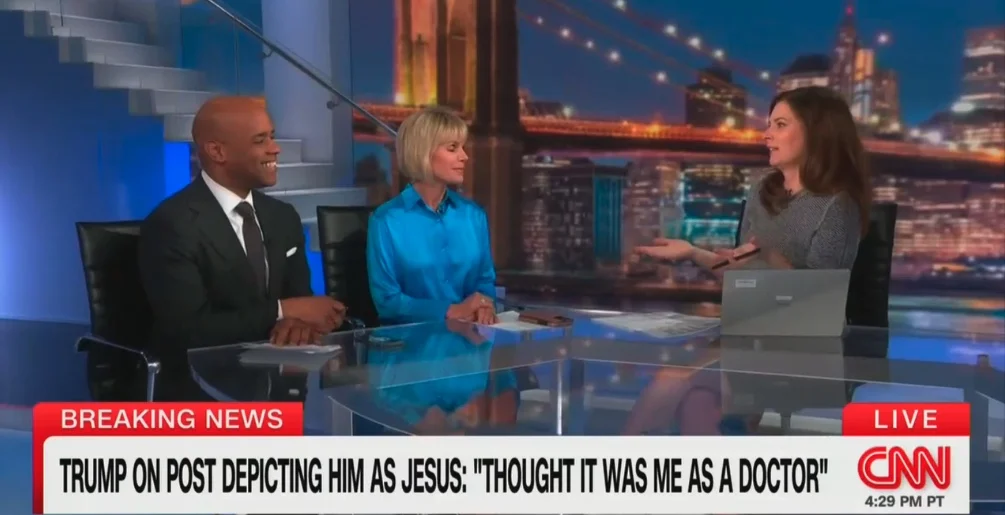
The intersection of religious iconography and political rhetoric has once again taken center stage in the American public discourse following a series of social media posts by former President Donald Trump. On a recent Sunday, the former president ignited a significant controversy by sharing an AI-generated image of himself depicted in a manner frequently associated with Jesus Christ, while simultaneously launching a verbal offensive against Pope Leo XIV. The incident, which has drawn sharp criticism from media figures, theologians, and political opponents alike, highlights the ongoing tensions between the former president’s campaign style and established religious institutions.
The controversy began when Donald Trump utilized his social media platform to address ongoing criticisms from the Vatican regarding his foreign policy stances, specifically his approach to tensions with Iran. In a post that was later deleted, the former president characterized Pope Leo XIV as "WEAK" and asserted that the religious leader should refrain from criticizing the President of the United States. Trump argued that his actions were a direct fulfillment of his electoral mandate, claiming he was doing "exactly what I was elected, IN A LANDSLIDE, to do." Accompanying these statements was a digitally rendered image showing a figure resembling Trump, dressed in robes, providing comfort to a bedridden individual in a style reminiscent of classical Christian art depicting the miracles of Jesus.
Chronology of the Controversy
The timeline of the event suggests a rapid escalation of rhetoric. The friction between the former president and the Papacy appeared to intensify late last week following a statement from the Vatican expressing concern over the potential for military escalation in the Middle East. Pope Leo XIV, known for his advocacy of diplomatic de-escalation, had issued a general plea for peace that many political analysts interpreted as a critique of the former president’s more hawkish rhetoric regarding Iran.
By Sunday morning, the former president responded with the aforementioned social media posts. The backlash was almost instantaneous, crossing traditional partisan lines. By Sunday evening, several high-profile conservative media figures and theologians associated with the "Make America Great Again" (MAGA) movement expressed discomfort with the messianic undertones of the AI-generated imagery. Under the weight of this bipartisan criticism, the post was removed from the platform by Monday morning. However, the discourse continued to evolve as the former president and his surrogates attempted to clarify the intent behind the post during various media appearances throughout the day on Monday.
Media Scrutiny and the Erin Burnett Reaction
On Monday evening’s broadcast of CNN’s OutFront, anchor Erin Burnett provided a pointed critique of the former president’s explanation for the post. During a public appearance, Trump had attempted to distance the image from its religious connotations, suggesting that he believed the image depicted him as a medical professional or a volunteer. "I did post it, and I thought it was me as a doctor — and, had to do with Red Cross, as a Red Cross worker there, which we support," Trump stated, adding that only "fake news" would interpret the image as a religious allegory.
Burnett’s reaction was one of profound skepticism. She characterized the explanation as "one of the most ridiculous things he’s said," noting that the visual cues of the image—specifically the long hair, robes, and ethereal lighting—were unmistakably messianic. "I don’t know anybody who didn’t look at that and think he just posted himself as Jesus Christ," Burnett remarked during her segment. Her analysis centered on the credibility of the former president’s defense, suggesting that the "Red Cross" explanation was an ad hoc attempt to mitigate the backlash from religious voters who viewed the image as blasphemous.
Political Defense and the Role of JD Vance
The controversy also required a response from the former president’s running mate, Senator JD Vance. Appearing on Fox News, Vance, who is a practicing Catholic, was asked by host Bret Baier about the appropriateness of the attacks on the Pope and the use of the messianic image. Vance’s defense rested on the argument that the former president possesses a unique sense of humor that is often misinterpreted by the media and the public.
Vance suggested that the post was intended as a "joke" and that the decision to remove it was not an admission of guilt, but rather a recognition that the humor had not landed as intended. "I think the president of the United States likes to mix it up on social media," Vance said. He further argued that Trump’s "unfiltered" nature is one of his primary strengths, allowing him to communicate directly with the electorate without the sanitization typically associated with political figures. Vance’s defense highlighted a recurring theme in the campaign’s strategy: reframing controversial statements as evidence of authenticity and a rejection of "political correctness."
Theological and Social Implications
The use of religious imagery in political campaigns is not a new phenomenon in American history, but the advent of AI-generated content has introduced a new layer of complexity. Theologians have noted that the "Christ-figure" motif is particularly potent in the United States, where a significant portion of the electorate identifies as Christian. According to data from the Pew Research Center, approximately 63% of U.S. adults identify as Christian, with white evangelicals and Catholics forming substantial voting blocs.
Critics argue that by blurring the lines between political leadership and divine authority, such imagery risks alienating moderate religious voters. The backlash from "MAGA-friendly" media suggests that even within the former president’s base, there are limits to the acceptable use of sacred symbols. Dr. Robert Franklin, a professor of social ethics, noted in a recent symposium that the "appropriation of messianic tropes can be perceived as an ultimate form of hubris, potentially backfiring by appearing to challenge the unique status of the religious figures they emulate."
Furthermore, the attack on Pope Leo XIV carries specific weight with the American Catholic vote, which remains a crucial demographic in "swing states" such as Pennsylvania, Michigan, and Wisconsin. Unlike evangelical voters, who have historically shown high levels of support for the former president, Catholic voters are often more divided. An attack on the head of the Catholic Church, combined with what some perceive as blasphemous imagery, could potentially shift the margins in a tightly contested election.
Supporting Data: The Impact of AI in Political Messaging
The incident also serves as a case study for the influence of AI-generated imagery in the 2024 election cycle. A report from the Center for Countering Digital Hate (CCDH) indicates that AI tools are increasingly being used to create "hyper-realistic" political content that can be disseminated instantly to millions of followers. The speed at which these images can be produced and shared allows political figures to test various "memes" or narratives in real-time.
Data suggests that while these images often generate high engagement, they also contribute to a fragmented information environment. In the case of the "Jesus-esque" post, the image served as a Rorschach test for the public: supporters saw a compassionate leader, critics saw a blasphemous egoist, and the campaign eventually characterized it as a misunderstood joke. This malleability of meaning is a hallmark of modern digital political strategy, where the "truth" of an image is often secondary to the emotional response it elicits.
Broader Impact and Future Outlook
As the 2024 campaign progresses, the fallout from this incident is likely to influence how both parties approach religious rhetoric. For the Trump campaign, the challenge remains balancing the desire for "unfiltered" engagement with the need to respect the sensibilities of a broad religious coalition. The rapid deletion of the post suggests an awareness that some rhetorical lines, once crossed, may carry a political cost that outweighs the benefit of "mixing it up" on social media.
For the Democratic opposition, the incident provides a rhetorical opening to question the former president’s temperament and his respect for traditional institutions. However, analysts warn that focusing too heavily on social media controversies can sometimes distract from core policy issues that drive voter behavior at the polls.
The exchange between Erin Burnett and the subsequent defense by JD Vance illustrates the deep divide in how political communication is perceived in the modern era. Where one side sees a "ridiculous" and "untrue" excuse, the other sees a "good thing" about a president who is "not filtered." As the electorate navigates these competing narratives, the role of religious authority and the sanctity of traditional imagery will undoubtedly remain a volatile element of the American political landscape. In the coming weeks, political observers will be watching closely to see if the former president adopts a more conciliatory tone toward the Vatican or if the conflict with Pope Leo XIV continues to serve as a cornerstone of his "outsider" political identity.


 Yuyun Lusiyani
 Joko Widodo
 Eva Lovia
 Pevita Pearce
 admin
admin
 Lina Irawan