
 Yuyun Lusiyani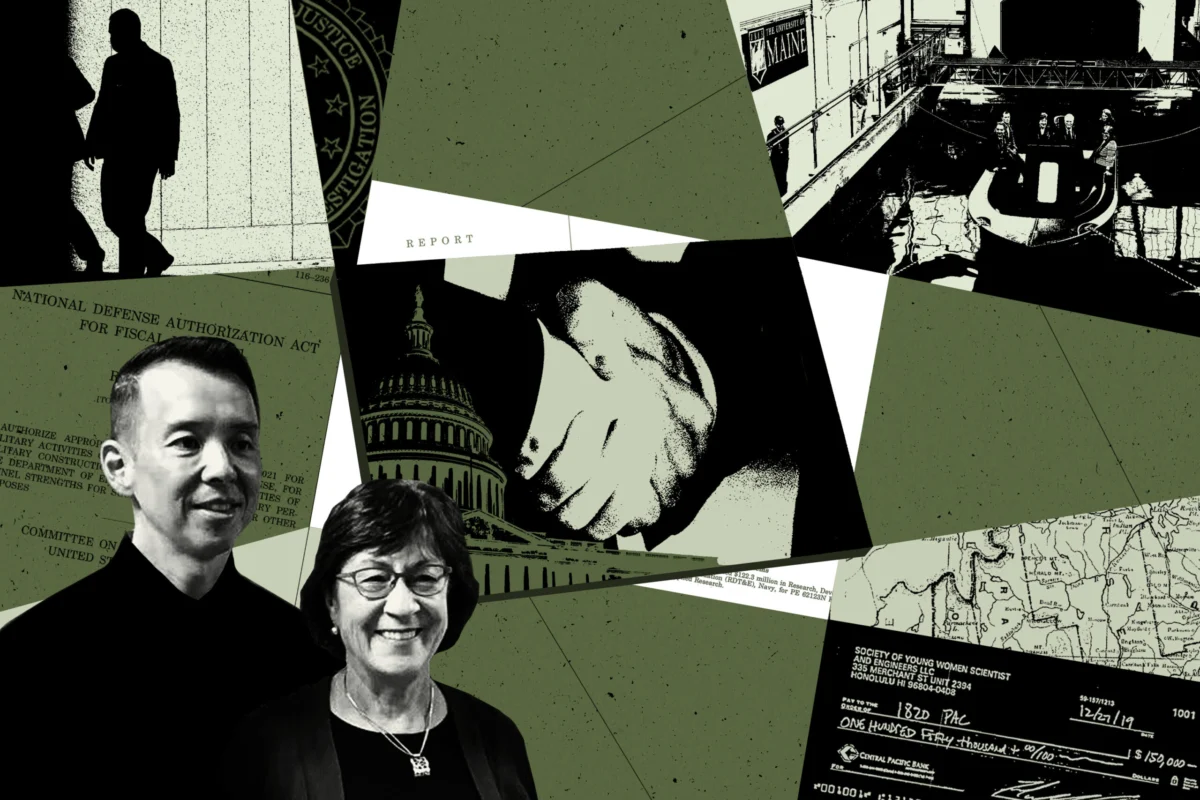
As the highly contentious Senate campaign intensifies, Senator Susan Collins finds herself embroiled in a deepening scandal concerning her alleged ties to Hawaii defense contractor Navatek and its former CEO, Martin Kao. A recent investigation by ProPublica, published Tuesday, September 22, 2026, brought these connections to the forefront, quickly establishing the issue as a central point of contention in her re-election bid. In response to the explosive allegations, Collins and her senior staff have mounted a robust defense, characterized by a series of public statements that ProPublica’s reporting indicates are factually incorrect or misleading.
The ProPublica investigation delves into the relationship between the senior senator from Maine and Martin Kao, who previously led Navatek. Kao, a significant political donor, pleaded guilty to multiple federal charges, including campaign finance and loan fraud. Following his plea, Kao reportedly confessed to law enforcement that he engaged in a quid pro quo scheme, exchanging campaign contributions for government contracts. This confession became the genesis of a federal inquiry that, according to ProPublica, saw the FBI scrutinizing Senator Collins, her top aides, and a pro-Collins Super PAC for several years. However, the investigation into these high-profile federal corruption matters was reportedly halted in its early stages in 2025, following a series of dismissals and reassignments of federal agents and Department of Justice attorneys under President Donald Trump’s administration, shortly after his return to office.
The Genesis of the Scandal: Martin Kao and Navatek
To understand the full scope of the controversy, it is crucial to establish the background of the key players and the allegations. Navatek, an engineering and technology firm based in Honolulu, Hawaii, specializes in advanced ship design and maritime technology, often securing lucrative contracts with the U.S. Navy and other defense agencies. Martin Kao served as the company’s CEO, overseeing its operations and, crucially, its political engagement through donations.
Kao’s legal troubles began to surface publicly in the early 2020s. He eventually pleaded guilty to a raft of serious federal offenses, including five counts of money laundering, three counts of wire fraud, one count of bank fraud, and making false submissions to the Federal Election Commission (FEC). These charges stemmed from schemes to defraud government programs and illegally funnel money into political campaigns, often disguising the source of funds through shell companies and straw donors. It was in the context of cooperating with federal authorities following his guilty plea that Kao made the allegations central to the ProPublica report: that he exchanged campaign contributions for favorable treatment in securing government contracts, explicitly naming Senator Collins as a beneficiary of his efforts.
Senator Collins’ Immediate Response and Contradictions
Following the publication of the ProPublica article, Senator Collins and her campaign swiftly moved to deny any wrongdoing. In numerous media appearances and official statements, they asserted their innocence and attempted to discredit the investigation’s findings. However, ProPublica’s detailed report directly challenged the veracity of several of these key denials.
One of Senator Collins’ primary assertions was made in an interview with Punchbowl News and reiterated on the Wall Street Journal podcast "All Things with Kim Strassel":
- Collins: “In 2021, the Biden Justice Department found there was no wrongdoing by anyone on my campaign staff, my office or me.”
- Collins: “The Biden-led Justice Department and FBI totally cleared my office, my campaign and me five years ago of these seven-year-old allegations.”
While an FBI spokesperson did confirm to ProPublica that the agency had investigated claims against Collins years prior "and ultimately found nothing implicating Senator Collins or Senator Collins’ campaign," this statement refers to an initial inquiry that began in 2021. This earlier investigation concluded without charges against anyone in Collins’ orbit.
However, the investigation at the heart of ProPublica’s story — the one based on Martin Kao’s specific allegations of quid pro quo — is entirely distinct and occurred much more recently. Kao’s claims were made between 2022 and 2024. This later, more focused investigation did not conclude under President Joe Biden’s administration, as Collins claimed. Instead, it was reportedly shut down in 2025 under President Trump’s administration, after federal agents and Department of Justice attorneys assigned to the case were purged or reassigned. This critical distinction in timelines and the scope of the investigations undermines Senator Collins’ assertion of a complete exoneration by the Biden Justice Department regarding the specific allegations from Kao. FBI records reviewed by ProPublica indicate that the agency maintained an active interest in the conduct of Collins and her staff right up until the most recent phase of their investigation was abruptly terminated under the Trump administration.
The Credibility of Martin Kao and Corroborating Evidence
Annie Clark, Deputy Chief of Staff to Senator Collins, also issued statements questioning Kao’s credibility:
- Clark: “The FBI and the Court obviously did not believe Kao.”
- Clark: “ProPublica took the word of someone who pled guilty to five counts of money laundering, three counts of wire fraud, one count of bank fraud, and making false submissions to the FEC.”
Clark’s argument hinges on the fact that Kao, a convicted felon, was ultimately sentenced to 87 months in federal prison and received no benefit from the judge for his cooperation with federal authorities. While it is true that Kao’s criminal history undoubtedly presented credibility challenges, ProPublica’s investigation revealed that FBI agents were able to corroborate several of his claims through independent evidence.
FBI documents obtained by ProPublica explicitly state: “Pursuant to a Grand Jury Subpoena issued to Navatek, related to the previous investigation, hundreds of thousands of documents were provided to the FBI.” Crucially, these documents further noted, “Several emails and other documents corroborate Kao’s statements made to the FBI.” Furthermore, individuals intimately familiar with the investigation confided in ProPublica that FBI agents found Kao to be a credible source, particularly when his accounts could be substantiated by other evidence. This direct contradiction to Clark’s assertion highlights a significant discrepancy between the campaign’s narrative and the findings of federal investigators.
ProPublica’s methodology in its investigation also directly refutes Clark’s claim that the report merely "took the word" of a convicted felon. The news organization meticulously reviewed a vast trove of evidence gathered by the FBI. This included thousands of pages of legal records and extensive interviews with dozens of individuals who had direct knowledge of Navatek, its lobbying activities in Washington, and the FBI’s inquiry. This comprehensive approach allowed ProPublica to independently corroborate a substantial portion of Kao’s account, rather than relying solely on his testimony.
The Alleged Quid Pro Quo: A $150,000 Donation
One of the specific allegations detailed by ProPublica concerns a $150,000 donation made to a pro-Collins Super PAC. Kao claimed that Scott Reed, the head of this Super PAC, promised to ensure Senator Collins was aware that Kao was the true source behind this large, anonymous donation, which was funneled through a shell company.
ProPublica’s investigation unearthed compelling evidence supporting Kao’s claim. They published emails exchanged between Reed and Kao, explicitly showing that Kao informed Reed of the name of the shell company he was utilizing to anonymize his $150,000 contribution. Furthermore, an email from an individual working for Reed was uncovered, requesting Kao’s contact number so that Senator Collins could personally thank him for the donation. These communications are highly consistent with Kao’s version of events, suggesting an attempt to circumvent campaign finance transparency rules while still ensuring the donor received personal acknowledgment from the politician.
Steve Abbott, Senator Collins’ campaign manager, addressed this specific point during a Wednesday press conference. While stating, “We have no record of her calling him,” he also acknowledged that such a phone call would not be out of the ordinary, adding, “We routinely thank people for contributions. … We try to thank everybody.” This statement, while denying a specific call record, implicitly confirms the practice of personal gratitude for donations, lending further credence to Kao’s allegation that he sought and expected direct acknowledgment.
Scott Reed, when questioned about the $150,000 donation, did not provide detailed answers but denied speaking to Senator Collins about Kao. He concluded his statement by noting, "I understand Martin Kao is now sitting in federal prison," an apparent attempt to undermine Kao’s reliability.
A Chronology of Federal Scrutiny and Political Interference
The timeline of the federal investigations into Martin Kao and his connections to Senator Collins is crucial for understanding the current controversy:
- 2021: The FBI initiates an initial investigation into Martin Kao. Senator Collins’ office and campaign are reportedly reviewed, but this phase concludes without charges against anyone in her circle. This is the investigation Collins’ campaign refers to when claiming "clearance" by the Biden DOJ.
- 2022-2024: Following his guilty plea on multiple federal charges, Martin Kao begins cooperating with federal authorities. During this period, he makes new and specific allegations about exchanging campaign cash for government contracts, directly implicating Senator Collins and her associates.
- September 2024: Kao sits for a two-day interview with FBI agents at the U.S. attorney’s office in Honolulu. During this extensive session, he provides a detailed 50-page document outlining numerous new allegations concerning his interactions with various elected officials, including Senator Collins.
- Early 2025: FBI agents continue to actively examine Kao’s relationship with Collins, her staff, and employees of the pro-Collins Super PAC, indicating ongoing investigative interest and the pursuit of corroborating evidence.
- 2025 (under Trump Administration): The investigation into high-profile federal corruption matters, including the Kao case, is reportedly shut down. This cessation occurs after President Donald Trump, recently returned to office, fires or pushes out most of the federal agents and lawyers who were working on these sensitive cases. This development is central to ProPublica’s reporting, suggesting political interference in an active corruption probe.
Broader Implications: Campaign Finance, Ethics, and Public Trust
This unfolding scandal raises significant questions about campaign finance ethics, the influence of money in politics, and the integrity of federal investigations. The line between legitimate political donations and illegal quid pro quo arrangements can be notoriously difficult to prove, yet Kao’s specific allegations and the FBI’s apparent corroboration elevate this case beyond typical lobbying concerns.
The role of Super PACs in political funding is also highlighted. These organizations can raise and spend unlimited amounts of money to support or oppose political candidates, but they are legally prohibited from coordinating directly with campaigns. The allegation that the Super PAC head promised to make the senator aware of an anonymous donation — and the email seeking Kao’s number for a thank you call — suggests a blurring of these legal lines, potentially facilitating undue influence.
Furthermore, the alleged shutdown of a federal corruption investigation under a new presidential administration, particularly one involving high-profile political figures, carries profound implications for the independence of the Department of Justice and the FBI. It can erode public trust in the justice system’s ability to impartially investigate powerful individuals, regardless of their political affiliation or influence.
For Senator Collins, a veteran politician with a reputation for moderation and bipartisanship, these allegations arrive at a critical juncture in her career. As a senior senator from Maine, she holds significant power and influence, particularly within the Appropriations Committee, which oversees federal spending and defense contracts. The scandal’s timing, making it a "central issue" in her re-election campaign, ensures that it will be vigorously debated and scrutinized by voters, media, and political opponents.
The ongoing controversy surrounding Senator Susan Collins, Navatek, and Martin Kao serves as a stark reminder of the persistent challenges in maintaining transparency and accountability in political fundraising and government contracting. As the campaign progresses, the public will undoubtedly demand further clarity and answers regarding the veracity of these allegations and the circumstances surrounding the federal investigation’s abrupt conclusion. The ProPublica report has undeniably ignited a fierce debate that will shape the narrative of her re-election bid and potentially have lasting consequences for her political legacy.




 Joko Widodo
 Eva Lovia
 Pevita Pearce
 admin
admin
 Lina Irawan